



- Home
- /
- Top Stories
- /
- Regrettable That No One From Legal...
Regrettable That No One From Legal Academia Has Ever Been Appointed As Supreme Court Judge: Justice Ujjal Bhuyan
Debby Jain
30 Aug 2026 4:06 PM IST
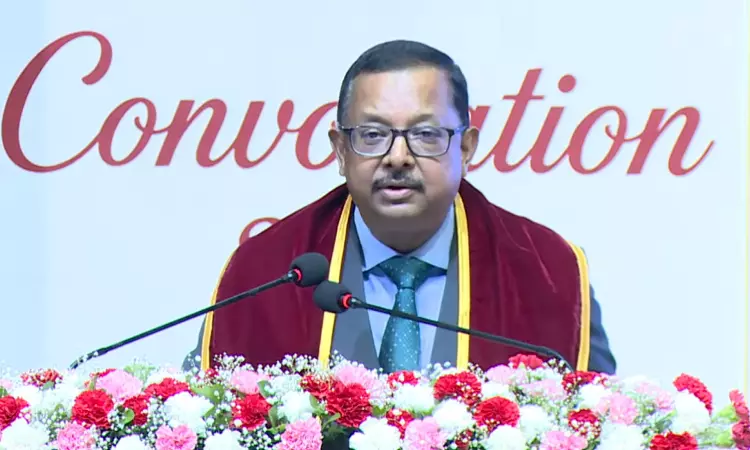
"It is not necessary for a person to practise law before a court to be acknowledged as a distinguished jurist", the judge opined.
Supreme Court judge Justice Ujjal Bhuyan today reflected during an event that despite the Constitution allowing it, no jurist has been appointed as a Supreme Court judge in the past 76 years.Speaking at the NLU Delhi convocation for LLM programmes, the judge said, "while our constitution has a provision for appointment of a jurist as a Supreme Court judge, no jurist had been appointed so far...
This is a premium content
Available exclusively to
Our subscribers
Subscribe Premium 
INR 1099+GST
Your support helps us to bring you more content at
an affordable subscription scheme !!!
All payment options available
Supreme Court judge Justice Ujjal Bhuyan today reflected during an event that despite the Constitution allowing it, no jurist has been appointed as a Supreme Court judge in the past 76 years.
Speaking at the NLU Delhi convocation for LLM programmes, the judge said,
"while our constitution has a provision for appointment of a jurist as a Supreme Court judge, no jurist had been appointed so far to the Supreme Court so far though the Constitution has completed more than 76 years...A distinguished jurist can be a great value addition to the Bench. By his or her scholarship, he or she can make a visible contribution to the decision-making process at the top level. Participation of renowned legal academia and scholars would have a defining impact on the judicial functioning of the Supreme Court."
Justice Bhuyan noted that the founding fathers envisioned distinguished jurists as judges of the top Court, however, either the Union government and the Collegium have not explored that aspect so far, or they consider Indian academics as lacking in the necessary depth for elevation as a Supreme Court judge.
"There can be two reasons for this. The first is that earlier, when the collegium system was not there, in the view of the Central Government, and thereafter, when the collegium system came into being, in the view of the collegium, there is not enough depth in the Indian academia to be seriously considered for elevation as a judge of the Supreme Court. The second, which is more probable, is that both the Central Government and the Collegium have not seriously explored this provision thus far...The founding fathers of our Republic had envisioned distinguished jurists as judges of the Supreme Court...It is regrettable that this provision has remained one of our Constitution's unused mandates."
The judge noted that the general practice has been appointment of a senior High Court judge or Chief Justice as a Supreme Court judge. At times, there have been direct appointments from the Bar, which have turned out to be "excellent". Yet, "no legal academic has yet been appointed as a judge of the Supreme Court, despite there being brilliant minds who could have made a substantial contribution had they become part of the Bench."
Justice Bhuyan rejected as "shallow" the purported argument against appointment of jurists as Supreme Court judges - that they lack practical experience. "Supreme Court is not only the highest adjudicatory body, but it is the moral, legal and constitutional conscience keeper of the nation. It is above technicalities. The reason for having this provision of distinguished jurist is to diversify the Bench with talented judges. It was believed that with their academic scholarship, such category of distinguished jurist would not remain constricted by narrow technicalities, thereby being in a stronger position to deal with public law issues" he said.
Though not a defined expression, “distinguished jurist”, according to Justice Bhuyan, shall mean all those eminent persons who are involved in the practice, teaching and research of law. "It is not necessary for a person to practise law before a court to be acknowledged as a distinguished jurist", the judge opined.
He further said that while lawyers and judges can be characterized as jurists, in the context of Article 124(3) of the Constitution, the term must extend beyond the two categories. "A person who is skilled in law or knowledgeable in the field of law would be qualified to be termed as a jurist", the judge said.
In this regard, Justice Bhuyan further reflected how the US Constitution does not require even a formal law degree for someone to be nominated as judge of a federal court. He noted that while in India, BCI Rules impede practice as a lawyer for a person in the academic field, even a full-time professor in the US can practice law as long as their practice does not affect the academic sessions.
From the US' history, Justice Bhuyan gave the examples of Felix Frankfurter (Austrialian-born law professor at Harvard), Samuel Miller (physician) and Ruth Bader Ginsberg, who were nominated as judges to the US Supreme Court. The judge added that even in Great Britain, Canada and Kenya, legal academicians can be appointed as judges to the top courts.
Also Read -
We Must Shed Excessive Deference To Judiciary: Justice Ujjal Bhuyan

Debby Jain
Debby Jain is a Correspondent with LiveLaw, covering the Supreme Court of India

