


Sabarimala Reference : Live Updates From Supreme Court 9-Judge Bench
LIVELAW NEWS NETWORK
7 April 2026 10:54 AM IST
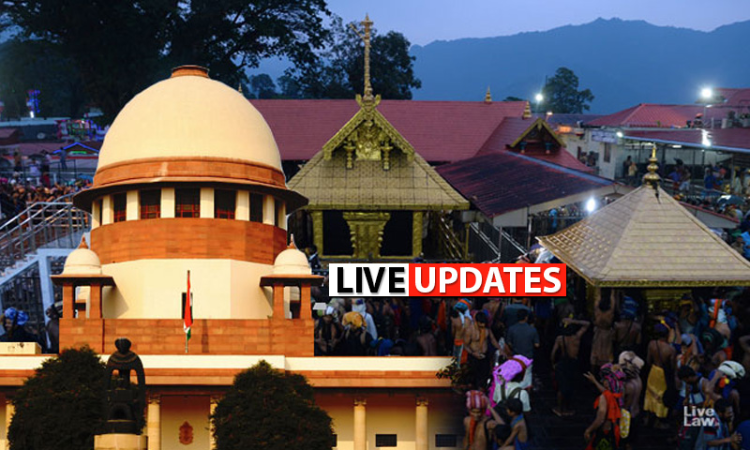
A 9-judge bench of the Supreme Court will start hearing the Constitutional issues referred to the larger bench in the Sabarimala review.
Apart from CJI Surya Kant, the Bench comprises Justice BV Nagarathna, Justice MM Sundresh, Justice Ahsanuddin Amanullah, Justice Aravind Kumar, Justice Augustine George Masih, Justice Prasanna B Varale, Justice R Mahadevan and Justice Joymalya Bagchi.
The seven questions before the Supreme Court are :
(i) What is the scope and ambit of right to freedom of religion under Article 25 of the Constitution of India?
(ii) What is the inter-play between the rights of persons under Article 25 of the Constitution of India and rights of religious denomination under Article 26 of the Constitution of India?
(iii) Whether the rights of a religious denomination under Article 26 of the Constitution of India are subject to other provisions of Part III of the Constitution of India apart from public order, morality and health?
(iv) What is the scope and extent of the word 'morality' under Articles 25 and 26 of the Constitution of India and whether it is meant to include Constitutional morality?
(v) What is the scope and extent of judicial review with regard to a religious practice as referred to in Article 25 of the Constitution of India?
(vi) What is the meaning of expression “Sections of Hindus” occurring in Article 25 (2) (b) of the Constitution of India?
(vii) Whether a person not belonging to a religious denomination or religious group can question a practice of that religious denomination or religious group by filing a PIL?
Follow this page for live updates.
Live Updates
- 7 April 2026 12:47 PM IST
SG: when we go to gurudwara or ajmer sharif, we cover our head. there is new jurisprudence which has developed. all sections of hindu is meant no caste based discrimination.
J Bagchi: that is a question- managing religious denomination prevails over Article 25[right to everyone over conscience].
- 7 April 2026 12:41 PM IST
SG: I will defend sabarimala in my own different way, it does not mean 4 days it means a particular age group. Lord Ayyapan temples are open through the world for all sections of ladies except one particular temple which is a sui generis case. there are 3 lord ayyapan temple in Delhi open for all.
- 7 April 2026 12:39 PM IST
SG: India is not that patriarchal or gender stereotyped that the west understands.
J Nagarathna: article 17 in the context of sabarimala, I don't know how it can be argued. Speaking as a women, there can't be a three day untouchability every month and on fourth day, there is no untouchability.
SG: I am not on menstruation
J Nagarathna: speaking as a women, Article 17 can't apply for 3 days and on 4th day, there is no untouchability
- 7 April 2026 12:34 PM IST
J Nagarathna: if there is a social ill which is branded as religious practice-the court can distinguish between the two-whether its a social evil or essential religious practice
SG: the constitutional answer would be the remedy is Article 25(2)(b)- legislature can legislate
- 7 April 2026 12:31 PM IST
SG: My lordships find if there is something unscientific, the remedy is with the legislature. but if it is to be gone into the remedy is a civil suit where parties can lead evidence and expert witnesses. it can't be that there is nothing in affidavit which satifies that this is not an essential religious practice
J Bagchi: your argument is not on justicability
SG: it is on justiciability and in most cases the forum also. in some religion, some persons claim there is right of human sacrifice has been a practice and it is essential- no evidence is made. if some examples come which directly hits public health or morality, mylordships doesnot have to go into essential religious
- 7 April 2026 12:31 PM IST
SG: that is a correct approach
J Bagchi: it is a unique capsule which can be seen from fundamental duties. there can be a faith which scientific temper may not ravel but that may not be a question but whether such faith existed within the members of a religious denomination can be an issue framed
SG: but not whether it is essential religious practice