


Sabarimala Reference : Live Updates From Supreme Court 9-Judge Bench
LIVELAW NEWS NETWORK
7 April 2026 10:54 AM IST
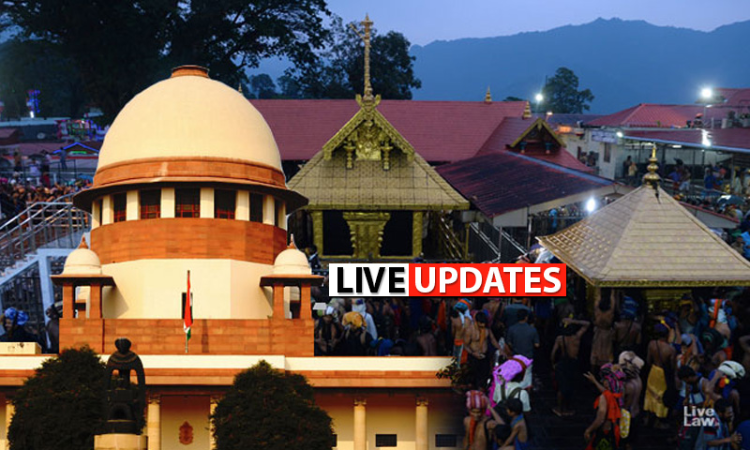
A 9-judge bench of the Supreme Court will start hearing the Constitutional issues referred to the larger bench in the Sabarimala review.
Apart from CJI Surya Kant, the Bench comprises Justice BV Nagarathna, Justice MM Sundresh, Justice Ahsanuddin Amanullah, Justice Aravind Kumar, Justice Augustine George Masih, Justice Prasanna B Varale, Justice R Mahadevan and Justice Joymalya Bagchi.
The seven questions before the Supreme Court are :
(i) What is the scope and ambit of right to freedom of religion under Article 25 of the Constitution of India?
(ii) What is the inter-play between the rights of persons under Article 25 of the Constitution of India and rights of religious denomination under Article 26 of the Constitution of India?
(iii) Whether the rights of a religious denomination under Article 26 of the Constitution of India are subject to other provisions of Part III of the Constitution of India apart from public order, morality and health?
(iv) What is the scope and extent of the word 'morality' under Articles 25 and 26 of the Constitution of India and whether it is meant to include Constitutional morality?
(v) What is the scope and extent of judicial review with regard to a religious practice as referred to in Article 25 of the Constitution of India?
(vi) What is the meaning of expression “Sections of Hindus” occurring in Article 25 (2) (b) of the Constitution of India?
(vii) Whether a person not belonging to a religious denomination or religious group can question a practice of that religious denomination or religious group by filing a PIL?
Follow this page for live updates.
Live Updates
- 7 April 2026 12:31 PM IST
J Bagchi: faith says this is my faith and followers follow that. the fact that this is my faith stated by the religious head is something which is within the domain of the court to apply appropriate forensic tool, but whether that faith exist is for the religious head to decide
- 7 April 2026 12:26 PM IST
SG: mylords will have to first decide what is religious practice and then what is essential religious practice
J Bagchi: there is difference between opinion on faith and faith perceived. one can have a particular faith but whether opinion exists in that denomination is separate from the testing of what is the faith itself
- 7 April 2026 12:24 PM IST
J Amanullah: are you suggesting that court may not go into the domain of ERP
J Bagchi: if your proposition is taken to a logical conclusion, courts are not experts in science but evidence act empowers the court to examine the opinions of experts and becomes expert of experts
- 7 April 2026 12:21 PM IST
SG: in case of Dargah Committee, 5 judges held it is a denomination, rightly held. The only problem with dargah committee was it introduced for the first time essential religious practice and goes to the extent of saying superstitution is not protected- courts certaintly can't decide
- 7 April 2026 12:17 PM IST
SG: so far Article 25 did not have sections thereof- because religious denomination may prevent a section- Sabarimala does not notice this. It says Sabarimala is not a denomination and therefore no protection under Articles 25 and 26. I gave example of Nizamuddin or Shirdi, everyone goes.
- 7 April 2026 12:15 PM IST
SG: 1 May, 1947, K Munshi moved to add a specific provision that religious freedom would not preclude the laws for throwing open the hindu religious institutions to all classes directly targeting exclusion of dalits and lower caste- we were living in society where one particular part of hindu was not allowed to be a part of broader hindu religion but this has nothing to do with gender.