SCAORA Moves Supreme Court Seeking Probe Into Delhi Police Actions Against Lawyers During CEC Protest
Amisha Shrivastava
12 Oct 2026 8:50 AM IST
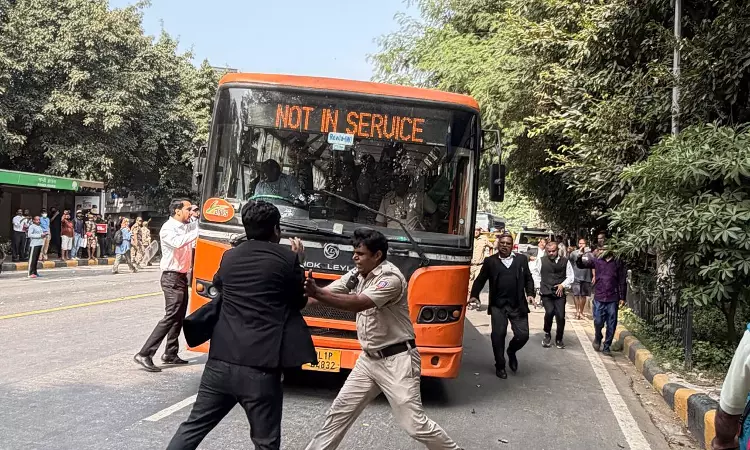
The Supreme Court Advocates-On-Record Association (SCAORA) has moved the Supreme Court seeking an independent, impartial and time-bound inquiry into the alleged illegal detention and manhandling of lawyers by Delhi Police during a protest march against Chief Election Commissioner Gyanesh Kumar and the Special Intensive Revision (SIR) of electoral rolls on October 10.
The writ petition contends that advocates, including senior lawyers, women advocates and Advocates-on-Record, were detained and subjected to excessive force while participating in a peaceful march near the Supreme Court. It seeks directions to identify the police personnel involved, preserve evidence relating to the incident and hold those responsible accountable in accordance with law.
The plea submits that the lawyers were intercepted by Delhi Police personnel and taken to the Yamuna Sports Complex in Surajmal Vihar, New Delhi. Advocates-on-Record Pyoli and Shashank Raj Singh were among those detained.
The petition refers to video footage showing Senior Advocate Shadan Farasat being carried by his arms and legs by police personnel, during which his shirt was torn. It further alleges that women advocates, including Anna Oomen and Anne Mathew, were manhandled by women police personnel who were not displaying name tags. An advocate is also stated to have sustained an injury resulting in a dislocated shoulder.


The petition emphasises that maintaining public order cannot justify arbitrary detention or disproportionate use of force, and police action must comply with the constitutional guarantees under Articles 14, 19 and 21. It argues that the right to assemble peacefully and express dissent cannot be rendered ineffective through indiscriminate force or intimidation.
“It is submitted that the maintenance of public order cannot be invoked to justify arbitrary detention, disproportionate force or the indignity allegedly inflicted upon members of the Bar. The exercise of police powers must conform to the constitutional guarantees under Articles 14, 19 and 21 of the Constitution of India and satisfy the requirements of legality, necessity, proportionality and accountability. The right to assemble peacefully and express dissent cannot be rendered illusory by the indiscriminate use of force or by action that intimidates participants and discourages the exercise of constitutionally protected freedoms”, the plea states.
The petition has been filed a day after lawyers protesting against Chief Election Commissioner Gyanesh Kumar and the Special Intensive Revision (SIR) of electoral rolls were detained by Delhi Police near the Supreme Court on October 10. The Supreme Court Bar Association subsequently sought the Chief Justice of India's intervention over allegations that lawyers, including women advocates, had been manhandled.
On October 11, during a special Sunday sitting, the Supreme Court directed that lawyers, journalists and other professionals should not be obstructed from performing their duties. The Court also issued directions concerning restrictions on public transport, internet services and movement across Delhi amid the protests.
In the plea, SCAORA has sought directions to preserve and produce all evidence relating to the incident, including CCTV footage, police body-camera recordings, drone footage, photographs, detention registers, deployment records and electronic communications.
The petition argues that such material is necessary to reconstruct the sequence of events and determine whether the police action was lawful and proportionate. It contends that failure to preserve the evidence could prejudice an effective inquiry and frustrate the identification of those responsible.
It has also sought disclosure of the legal authority and justification for collecting, recording, storing, identifying, circulating and using photographs and video recordings of lawyers and other participants in the protest.
The association contends that the use of recording equipment during a protest, even for legitimate law-enforcement, must be supported by lawful authority and restricted to legitimate objectives.
The petition also raises concerns over internet shutdowns and disruption of internet services on October 10, arguing that restrictions obstruct access to courts, virtual hearings, the filing of pleadings and communication between advocates and their clients.
“Advocates occupy an indispensable position in the administration of justice and must be able to discharge their professional functions without unlawful interference, intimidation or coercion. Any police action that obstructs access to Courts, impedes legal representation, interferes with legal aid or creates a chilling effect upon the exercise of constitutional freedoms prejudices not merely the Advocates concerned, but also the effective administration of justice and the rights of litigants dependent upon their representation”, the plea states.
The association has sought directions to ensure that restrictions on internet and telecommunication services do not arbitrarily interfere with the functioning of courts or access to justice.
SCAORA has further sought protection against retaliation, intimidation, harassment or coercive action against advocates solely for participating in peaceful protests or expressing lawful professional grievances.
The petition has been filed through Advocate-on-Record Anas Tanwir.