Shiv Sena Row | ECI Was Bound To Award Bow And Arrow Symbol Once It Found Shinde Faction Was Real Party: Kaul Tells Supreme Court
Amisha Shrivastava
8 Oct 2026 7:55 PM IST
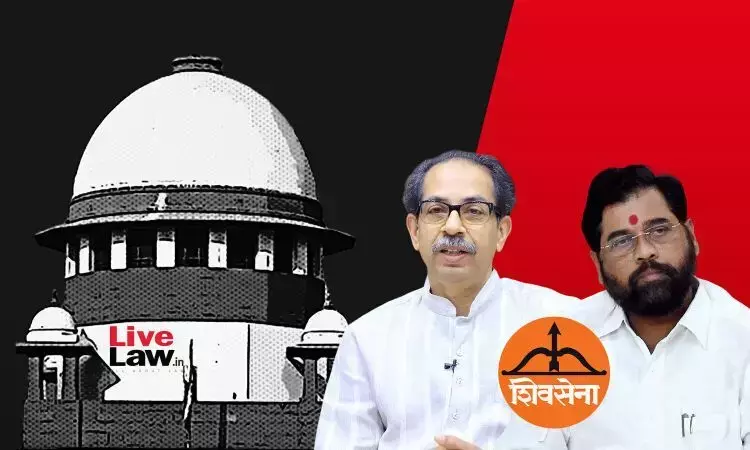
The Election Commission of India was bound to allot the Shiv Sena's reserved election symbol to the Eknath Shinde faction once it concluded that the faction represented the real political party, Senior Advocate Neeraj Kishan Kaul argued before the Supreme Court today in the Shiv Sena case.
He also submitted that the symbol cannot be treated as a “continuing cause of action” capable of shifting between rival factions based on subsequent developments. He argued that ECI's decision awarding the bow-and-arrow symbol to the Shinde faction cannot be reopened even if the faction is subsequently disqualified, as the determination under Paragraph 15 of the Symbols Order has to be made on the facts existing when the ECI decides the dispute.
“If the ECI in its wisdom comes to a conclusion that legislative test is all that we are left with, they try every conceivable test and say we have no option but to do this, in that kind of a scenario, my lords, at that stage, it had no option, but to hold them to be the real political party, and once they hold that, the symbol must go. And in such a situation, to say that, 'could they have considered an option of not giving it to anyone or not at least giving it or would it change with passing of time with a decision changing on disqualification?' would play violence, in all humility, would do great violence to the Symbols Order and the object behind the Symbols Order and what your lordships have held”, he said.


A bench of CJI Surya Kant, Justice Joymalya Bagchi and Justice V Mohana was hearing the challenge made by Uddhav Thackeray to the Election Commission's decision recognising the Eknath Shinde faction as the real Shiv Sena and allowing it the use of the 'bow and arrow' symbol.
On whether the symbol decision can be revisited after subsequent disqualification
On Justice Bagchi's earlier question concerning the possibility of revisiting the symbol allotment if the Shinde faction were to be subsequently disqualified, Kaul relied on the Constitution Bench judgment in Subhash Desai v. Principal Secretary, Governor of Maharashtra, arguing that in such an eventuality, those who remained in the House would have to apply for a new symbol.
“Take a situation where the Election Commission has already decided on giving one split the old symbol. That split gets disqualified later on. Will it be a relevant consideration to revisit the continuation of old symbol or explore the fourth option?” Justice Bagchi asked.
Kaul submitted that it could not. He relied on Subhash Desai judgment, contending that disqualification and the consequences flowing from it are prospective in nature.
He pointed out that the Constitution Bench had contemplated a situation where members of the faction awarded the symbol were subsequently disqualified. In such a situation, he submitted, the members who remained in the House would have to apply for a new symbol. The symbol already awarded would not automatically revert to them, he said.
Kaul relied on the principle that the symbol dispute must be determined with reference to the facts existing when the ECI makes its decision. He argued that the symbol cannot subsequently move from one faction to another because of a later disqualification or change in the composition of the party organisation.
Kaul emphasised that the alternative would cause the symbol would repeatedly change hands as subsequent decisions altered the numerical or organisational position of the factions.
“The principle of shifting stands can't be applied here. It will actually lead to chaos that at every stage if there's a change in decision, the symbol will keep travelling like a pendulum from one side to the other,” he said.
Giving an illustration, he submitted that even if the organisational-majority test were adopted and members subsequently left the organisation, the ECI's determination would still have to be assessed as on the date it was made.
“You can't have a symbol shifting from one to the other. Now, suppose it has a three time shift, once disqualified, not and then again, then what happens? And where do we go after that? Or, let's test it in a political majority in a majority in an organization. I decide on a particular date who represents the organizational majority. Three months down the line, a lot of those people leave and join another party. These issues have to be decided on a particular date and frozen, they can't shift every time a new decision comes. On the date were they correctly taken or not is the issue. On that date, if it's wrong, that's the end of the matter. But if on that date, it was the correct decision on the facts as they stood, then it calls for no interference on any count whatsoever”, he said.
On why the ECI used legislative majority test instead of withholding the symbol from both factions
Kaul also addressed the question whether the ECI ought to have considered a fourth option of not awarding the reserved symbol to either faction.
He submitted that neither faction made out a case for exercising that option before the ECI or the Supreme Court. Both factions had positively asserted that they represented the real Shiv Sena and sought the reserved symbol for themselves, he highlighted.
Kaul submitted that once the ECI concluded that one faction represented the political party, the reserved symbol had to be allotted to that faction.
He relied on the Constitution Bench's discussion in the Subhash Desai judgment on the importance of a reserved symbol to a recognised political party. He submitted that withholding the symbol despite finding that one faction represented the political party would defeat the object of the Symbols Order.
“If this symbol, which is such a prized association with the political party, this is how the electorate associates itself with the political party, keeps shifting like the shifting sands, we'll never have any finality to it my lords, the whole issue. That is my argument and there was nothing wrong, there was no need for the Election Commission to ever consider any such option that should I not give it to either them because neither did anyone argue it, nor could it have done it. And lastly, and most importantly, Sadiq Ali and Subhash Desai say the moment you come to the conclusion, you must give it to one or the other”, he said.
Kaul further submitted that the ECI had examined the party Constitution, party posts, votes polled, legislative strength, political-party membership and other relevant considerations before choosing the legislative test.
He argued that the ECI could not be faulted merely because the Supreme Court might consider another test preferable. Unless the Court finds that ECI's decision was completely perverse, the decision cannot be interfered as long that there was reasonable application of mind, he said.
“If the Election Commission in its wisdom considers all facts, that's another issue if your lordships come to a conclusion that it completely perversely applied our principles, but if your Lordships feel that there was application of mind and a reasonable, a plausible conclusion was reached by them (ECI), that is enough,” he submitted.
Kaul argued that the Constitution Bench judgment in Subhash Desai did not exclude the legislative-majority test for resolving disputes under Paragraph 15 of the Election Symbols Order.
He submitted that while Subhash Desai described the legislative test as “diluted”, “weak” or “futile” in certain circumstances, the judgment simultaneously held that “no test is excluded” and that the ECI was free to fashion a test suited to the facts and complexities of a particular dispute.
“The test of legislative majority remains a valid test,” Kaul submitted, arguing that the observations describing it as weakened or futile could not be read in isolation.
His submission was that the ECI had, in fact, examined the various relevant factors before concluding that legislative strength was the appropriate test in the circumstances of the Shiv Sena dispute.
Kaul said that the question for the Supreme Court was therefore whether that conclusion was so perverse, unreasonable, mala fide or influenced by extraneous considerations that it warranted interference in judicial review.
He also refuted the petitioner's argument that the ECI had created new jurisprudence specifically for Shiv Sena dispute by examining the party Constitution. He submitted that the Commission had been insisting upon democratic structures in political parties for decades.
The hearing will continue next week.