



- Home
- /
- Top Stories
- /
- Supreme Court Allows Lalu Prasad...
Supreme Court Allows Lalu Prasad Yadav To Raise Issue Of S.17A PC Act Sanction During Trial Of 'Land-for-Railway Jobs' Case
Amisha Shrivastava
13 April 2026 11:34 AM IST
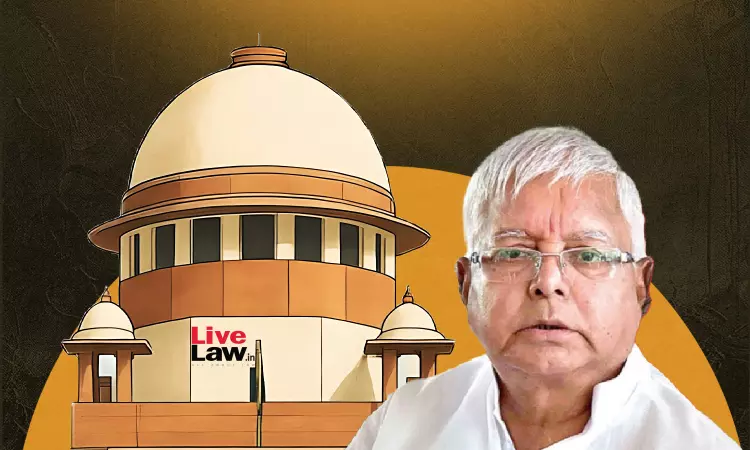
The Court disposed of Yadav's plea to quash the proceedings, giving liberty to him to raise the issue of 17A during the trial.
The Supreme Court on Monday allowed RJD Chief Lalu Prasad Yadav to raise the issue of the applicability of Section 17A of the Prevention of Corruption Act in the alleged land-for-jobs case investigated by the Central Bureau of Investigation during the trial.The Court also dispensed with his personal appearance during the trial.Dictating the order, the Bench observed that it was not expressing...
This is a premium content
Available exclusively to
Our subscribers
Subscribe Premium 
INR 1099+GST
Your support helps us to bring you more content at
an affordable subscription scheme !!!
All payment options available
The Supreme Court on Monday allowed RJD Chief Lalu Prasad Yadav to raise the issue of the applicability of Section 17A of the Prevention of Corruption Act in the alleged land-for-jobs case investigated by the Central Bureau of Investigation during the trial.
The Court also dispensed with his personal appearance during the trial.
Dictating the order, the Bench observed that it was not expressing any view on the issue of whether Section 17A operates prospectively or retrospectively. Taking into consideration the facts and circumstances of the case, the Court granted liberty to the petitioner to raise the legal issue at the time of trial. The Court further clarified that the earlier High Court order, which refused to quash the case, would not stand in the way of the petitioner raising the contention before the trial court.
With these observations, the bench of Justice MM Sundresh and Justice N Kotiswar Singh disposed of the plea filed by Yadav seeking to quash the corruption case in the alleged land-for-jobs case, which relates to the railway appointments made during 2004-2009 when he was the Union Railway Minister.
Appearing for the prosecution, Additional Solicitor General S.V. Raju submitted that Section 17A of the Prevention of Corruption Act would apply only if the accused was the decision-making authority or the recommending authority. He argued that Yadav was neither the person who took the decision nor the recommending authority, and therefore prior approval under Section 17A was not required. Raju further stated that sanction had been obtained for more than 30 officers in the case and there was no reason to omit such approval for Yadav if it had been necessary.
However, Justice Sundresh raised concerns, saying , "The question is whether the recommendation is taken not officially but at his instance. Tomorrow it may be a problem for you. It may be a formal decision or informal decision. If you say that he is at the apex of the entire ministry the trial court says your own case is that because he was holding the post he influenced."
Expressing doubts at the CBI's stand, Justice Sundresh said, "It is very difficult to sustain your own argument. He is at the top of the ministry. The question will be what will the effect of the recommendation made or taken though not officially."
Senior Advocate Kapil Sibal, appearing for Yadav, countered that the prosecution's arguments were not the basis on which the High Court had rejected the quashing petition. He pointed out that the High Court had held Section 17A to be prospective in operation and therefore inapplicable to the alleged offences said to have occurred between 2004 and 2009.
Sibal argued that the prosecution case itself alleged that Yadav acquired land parcels by influencing officials by virtue of his official position as Union Minister for Railways, and therefore the acts complained of were intrinsically connected to the discharge of official duties. Sibal contended that sanction under Section 17A is required at the stage of investigation itself, and that investigation cannot proceed without such prior approval.
Responding to the timeline objection raised by the prosecution, Sibal submitted that the final charge sheet was filed and cognizance under Section 19 of the Prevention of Corruption Act was taken on February 25, 2025, after which the issue regarding Section 17A was immediately raised. He questioned how the objection could have been raised before the filing of the final charge sheet.
The Court however did not examine the merits of the arguments, and left the issue to be decided in trial.
Expressing concern about the consequences of the order, Sibal submitted that the charge order had already been passed and that the petitioner faced the risk of conviction and incarceration while similar legal issues remained pending in other matters. He also argued that authorities had filed another charge sheet after nine years on the same grounds on which the case had earlier been closed, urging that at least a final order should not be passed in the meantime.
"We have passed the order," Justice Sundresh said, without entertaining further arguments.
"Other matters are pending on the same issue and we don't get any relief. This is not fair," Sibal said.
Background
The CBI's case arises from appointments made between 2004 and 2009 in Group-D posts in various railway zones, including Mumbai, Jabalpur, Kolkata, Jaipur and Hajipur, during Yadav's tenure as Union Railway Minister. According to CBI, candidates or their family members transferred land to Yadav's family members or to a company, M/s AK Infosystems Private Limited, which was later taken over by his family, in lieu of appointments.
A charge sheet filed on October 10, 2022 names 16 accused, including Yadav, his wife Rabri Devi and daughter Misa Bharti. CBI has alleged that the appointments were not in accordance with the recruitment norms of the Indian Railways.
Last month, the Delhi High Court dismissed Yadav's plea seeking quashing of the FIR, three charge sheets, and the trial court's cognizance orders in the case holding that the plea lacked merit and declined to interfere with the prosecution at the threshold stage.
Before the High Court, Yadav had argued that the investigation was initiated without mandatory approval under Section 17A and was therefore illegal from inception. He contended that he was being subjected to a motivated investigation in violation of his right to a fair investigation, and that the entire proceedings, including the FIR, charge sheets, and cognizance, were liable to be set aside on this ground.
The High Court rejected Yadav's argument that the investigation was vitiated for want of prior approval under Section 17A of the Prevention of Corruption Act, 1988. It held that Section 17A, which requires prior sanction to investigate decisions taken by public servants in discharge of official duties, operates prospectively and would not apply to alleged offences committed between 2004 and 2009.
The Court further found that the acts alleged against Yadav were not connected to any recommendation or decision made in discharge of official functions. It ruled that the protection under Section 17A is not blanket in nature and does not extend to acts that are ex facie criminal. It also held that absence of prior approval would not invalidate the preliminary enquiry, FIR, investigation, or cognizance orders.
The High Court also refused to exercise its powers under Article 226 of the Constitution or Section 482 of the Code of Criminal Procedure to quash the proceedings, observing that such jurisdiction cannot be used to bypass statutory limitations or derail a prosecution at the stage of trial.
Case no. - SLP(Crl) No. 6125/2026
Case Title - Lalu Prasad Yadav v. Central Bureau of Investigation
Tags

Amisha Shrivastava
Amisha Shrivastava is a Senior Correspondent with LiveLaw, covering the Supreme Court of India. She can be reached at amisha@livelaw.in

