Upper-Age Limit On Admission To LLB Courses Withdrawn: BCI Tells Supreme Court
Debby Jain
6 Nov 2026 3:11 PM IST
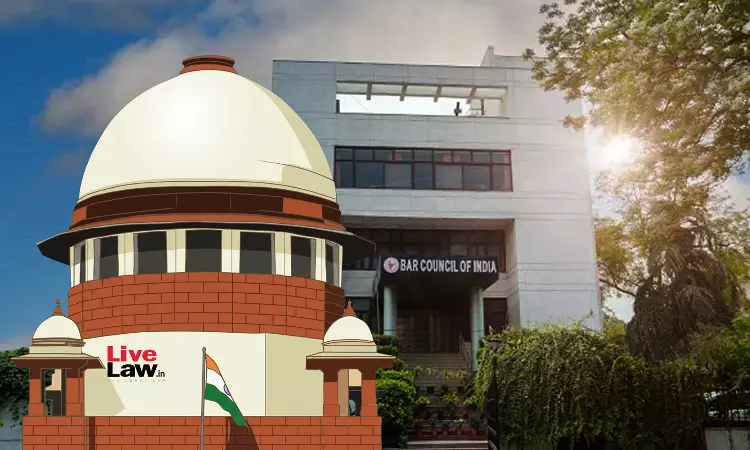
The Bar Council of India today informed the Supreme Court that it has withdrawn the upper-age restrictions for admission to 3-year and 5-year law programmes.
A bench of CJI Surya Kant, Justice Joymalya Bagchi and Justice V Mohana was apprised of the development by AoR Radhika Gautam (for BCI) during the hearing of a plea by Rishab Duggal, seeking setting aside of a 2016 circular by which the BCI restored Clause 28 in Schedule III of Rule 11 of the Rules of Legal Education, 2008 (earlier withdrawn in 2013) which provided for a maximum age limit of 20 years for taking admission in the integrated bachelor of law degree programme.
In view of the development, the case was disposed of as infructuous.
Advocate Zoheb Hossain, for the petitioner, requested the Court to record in its order the last few lines in the BCI resolution (noting that the BCI General Council decision was "conscious and final"). He reminded that earlier as well, the BCI had withdrawn and then restored the provision. In response, Gautam submitted that the BCI resolution (handed over in court) was passed yesterday only, otherwise she would have filed it.


The bench ultimately closed the matter in view of the BCI resolution.
Notably, as per the BCI resolution, the restriction was withdrawn pursuant to a reasoned order by former Delhi High Court Chief Justice Rajendra Menon (Co-Chairman of Legal Education Committee) and the resolution of the Standing Committee on Legal Education. The general council also took note of the Supreme Court order of August 2026, whereby the BCI counsel was asked to obtain instructions on withdrawal of the impugned circular.
After an independent consideration, the General Council agreed that an absolute maximum age restriction lacked sufficient academic justification. "The Council is satisfied that existing requirements governing educational qualifications, attendance, teaching hours, examinations and professional training adequately safeguard standards of legal education, without excluding otherwise eligible candidates merely on account of age."
To recap, the petitioner submitted that the impugned provision violated the fundamental rights of aspiring law students under Articles 14, 19(1)(g) and 21 of the Constitution.
The plea averred that in a similar move in the year 1993, the BCI had added Rule 9 under Chapter III of Part VI of the BCI Rules, barring those persons who have completed 45 years of age from enrolling as an advocate under the Advocates Act, 1961. The said Rule 9 was challenged before the Apex Court in the case of Indian Council of Legal Aid & Advice v. BCI where it was struck down.
"Therefore, the introduction of a rule unreasonably restricting the admission to the law courses itself being a harsher and an even more unreasonable restriction on the rights of aspiring law students is contrary to the principle and ratio laid down by this Hon'ble Court in Indian Council of Legal Aid & Advice", it was contended.
Further, it was pointed out that in view of the Conflicting judgments passed by different High Courts in writ petitions challenging the validity of the said clause, the interference of the top Court was indispensable to ensure certainty in the lives of students and consistency in the approach of the BCI [while the Punjab & Haryana and the Bombay High Courts declared the clause to be ultra vires the provisions of the Advocates Act, the Madras High Court upheld the age-limit].