Supreme Court Directs Inquiry Committee To Examine Journalists' Allegation Of Police Abuse During Delhi CEC Protests
Debby Jain
26 Nov 2026 12:54 PM IST
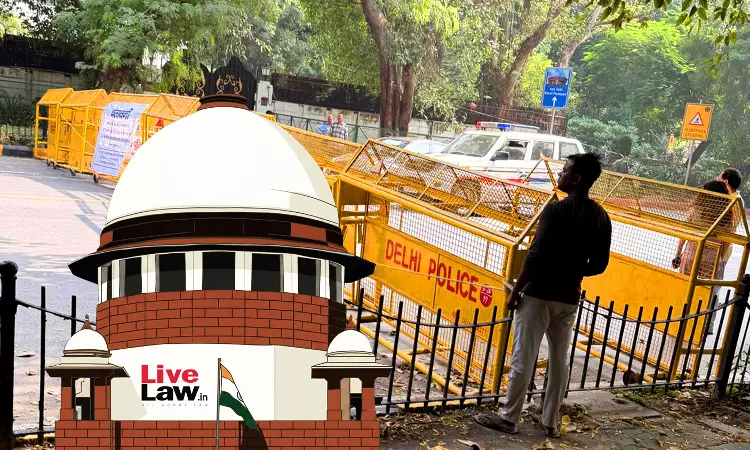
The Supreme Court on Wednesday (November 26) directed the Inquiry Committee, headed by former Supreme Court judge Justice Subhash Reddy, to examine allegations by seven Kerala journalists that they were subjected to police abuse and wrongful detention while covering the protests against Chief Election Commissioner Gyanesh Kumar in October in the national capital.
A bench comprising Chief Justice of India Surya Kant, Justice Joymalya Bagchi and Justice V Mohana relegated the petition filed by the Kerala Union of Working Journalists (KUWJ) to the committee constituted by the Supreme Court in August to inquire into the police action during the July student protests.
The Court asked the journalists to produce relevant material before the committee and requested it to examine their allegations and record factual findings.
During the hearing, Senior Advocate PV Dinesh, appearing for KUWJ, pointed out that seven journalists had been subjected to alleged police abuse and that the Delhi police had filed a composite counter-affidavit without specifically addressing the allegations concerning them. He requested the Court to direct the authorities to file a separate counter-affidavit dealing with the individual allegations.


Solicitor General of India Tushar Mehta however maintained that all allegations have been addressed in the counter-affidavit.
Justice Bagchi said the Court would first examine the factual aspects through the inquiry committee. He observed that the committee would have to ascertain whether the journalists were present at the protest, whether they were subjected to force and, if so, whether the force used was excessive in relation to what was necessary for maintaining public order.
The Bench also indicated that it would examine the broader legal questions concerning the rights of journalists covering demonstrations and other public events.
Justice Bagchi observed that one of the questions requiring consideration was whether journalists enjoy a special or different category of protection while covering demonstrations, or whether their rights in such situations are governed by the same considerations applicable to other members of the public.
Dinesh clarified that the journalists were not claiming any special privilege but were merely seeking the freedom to discharge their professional duties. "We are just journalists, recognised journalists. Allow us to do our work," he submitted.
Dinesh further argued that the seven journalists were working with established media organisations and were not merely individuals creating content for social media. He questioned whether recognised journalists could be taken into custody while covering events.
Responding to the submissions, Justice Bagchi said that the Court would examine the constitutional protections available to journalists, including their freedom of movement and their right to pursue their profession.
The judge also indicated that the Court could examine whether taking a journalist away from a spot amounts to custody and the legal consequences that would follow.
"If you are canvassing against seven individual cases of journalists being wrongfully detained and prevented from discharge of their professional duties, and you feel that the law need not be addressed or considered, we will relegate you," Justice Bagchi observed.
The bench then dictated the order, stating that the matter involved substantial questions of fact and that the petitioners could place their material before the Empowered Inquiry Committee.
"Without expressing any opinion on the merits of this case, it is disposed of," the CJI said in the order.
The Bench also indicated that similar cases involving individual journalists could be identified by the nodal counsel and placed before the committee.
Background
The KUWJ had approached the Supreme Court alleging that journalists covering protests in Delhi were subjected to unlawful detention, physical assault, manhandling and intimidation by police and security personnel.
The petition identified seven journalists, including Suhail Muhammed, Chief Reporter and news anchor of 24 News; V.S. Rahul, cameraperson of 24 News; Sajin, reporter of Asianet News; Roshni Rajan and Farsana, women journalists of Reporter TV; Vishnuprasad, press photographer of Mathrubhumi; and Miji P. Jose, senior reporter of Manorama News.
Among the specific incidents alleged were attempts to snatch a photographer's camera and the physical assault of a woman journalist while she was reporting live.
The petition also alleged that the police action violated the Supreme Court's earlier directions that journalists, lawyers and other professionals should not be hindered in discharging their professional duties.
The KUWJ sought an independent inquiry, action against officials found responsible, compensation for the affected journalists and guidelines to protect journalists covering public events.