Retired Meghalaya DGP Resigns From Supreme Court-Appointed Committee For Probing Violence During Student Protests
Debby Jain
5 Nov 2026 3:36 PM IST
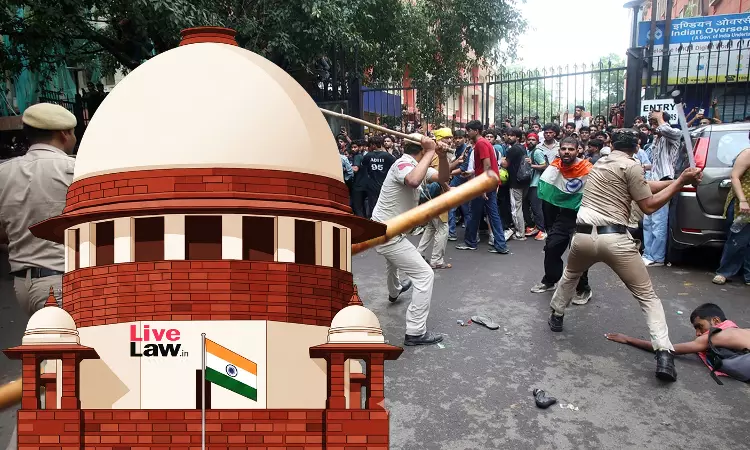
The petitioners had earlier raised concerns about appointment of Bishnoi to the Committee, but the Court refused to reconstitute it.
Dr. LR Bishnoi, retired Director General of Police of Meghalaya has resigned as member of the Supreme Court-appointed High-Powered Enquiry Committee (HPEC) constituted to probe allegations of violence during the July Student Protests.
Today, a bench of CJI Surya Kant and Justice Joymalya Bagchi accepted Bishnoi's resignation. It may be recalled that the petitioners had earlier raised concerns about the Committee composition, but the Court declined to reconstitute it.
During the hearing on September 10, Advocate Prashant Bhushan had submitted that one of the members of the HPEC (a former DGP of a north-eastern State) was under a "conflict of interest" as he was a close friend of a high functionary who was likely to be under investigation.
The HPEC was constituted by the Supreme Court on August 18, 2026 to examine the allegations of police excesses and violence during demonstrations held at Jantar Mantar in Delhi and several other parts of the country over NEET exam paper leaks and other alleged irregularities.


Former Supreme Court judge Justice R. Subhash Reddy was appointed head of the Committee, while its other members were former Punjab and Haryana High Court Chief Justice Justice Ravi Shankar Jha, former Delhi High Court judge Justice Shalinder Kaur, former CBI Director Rishi Kumar Shukla and Bishnoi.
Vide its order, the Court entrusted the committee with an independent examination of allegations concerning the use of excessive force by police and paramilitary personnel against protesters, including alleged use of pellet guns, electric batons, lathi charge and tear gas, as well as allegations of violence against police personnel and damage to public property.
The Court had directed the Committee to submit periodic interim findings and priority was to be given to allegations of excessive force against protesters and incidents of targeted violence, harassment and molestation of female protesters.
On September 10, the Supreme Court declined to reconstitute the HPEC after some petitioners raised objections to its composition, describing the allegations against the committee as premature and based on conjecture and preconceived notions.
The Court, however, reiterated the need for a fair and transparent inquiry, directing the Committee to protect vulnerable witnesses and maintain confidentiality of their identities and statements.
Later, the Court took note of the HPEC's status report, which stated that the National Informatics Centre was engaged to design and develop the complaint portal and the portal was ready for launch. The report informed that two templates were provided for the purpose - one, for aggrieved protestors, and one, for aggrieved police personnel.