



- Home
- /
- Top Stories
- /
- Supreme Court Issues Directions For...
Supreme Court Issues Directions For Faster Election Of New Bar Council Of India Members; Asks BCI To Involve AG & SG For Policy Decisions
Debby Jain
2 Sept 2026 1:02 PM IST
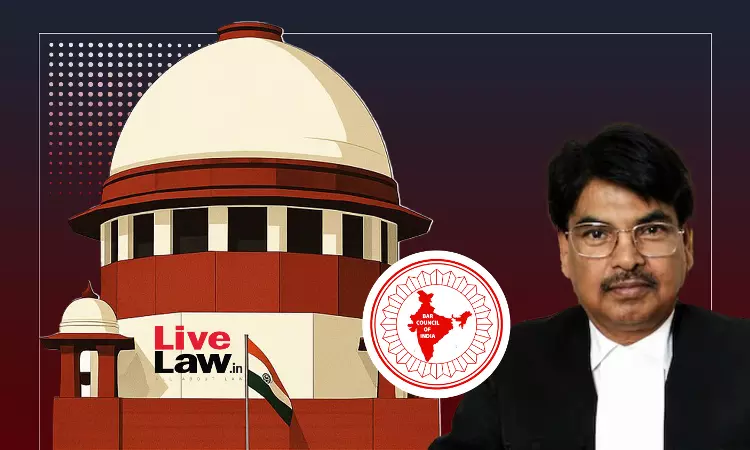
The bench observed that Manan Kumar Mishra was continuing as a "pro tem Chairman" to manage the day-to-day functioning till the next elections.
While hearing petitions challenging the continued tenure of Senior Advocate Manan Kumar Mishra as the Chairperson of the Bar Council of India (BCI), the Supreme Court on Wednesday laid down concrete timelines for the composition of State Bar Councils, so that the election of new office-bearers of the BCI can be conducted soon.Observing that the issues raised against Mishra's continuation at...
This is a premium content
Available exclusively to
Our subscribers
Subscribe Premium 
INR 1099+GST
Your support helps us to bring you more content at
an affordable subscription scheme !!!
All payment options available
While hearing petitions challenging the continued tenure of Senior Advocate Manan Kumar Mishra as the Chairperson of the Bar Council of India (BCI), the Supreme Court on Wednesday laid down concrete timelines for the composition of State Bar Councils, so that the election of new office-bearers of the BCI can be conducted soon.
Observing that the issues raised against Mishra's continuation at the BCI's helm can be addressed if the long-due BCI elections are expedited, the bench comprising Chief Justice of India Surya Kant, Justice Joymalya Bagchi and Justice V Mohana issued the following directions :
- Chief Justices of the High Courts are requested to complete the co-option of two women members to State Bar Councils within two weeks.
- State Bar Councils must notify their new composition within one week after the HC CJs complete the co-option.
- The newly constituted State Bar Councils must elect their Chairperson, Vice Chairperson, other office bearers and the one representative to the Bar Council of India within three weeks from the notification of their composition.
The Court stated that it will consider the issue of composition of the BCI after the above exercise is complete.
The Court also recorded an undertaking given on behalf of the BCI that it will involve the Attorney General for India and the Solicitor General of India, who are ex-officio BCI members, before taking any major policy decision. "Both the Attorney General for India and the Solicitor General for India shall be actively associated with every policy decision taken by the Bar Council of India," the Court observed.
The matters will be considered on September 17 to ascertain compliance with the directions on co-option and notification of new State Bar Councils' composition.
The Court was hearing the writ petitions filed by Advocates M Varadhan and Yogamaya MG challenging the prolonged tenure of BCI Chairperson Manan Kumar Mishra and seeking audit of the BCI's financial affairs and the BCI-PEARL FIRST TRUST. The pleas were filed in the wake of the NALSAR controversy involving Mishra, where he passed directions against enrolment of NALSAR graduates over their objection to CJI Surya Kant as a convocation guest but later apologised after facing severe backlash.
Courtroom hearing
At the outset, Senior Advocate Madhavi Divan, appearing for M Varadhan, submitted that the petitioners raised "serious issues" regarding the continuation of tenure and the need to fix term limits.
"What is the tenure specified in the rules?" CJI Surya Kant asked. Divan replied that it was two years.
Senior Advocate Chander Uday Singh, appearing in the connected petition filed by Yogamaya MG, submitted that the April 2025 notification, increasing the term of BCI Chairman till April 2030, has been challenged in the petition.
Divan submitted that the April notification does not specify under which provision it has been issued. She added that the notification has not been uploaded on the website. Also, as per the notification, V Prabhakaran has been appointed as the BCI Vice Chairman till 2030; however, he has lost the recently held Bar Council elections, Divan informed.
"As per the rules, what is the tenure of the Chairman and the Vice Chairman?" Justice Bagchi asked. Divan replied that it was 2 years as per Rule 12(2) of the BCI Rules.
Justice Bagchi then observed that the notification cannot supersede the Rules. "If the rule holds, it can't extend beyond 2027. On the face of the rule, notification can't override a statute and empower a body to give additional tenure."
Divan submitted that the transitional provisions such as Section 4(3) of the Advocates Act 1961, which are intended to prevent an administrative vacuum while elections are pending, are being misused to perpetuate the tenure of the existing office-holders. Divan pointed out that the proviso of Section 4(3) says that every BCI member shall continue to hold office until their successor is elected. This proviso is being used as a license to perpetuate the term of the existing members. The Bar Council elections were stalled for a long time on the pretext of verification of the lawyers' degrees, and using this situation, the BCI Chairman was prolonging his continuance, she added.
The Chief Justice then asked what the situation is after the recently held State Bar Councils. Senior Advocate Shobha Gupta(assisted by Advocate Deepak Prakash & AoR Sreeram Parakkat) submitted that the BCI has to be reconstituted by the newly elected State Bar Councils.
Gupta submitted that the April 2025 notification will enable the BCI Chairman and BCI Vice Chairman to continue till April 2030.
The CJI opined that the April 2025 notification might have become infructuous since the Bar Council elections have taken place. The CJI said that once the constitution of the State Bar Councils based on the recently held elections is complete, then the State Bar Council members will elect the BCI members.
The CJI added that after the April 2025 notification, a new development happened: the Supreme Court ordered time-bound completion of State Bar Council elections, and the elections are now complete. So, it is preferable to await the new composition of the elected body, the CJI advised.
BCI-PEARL Trust Issue Raised
Senior Advocate Gopal Sankaranarayanan, raised the issue of the BCI-PEARL FIRST Trust, which was formed in 2020 to replace the BCI Trust. As per the Trust Deed, the trustees will continue to be trustees even after the expiry of their term in the BCI. This trust then set up a Law University in Goa, the senior counsel informed, and there is no clarity regarding the finances of the trust and the law university.
CU Singh submited that the provisions allowing the trustees to continue even beyond their BCI term have been challenged. The 1974 trust deed specifically provided that its trustees must be members of the Bar Council of India. The moment a person ceased to be a member of the Council, that person also ceased to be a trustee; but the new Trust deed allows the trustees to continue in perpetuity.
Justice Bagchi asked if a trust created by an elected body could be handled by permanent trustees who are no longer BCI members. "We have to examine the relevant terms of the Trust, because the Trust is created out of the assets of the Bar Council. Bar Council, as per Section 5 of the Act, is a juristic body. So that juristic body creates a trust, which it is entitled to do, by virtue of the elected members who are constituting the Bar Council. So can those elected members thereby become permanent trustees when the composition of the corporate entity, which set up the trust, is an elected body? Whether by virtue of his continuum, in view of the proviso of Section 4(3) of the Advocates Act, can these members create a Trust where the members themselves perpetuate their rights of trustees beyond their capacity?"
"This requires a high-level investigation on what happened after they transferred the BCI assets in last 6 years," Sankaranarayanan submitted. He submitted that a committee is to be constituted to examine the affairs of the Trust. Singh also backed the plea for an oversight committee.
Senior Advocate Sanjay Hegde also backed the concerns raised by other lawyers regarding the BCI's functioning. The CJI, however, expressed against making a judicial intervention when the newly elected body is on the verge of being constituted. Providing a timeline for the constitution of the Bar Councils can solve most of the issues, the CJI said.
Senior Advocate Maninder Singh, for the BCI, welcomed the Court's proposal to lay down timelines, but said that issues should not be mixed up. Senior Advocate Guru Krishnakumar, for the BCI Chairman, while agreeing to the laying down of the timelines, however said that the Court's platform cannot be used by the petitioners to make "broad-based insinuations and indirect allegations."
Why not invite Attorney General for BCI meetings on policy decisions? Bench asks
Justice Bagchi, pointing out that Mishra is continuing as a pro-tem Chairman till the next elections of BCI members, advised that the Attorney General for India should also be invited to BCI council meetings related to major policy decisions.
"Under the statutory scheme, the Attorney General and Solicitor General are already members of the Bar Council of India.. They need not be involved in the Council's day-to-day functioning. However, whenever a decision having significant policy implications is considered, the Attorney General and Solicitor General can be invited to participate," Justice Bagchi said. Krishnakumar said that there is no objection to inviting the Attorney General.
"You should also bear in mind that you are like a pro tem Chairman till a fresh election of the Bar Council of India, pursuant to the elections already conducted in the State Bar Councils, takes place. So, it is not a situation where he is democratically elected and continues to be so. His term is co-terminus with the elections which are imminent. Becasue the new Bar Councils are about to be constituted. So in this situation, what we generally do is, day-to-day functioning, left to the pro tem Chairman. But whenever a policy decision is taken, a permanent ex-officio member, like the Attorney General, must be involved," Justice Bagchi said.
Justice Bagchi, clarifying that the Court was not encouraging any "shadow-boxing", however said that there was a need to ensure institutional integrity. "So till an elected Bar Council of India comes into being, a pro tem continuance of proviso to Section 4(3), would be good for day-to-day functioning, but when it comes to policy decisions, it must be in the presence of the Attorney General," Justice Bagchi said.
Details of the petitions
The petition filed by Advocate Yogamaya MG, challenges Mishra's tenure, and his prolonged continuance in the post. It points out that Mishra first became BCI Chairman in 2012. After a brief break in 2014, he returned to the post in November 2014 and has remained Chairman since then. He was again elected unopposed in March 2025. The petitioner describes this as his seventh consecutive term.
The main challenge is to the five-year tenure notified by the BCI in April 2025. The Gazette notification records Mishra's tenure from April 17, 2025 to April 16, 2030. The petitioner argues that Rule 12(2) of the BCI Rules provides for a two-year tenure for the Chairman and Vice-Chairman, or until cessation of membership, whichever is earlier. The plea says an administrative notification cannot extend the tenure beyond what the Rules permit.
The plea asks the Supreme Court to quash the April 21, 2025 Gazette notification and direct the BCI to withdraw or rescind it. It also seeks an order that Mishra and the Vice-Chairman cease to hold office and that fresh elections be conducted within a time-bound period under independent supervision.
Another petition, filed by Advocate M Vardhan, challenges the provisions which allow the perpetual continuance of the same individuals at the top posts of the Bar Council of India (BCI) and State Bar Councils. The petitioner contended that prolonged continuance of elected representatives, delayed elections and the absence of cumulative tenure limits have weakened the democratic and representative character of the statutory bodies.
The petition has challenged the manner in which Section 4(3) of the Advocates Act, 1961, permitting members of the BCI to continue in office “until his successor is elected”, has operated when elections are delayed. The petitioner contended that a provision intended to prevent an institutional vacuum cannot be used to facilitate indefinite continuation of incumbents.
Referring to Sections 8 and 8A of the Advocates Act, the petitioner pointed out that State Bar Council members have a five-year tenure, with a statutory extension of not more than six months in specified circumstances. Section 8A provides for constitution of a Special Committee if elections are not held within the prescribed period and requires the committee to conduct elections within six months, subject to the statutory mechanism for extension.
The plea also raised concerns over Rule 32 of the Bar Council of India Certificate and Place of Practice (Verification) Rules, 2015, substituted by the BCI in June 2023.
Cases: M. VARADHAN Versus UNION OF INDIA AND ORS. W.P.(C) No. 1049/2026; YOGAMAYA M.G. Versus UNION OF INDIA AND ORS. W.P.(C) No. 1092/2026
Tags
Debby Jain
Debby Jain is a Correspondent with LiveLaw, covering the Supreme Court of India

