



- Home
- /
- Top Stories
- /
- Supreme Court Judges Urge CJI To...
Supreme Court Judges Urge CJI To Consider Constituting Permanent Constitution Bench, Flag Years-Long Delay In References
Amisha Shrivastava
23 Sept 2026 7:54 PM IST
The Supreme Court on Wednesday urged Chief Justice of India Surya Kant to consider constituting a permanent five-Judge Constitution Bench to decide pure constitutional questions, flagging the years-long delay in references to larger benches.The Court observed that the inordinate delay in resolving references was a source of institutional embarrassment which all stakeholders should strive...
This is a premium content
Available exclusively to
Our subscribers
Subscribe Premium 
INR 1099+GST
Your support helps us to bring you more content at
an affordable subscription scheme !!!
All payment options available
The Supreme Court on Wednesday urged Chief Justice of India Surya Kant to consider constituting a permanent five-Judge Constitution Bench to decide pure constitutional questions, flagging the years-long delay in references to larger benches.
The Court observed that the inordinate delay in resolving references was a source of institutional embarrassment which all stakeholders should strive to avoid.
“If statistics are any guide, none can say with any reasonable degree of certainty when long pending references will get resolved. Undisputedly, this is an area of grave concern and the inordinate delay in resolution of the references is itself a source of institutional embarrassment which all stakeholders ought to strive to avoid. Self-introspection, indeed, is required,” it observed.
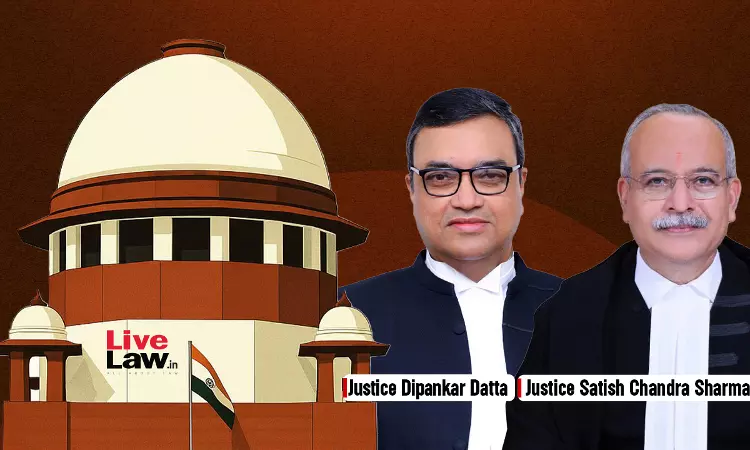
A bench of Justice Dipankar Datta and Justice Satish Chandra Sharma made the request while directing that the pleas challenging the Chief Election Commissioner and other Election Commissioners (Appointment, Conditions of Service and Term of Office) Act, 2023 be placed before the CJI for considering the constitution of a Constitution Bench.
The bench was divided on whether the challenge itself warranted a reference to a larger Bench. Justice Datta held that the existing division bench could decide the challenge, while Justice Sharma held that the case involved a substantial question of constitutional interpretation requiring consideration by a Constitution Bench.
The judges, however, agreed that sending the issue of their difference of opinion to another three-judge bench would only delay the adjudication.
Thay addressed the concern raised by the petitioners regarding the time taken by the Supreme Court to decide references to Constitution Benches.
The Court noted that Anoop Baranwal v. Union of India originated from a writ petition under Article 32 filed in 2015. A reference to a Constitution Bench was made three years later, in 2018, and it took another five years for the Constitution Bench to deliver its judgment in 2023 – eight years in total.
The Court also referred to State of Uttar Pradesh v. Jai Bir Singh. Both Justice Datta and Justice Sharma had been part of the nine-judge bench in that matter. Thay noted that the reference made by a seven-judge bench took nine years to reach the nine-judge bench, following which the bench took another five months to decide it. The reference had remained pending since 2002, for 15 years, before being placed before the larger bench, they noted.
Against this background, the Court observed that the petitioners appeared justified in expressing anxiety over references to five-judge benches remaining unresolved for years.
Therefore, the judges requested the CJI to consider constituting a permanent 5-judge Constitution bench.
They noted that such a proposal was not novel and that it was merely endorsing an opinion expressed by responsible citizens of the country.
“We, thus, take this opportunity of requesting the Hon'ble the Chief Justice of India to also explore the necessity of constituting a permanent 5-Judge Bench to decide pure constitutional issues. This is not something novel that we are saying. It has been opined time and again by responsible citizens of the country and we simply endorse their opinion. Given that resolving constitutional issues is the primary task of Judges of this Court, that must remain its core priority. Pendency of references for far too long [any period between 5 (five) and 20 (twenty) years or more] does not reflect well on the institution. It is time that the institution addresses the issue with the urgency and promptitude it deserves,” the bench observed.
The bench also expressed hope that the reference concerning the constitutional validity of the 2023 law would not face a similar delay, given that the issues requiring consideration are of foundational importance to the democratic fabric of the country and its citizenry.
The order was passed in the batch of petitions challenging the 2023 Act, which replaced the interim appointment mechanism laid down by the Supreme Court in Anoop Baranwal. The petitions challenge, among other provisions, Section 7 of the 2023 Act, under which the selection committee comprises the Prime Minister, the Leader of Opposition in the Lok Sabha and a Union Cabinet Minister nominated by the Prime Minister.
Case no. - W.P.(C) No. 14/2024 Diary No. 146 / 2024 and connected cases
Case Title - Dr. Jaya Thakur v. Union of India and connected cases
Citation: 2026 LiveLaw (SC) 976
Tags

Amisha Shrivastava
Amisha Shrivastava is a Senior Correspondent with LiveLaw, covering the Supreme Court of India. She can be reached at amisha@livelaw.in

