



- Home
- /
- Top Stories
- /
- Supreme Court Suggests Professional...
Supreme Court Suggests Professional Bondspersons, Dedicated District Staff For Surety Verification
Amisha Shrivastava
22 Aug 2026 5:49 PM IST
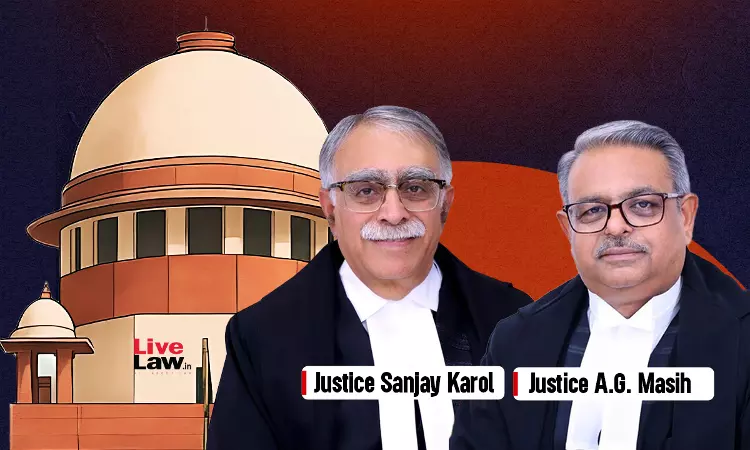
The Supreme Court recently suggested several measures to reform the system of surety verification, including introducing professional bail bondspersons, creating dedicated personnel in district courts for verification of sureties and developing a nationwide Surety Information Management System (SIMS).A bench of Justice Sanjay Karol and Justice Augustine George Masih made the suggestions...
This is a premium content
Available exclusively to
Our subscribers
Subscribe Premium 
INR 1099+GST
Your support helps us to bring you more content at
an affordable subscription scheme !!!
All payment options available
The Supreme Court recently suggested several measures to reform the system of surety verification, including introducing professional bail bondspersons, creating dedicated personnel in district courts for verification of sureties and developing a nationwide Surety Information Management System (SIMS).
A bench of Justice Sanjay Karol and Justice Augustine George Masih made the suggestions while considering the problem of fake sureties in cases involving foreign nationals accused of offences involving commercial quantities under the Narcotic Drugs and Psychotropic Substances Act, 1985 (NDPS Act).
The Court clarified that these were suggestions for consideration by the relevant authorities and were separate from the directions issued by it.
Professional Bail Bondspersons
The Supreme Court suggested consideration of a system of professional bail bondspersons, under which persons registered and licensed for the purpose would provide sureties for accused persons who are unable to arrange conventional sureties. The Court noted that such professional sureties may, in some cases, be the only answer to the difficulty faced by accused persons in furnishing sureties. It observed that there are presently no rules governing such a system and that its introduction would require an in-depth study of the relevant laws and its socio-economic impact.
The Court had asked Additional Solicitor General SV Raju and senior advocate Sidharth Luthra to examine the issue. They furnished draft rules, which the Court studied, analysed and amended. Under the proposed rules, a “Professional Bail Bondsperson” would mean a person registered under the framework to provide sureties for an accused and undertake related activities. The proposed system would involve licensing and registration, with State Bail Bondsperson Regulatory Authorities empowered to issue licences and regulate the maximum service fees that such bondspersons may charge.
The Court opined that the question of allowing entities or limited liability partnerships to function as bail bondspersons also requires consideration. It said that the Executive must take a call after considering the positive and negative aspects of the corporatization of bail.
Dedicated Personnel for Physical Verification of Sureties
The Court noted that the usual practice is for the Investigating Officer to verify the surety physically and thereafter produce the surety and relevant documents before the Magistrate for satisfaction. However, it opined that there was a need for change in the process.
It suggested that each district court may be provided with human resources specifically for surety verification. The designated personnel should make all practical attempts to associate at least two independent witnesses during the verification.
Surety Information Management System
The Court further suggested that government authorities and courts develop the Surety Information Management System (SIMS) as a common system across States for effective storage and management of information relating to sureties.
Geo Fencing
The Court suggested that Ministry of Electronics and Information Technology consider framing guidelines for the use of geo-fencing technology to monitor whether an accused complies with geographic restrictions imposed as a bail condition, after examining the relevant Supreme Court judgments. The guidelines may specify the cases in which geo-fencing can be used.
Aadhaar Authentication for Surety Verification
The Court also suggested that the Union Government, through the concerned Ministry, may apply to the Unique Identification Authority of India (UIDAI) to facilitate the use of Aadhaar authentication for surety verification under the Aadhaar Authentication for Good Governance (Social Welfare, Innovation, Knowledge) Rules, 2020.
The Court, however, rejected a broader suggestion to make information held by UIDAI, M-Parivahan, land registry records and the Ministry of Road Transport and Highways available online for real-time verification of sureties, considering it too wide.
Bond for Good Behaviour
The Court suggested that the Ministry of Home Affairs consider including the NDPS Act in the list of statutes under Section 129 of the BNSS, 2023. This would allow an Executive Magistrate to require an offender residing within the jurisdiction to execute a bond for good behaviour, the Court said.
Training to Judges
The Court also suggested that Judicial Academies provide training to judges and judicial officers on the relationship between social and economic realities, particularly financial vulnerability, and access to justice in cases involving surety-based bail.
The Court directed that copies of the judgment be sent to the Department of Law and Justice, Chief Secretaries of all States and Union Territories and Registrars General of High Courts for necessary follow-up action.
Case Title: Union of India v. Chidiebere Kingsley Nawchara & Ors.
Citation: 2026 LiveLaw (SC) 817
Case No.: SLP (Crl.) No. 14185 of 2025
Tags

Amisha Shrivastava
Amisha Shrivastava is a Senior Correspondent with LiveLaw, covering the Supreme Court of India. She can be reached at amisha@livelaw.in

