



- Home
- /
- Top Stories
- /
- Supreme Court Affirms Ban On...
Supreme Court Affirms Ban On Commercial Activity In Segur Plateau Elephant Corridor
Debby Jain
20 July 2026 6:51 PM IST
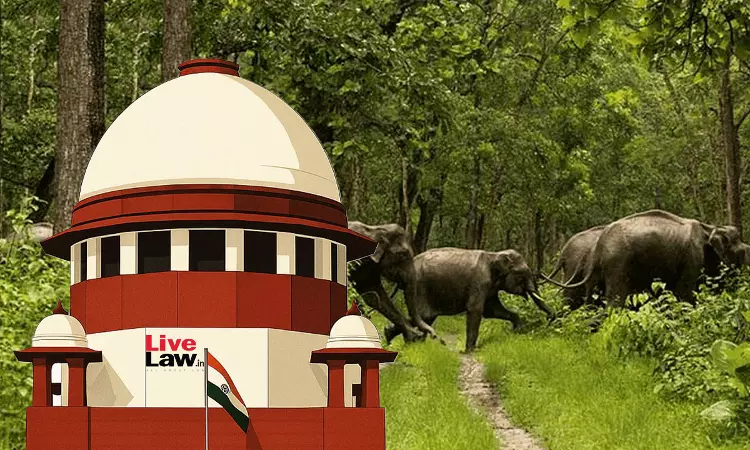
The Court allowed the affected persons to seek alternate sources of livelihood.
The Supreme Court today categorically ruled out any sort of commercial activity in the Segur plateau (Western Ghats area), which was declared as an Elephant corridor.A bench of CJI Surya Kant, Justice Joymalya Bagchi and Justice V Mohana disposed of a bunch of petitions challenging the Madras High Court order which upheld the findings of a Supreme Court-appointed committee, declaring as null...
This is a premium content
Available exclusively to
Our subscribers
Subscribe Premium 
INR 1099+GST
Your support helps us to bring you more content at
an affordable subscription scheme !!!
All payment options available
The Supreme Court today categorically ruled out any sort of commercial activity in the Segur plateau (Western Ghats area), which was declared as an Elephant corridor.
A bench of CJI Surya Kant, Justice Joymalya Bagchi and Justice V Mohana disposed of a bunch of petitions challenging the Madras High Court order which upheld the findings of a Supreme Court-appointed committee, declaring as null and void the land bought by resort owners in the Segur plateau.
It however gave persons aggrieved by the High Court order, who have lost their livelihood, liberty to seek alternative sources of livelihood. The Court further gave the State of Tamil Nadu liberty to identify the land which was worth acquisition in the area and not possessed/owned by tribal communities.
Addl. Advocate General Haripriya Padmanabhan, for Tamil Nadu, informed the Court that no commercial activity was taking place in the area and the State had taken steps to remove all encroachers. She further submitted that the State was in agreement with the High Court order. But so far as it had ordered acquisition of some land in the area by the state, which would entail a burden of Rs.1300 crores, she sought 4 weeks' time to take instructions.
The CJI however opined that the matter required no interference and the High Court order was "perfectly correct". "If system is not permitting them to utilize their land, you have to acquire", the CJI added.
Padmanabhan however argued that the matter was not that simple. She informed that there were Adivasis and forest-dwellers living in the area, and therefore acquiring the land may have repercussions. The AAG further said that the government was considering whether acquisition is possible, and if so, to what extent.
The Court however disposed of the plea observing :
“We see no ground to interfere with the impugned judgment of the High Court. The guidelines directed by the High Court to be adopted for protecting the Elephant Corridor need to be given effect. However, the state shall be at liberty to identify the land which is worth acquisition and is not owned/possessed by tribal communities. In case the state faces any difficulty in the acquisition process, it shall be at liberty to approach the High Court for suitable modification.”
Senior Advocates Salman Khurshid, Shoeb Alam and PB Suresh appeared for the petitioners. After the order was dictated, Alam urged that one of the petitions before the High Court was dismissed on a technical ground (source of a government document unknown) and thereafter, other petitions got dismissed based on the first dismissal order. He claimed that there had been no adjudication at all in the batch of cases he was arguing.
The senior counsel beseeched the Court to keep the order in abeyance for 2 weeks and grant an opportunity of hearing, especially as the state also did not have complete instructions. It was submitted that the matter could be heard anytime within the 2 weeks and in the meantime, an order barring commercial activity could be passed.
"It can't be that the Supreme Court of India is not going to hear parties who are landowners, pursuant to orders of the court. It has never happened and your lordships certainly would not do it now" Alam submitted.
"We should have dismissed on the very first day", countered the CJI. At this point, Alam emphasized that he was not arguing on behalf of any commercial organization, but rather some landowners who had land in the area.
Suresh, arguing for some other petitioners, contended that he may be allowed to withdraw, with liberty to approach the High Court to point out that the petitioners were willing to remove the element which apparently made their property "commercial".
Ultimately, the Court refused to go consider the pleas on a case-by-case basis. It permitted aggrieved persons (who had lost their livelihood by virtue of the High Court order) to make a prayer for alternate source of livelihood. "Such a request may be considered sympathetically. We however make it clear that no commercial activity whatsoever shall be allowed to be run at the subject site", the order stated.
Background
The Madras High Court, in 2011, had upheld the validity of a notification issued by the Tamil Nadu government in 2010 declaring the Elephant Corridor in Segur Plateau. The government notification also contained the Survey number of the lands which came under the Elephant Corridor. The court had directed the resort owners and other private landowners to vacate and hand over the vacant possession of the lands falling within the notified elephant corridor.
The Hospitality Association of Mudumalai challenged this order in the Supreme Court, contending that the notified elephant corridor did not align with the historical elephant movement patterns and that their lands did not fall within the scientifically recognised elephant corridor.
The Supreme Court upheld the notification and established a three-member committee headed by a retired High Court judge to address the individual objections of persons claiming to be aggrieved. The committee had declared that since the vendors of the resort owners had not taken prior permission from the committee constituted under the land to sell or alienate the land declared as private forests, the sale was null and void.
Following the findings of the Inquiry Committee, the local authorities ordered the demolition of the buildings constructed on the land that came under the Elephant corridor.
Challenging the findings of the Committee, and the demolition orders of the local authorities, pleas were filed before the High Court by resort and land owners in the area.
The High Court noted that in many cases, the parties had obtained permission for using the area as residential premises, but had later carried on commercial activities. It underlined that commercial activities could not be permitted in the area, causing hindrance to the movement of elephants.
The court thus refused to interfere with the demolition order, which was passed by the Executive Officer/local authorities based on the order of the Inquiry Committee. However, with respect to other directions where the committee had recommended handing over the land to the government, the court disagreed with it and said that the parties who had purchased the lands and were using them for agricultural purposes could continue to do so.
The Court noted that after notifying the area and removing the electric fences for free movement of elephants, it would be difficult for the persons to continue being in possession of the property for agriculture, plantation, etc. Thus, the court said that it would be appropriate for the government to take over the properties. Therefore, the court asked the state to initiate the acquisition proceedings and complete the same within 6 months.
Case Title: M/S JUNGLE HUT Versus THE HONBLE SEGUR PLATEAU ELEPHANT CORRIDOR INQUIRY COMMITTEE AND ORS. SLP(C) No. 32019/2025 (and connected cases)
Tags

Debby Jain
Debby Jain is a Correspondent with LiveLaw, covering the Supreme Court of India

