



- Home
- /
- Top Stories
- /
- Supreme Court Upholds Election...
Supreme Court Upholds Election Commission's Power To Conduct SIR Of Electoral Rolls, Says It Advances Free & Fair Elections
Gursimran Kaur Bakshi
27 May 2026 10:58 AM IST
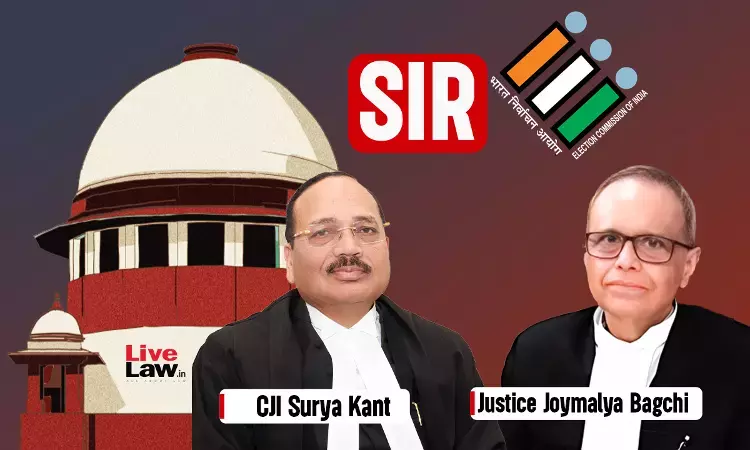
The Court held that the procedure adopted by the ECI in conducting SIR did not violate the law and had nexus with the Constitutional goal of free and fair elections.
The Supreme Court today(May 27) upheld the legality of the Special Intensive Revision (SIR) of the electoral rolls done by the Election Commission of India and observed that electoral SIR advances the Constitutional imperative of free and fair elections.The Court held that the Election Commission has the power to conduct SIR under Article 324 of the Constitution, read with Representation of...
This is a premium content
Available exclusively to
Our subscribers
Subscribe Premium 
INR 1099+GST
Your support helps us to bring you more content at
an affordable subscription scheme !!!
All payment options available
The Supreme Court today(May 27) upheld the legality of the Special Intensive Revision (SIR) of the electoral rolls done by the Election Commission of India and observed that electoral SIR advances the Constitutional imperative of free and fair elections.
The Court held that the Election Commission has the power to conduct SIR under Article 324 of the Constitution, read with Representation of the People Act, 1950, and the Rules made thereunder.
A bench comprising Chief Justice Surya Kant and Justice Joymalya Bagchi pronounced the judgment in the writ petitions, which challenged the notification issued by the ECI in June last year to conduct SIR in Bihar.
The Court held that the SIR process had a nexus with the goal of having free and fair elections.
The judgment pronounced by CJI Surya Kant held :
"When the statute itself authorises a special revision at any time, for reasons to be recorded and in such manner as the Election Commission may deem fit, the impugned exercise cannot be invalidated merely because it does not conform in every respect to the ordinary modalities contemplated for routine revision. In our considered opinion, the impugned SIR does not supplant the Representation of the People Act and the Rules. Rather, it breathes life into the constitutional mandate under Article 324 within the precise statutory contours provided by Section 21(3). Therefore, it cannot be said that the Commission has acted in excess of its statutory powers."
The Court observed that the object sought to be achieved by the SIR bore a direct nexus with the constitutional goal of ensuring free and fair elections, noting that such elections did not rest merely on the mechanics of polling but fundamentally depended on the integrity, accuracy, and credibility of the electoral rolls, which formed the foundation of the democratic process.
It further observed that the reasons recorded by the Election Commission, including the passage of more than four decades since the last intensive revision, large-scale additions and deletions over the years, and rapid urbanisation and migration leading to the possibility of duplication and inaccuracies in the electoral rolls, were clearly aimed at preserving that foundational integrity.
Procedure did not violate the law
The Court rejected the argument that the procedure adopted by the ECI was contrary to the Representation of the People Act, 1950 and the Registration of Electors Rules, 1960.
The Court also rejected the argument that the procedure negated the presumption of citizenship of persons already on the rolls.
"Calling upon electors to furnish supporting material in the course of such an exercise does not amount to negation of the presumption. Rather, it reflects the procedural mechanism through which the Commission seeks to reaffirm or, where necessary, correct existing entries. The presumption continues to operate, but it does not negate the possibility of verification," CJI Kant observed.
The Court rejected the argument that the procedure violated the judgment in Lal Babu Hussein, on the ground that the judgment only emphasised procedural fairness and did not foreclose verification. In any case, the presumption of citizenship is a rebuttable one, the Court noted.
The bench further ruled that deletions carried out under the SIR are not contrary to Rule 21A of the 1960 Rules, stating that the essential safeguards of notice and hearing remain preserved in substance.
On the documentation requirements, the Court upheld the Election Commission's framework, holding that the classification of acceptable documents was based on intelligible criteria linked to the objective of maintaining electoral integrity, and was not arbitrary. It noted that Aadhaar had already been included pursuant to an earlier order.
The Court held that the SIR satisfies the test of proportionality, observing that the exercise serves the legitimate constitutional objective of ensuring accurate, complete and credible electoral rolls, which are foundational to free and fair elections. It found that the measures adopted were neither excessive nor arbitrary, and that adequate procedural safeguards were built into the process.
ECI has power to go into questions of citizenship
The Court held that the ECI has the power to examine the questions bearing upon citizenship for the purpose of including in the electoral roll. However, the negative determination of the ECI does not result in a conclusive finding that the person is not an Indian citizen. The ECI's exercise is only confined to electoral roll preparation.
"Upon detailed consideration, we have come to the conclusion that, in view of the statutory requirement under Section 16 of the Representation of the People Act, the Commission, in the course of preparing or revising electoral rolls, is undoubtedly empowered to examine questions bearing upon citizenship.
The consequence of such a citizenship determination is correspondingly limited. It affects the individual's entitlement to be included in the electoral rolls and thereby the right to participate in the electoral process. It does not, however, operate to divest the individual of claims to citizenship, nor does it foreclose adjudication of that question by the competent authority under the Citizenship Act," CJI Surya Kant pronounced.
In cases where the Commission is not satisfied that a person fulfils the statutory conditions for inclusion in the electoral rolls, it would be incumbent upon the Commission to refer such an individual to the competent authority of the Union Government for adjudication in accordance with law. The Commission's determination, being confined to electoral purposes, cannot assume finality on the question of citizenship. Any deletion effected on this ground shall therefore remain subject to the outcome of adjudication by the competent authority.
The Court also asked the ECI to forward to the Central Government the names of persons deleted from the 2003 Bihar electoral rolls over doubtful citizenship within four weeks.
Also Read - 'SIR Meets Proportionality Test' : Conclusions From Supreme Court Judgment
Background
It may be noted that the Court did not interdict the SIR process, and it has been completed in Bihar, Kerala, Tamil Nadu, Puducherry and West Bengal. It is ongoing in several other states such as Uttar Pradesh, Gujarat, Rajasthan etc. While allowing the process to go on, the Court said that it will determine the legal question of whether the ECI has the power to carry out the exercise. Judgment was reserved on January 29 this year.
Most of the petitions were filed in June last year, following the ECI's decision to conduct SIR in Bihar. The Association of Democratic Reforms, political activist Yogendra Yadav, Mahua Moitra (TMC MP), Manoj Jha (RJD MP), KC Venugopal(Congress MP), Supriya Sule (NCP SP), etc are some of the petitioners.
Petitioners: SIR Is A Backdoor Citizenship Verification Exercise
The petitioners mounted a broad constitutional challenge, contending that the SIR fundamentally alters the statutory framework governing electoral roll revision.
Their principal argument was that the exercise transforms the Election Commission into a de facto citizenship adjudicator. According to them, electoral registration law does not permit the Commission to require citizens already on the rolls to newly establish their citizenship through documentary proof. Questions regarding citizenship, they argued, must be addressed only through the legal mechanisms prescribed under the Citizenship Act and related laws, not through an electoral enumeration process.
In this context, the petitioners characterised the SIR as an “NRC-like” exercise, arguing that it creates a presumption of ineligibility and shifts the burden onto voters to prove their citizenship, contrary to established legal principles.
A related concern raised was that the exercise creates what counsel described as a state of “suspended citizenship.” If a person's name is excluded from the electoral roll pending verification, that individual is effectively deprived of a core democratic right without any formal citizenship determination by a competent authority.
The petitioners also questioned the statutory basis of the process itself. They argued that the enumeration forms being used for verification have no explicit backing under the Representation of the People Act, 1950 or the relevant electoral rules, making the procedure legally vulnerable.
On the scope of the Election Commission's powers, the petitioners argued that Section 21(3) of the Representation of the People Act does not authorise a sweeping, simultaneous SIR across multiple States and Union Territories. The provision allows a “special revision” for “any constituency or part of a constituency,” which, according to them, contemplates targeted and exceptional interventions rather than a mass, nationwide-style exercise.
They further argued that the Election Commission failed to disclose constituency-specific or state-specific reasons justifying the revision, raising concerns about arbitrariness.
The petitioners also relied on the Supreme Court's judgment in Lal Babu Hussein, which held that once a person is included in the electoral roll, there is a presumption in favour of citizenship, and the burden lies on the objector to prove otherwise. Their case was that the SIR inverts this principle by compelling already-enrolled voters to re-establish their eligibility.
ECI: Electoral Purification, Not Citizenship Adjudication
Defending the exercise, the Election Commission argued that the petitioners had fundamentally misunderstood the nature of the SIR.
Its primary position was that the exercise is not a citizenship adjudication mechanism in the sense contemplated under deportation or nationality laws. Rather, it is an electoral verification exercise aimed solely at ensuring that only eligible citizens remain on electoral rolls.
The Commission emphasised that the Constitution envisages a citizen-based franchise, making it its constitutional obligation to maintain electoral purity by excluding non-citizens from voter rolls.
Rejecting the comparison with an NRC-style process, the ECI argued that the SIR adopts what it described as a “liberal” and “soft-touch” verification model rather than a coercive investigation.
On the petitioners' reliance on Lal Babu Hussein, the Commission argued that the precedent was factually distinguishable. It submitted that the earlier case involved materially different circumstances, including police involvement in the verification process and an absence of procedural safeguards.
By contrast, in the present case, the Commission argued that the exercise is being conducted by election officials, not police authorities, and incorporates adequate procedural safeguards. It also argued that prior inclusion in electoral rolls continues to carry evidentiary significance and is not being ignored altogether.
The ECI further defended its authority under the statutory scheme, arguing that the power to conduct special revision of electoral rolls necessarily includes intensive verification where required to preserve electoral integrity.
The Commission also rejected allegations of political motivation, maintaining that its role is institutional and constitutional, not responsive to political narratives surrounding the exercise.
Headnote
Representation of the People Act, 1950 – Section 21(3) – Registration of Electors Rules, 1960 – Rule 21A – Constitution of India – Articles 324, 325, 326 & 327 – Special Intensive Revision (SIR) of Electoral Rolls – Power of the Election Commission of India (ECI) to conduct state-wide Special Intensive Revision – The expression "for any constituency or part of a constituency" in Section 21(3) of the RP Act includes "many" or "all" constituencies if state-wide reasons like rapid urbanization, migration, and duplication pollute the rolls - The non-obstante clause in Section 21(3) frees the Commission from the ordinary procedural limitations of Section 21(2), allowing it to shape the course of revision as it thinks fit, provided it records cogent reasons. [Paras 35 – 50]
Constitution of India – Article 324 & Article 327 – Interplay between Constitutional Powers and Parliamentary Legislation – The legislative competence of Parliament under Article 327 and the ECI's mandate under Article 324 are complementary, not competing - Parliamentary legislation cannot extinguish or paralyse the core constitutional functions of the Commission - The Commission retains plenary authority to issue regulatory directions and fill vacuums where the law is silent, though it must act consistently with express statutory prohibitions. [Relied on: Mohinder Singh Gill v. Chief Election Commissioner, (1978) 1 SCC 405; Sadiq Ali v. Election Commission of India, (1972) 4 SCC 664; All Party Hill Leaders' Conference v. Captain W.A. Sangma, (1977) 4 SCC 161; Kanhiya Lal Omar v. R.K. Trivedi, (1985) 4 SCC 628; In Re: Special Reference No. 1 of 2002, (2002) 8 SCC 237; Para 175-186]
Administrative Law – Doctrine of Proportionality – Legitimate Purpose and Least Restrictive Measure – ECI's order directing a Special Intensive Revision after a gap of over two decades (since 2003) satisfies the four-pronged proportionality test - The restoration of the accuracy and purity of electoral rolls is a legitimate purpose embedded in Articles 325 and 326 - House-to-house verification and documentary scrutiny bear a rational nexus to this goal - A state-wide systemic issue cannot be remedied by piecemeal constituency-specific revisions, making the comprehensive SIR necessary. [Relied on Vivek Narayan Sharma v. Union of India, (2023) 3 SCC 1; Paras 69 - 82]
Election Law – Presumption of Regularity of Existing Entries – Scope of Re verification – Enrolment in an electoral roll carries a rebuttable evidentiary presumption of validity under Section 114 of the Evidence Act, but it does not impose a blanket embargo on the ECI's power to conduct a systemic, inquisitorial re-verification exercise - A prior entry cannot be used as a shield to obstruct the Commission's constitutional mandate of systemic oversight. [Distinguished: Labu Babu Hussein v. Electoral Registration Officer, (1995) 3 SCC 100 Paras 111-125]
Registration of Electors Rules, 1960 – Rule 21A – Procedure for Deletion/Removal of Names – The safeguards of notice and hearing under Rule 21A are not violated by the SIR guidelines - While non-submission of the enumeration form results in provisional non-inclusion in the draft roll, final deletions are only made after the claims and objections stage, where the ERO conducts an enquiry, issues show cause notices for doubtful cases, and passes speaking orders subject to a two-tier statutory appeal. Substance of due process is preserved. [Paras 136-142]
Representation of the People Act, 1950 – Sections 16, 19 & 23(4) – Citizenship Act, 1955 – Section 9(2) – Scrutiny of Citizenship for Electoral Eligibility – The ECI is empowered to undertake a limited, prima facie enquiry into the citizenship status of an individual to satisfy itself of the baseline eligibility condition under Section 16 of the RP Act - There is a distinction between an administrative satisfaction for electoral purposes and a formal adjudication of status under the Citizenship Act - ECI's decision does not amount to a final declaration of non-citizenship - In cases of doubt, the ECI must refer the individuals to the Competent Authority under the Citizenship Act, 1955 for final adjudication within a reasonable timeframe - Aadhaar Card can be treated as a 12th identity document for registration under Section 23(4) of the RP Act but does not constitute proof of citizenship. [Paras 157-178]
Senior Advocates Kapil Sibal, Dr AM Singhvi, Gopal Sankaranarayanan, Shadan Farast, PC Sen, Raju Ramachandran, Advocates Prashant Bhushan, Vrinda Grover, Nizam Pasha, Sharukh Alam, Fauzia Shakil, Neha Rathi, etc appeared for various petitioners.
Senior Advocates Rakesh Dwivedi, Maninder Singh, Dama Seshadri Naidu, and Advocate Eklavya Dwivedi appeared for the ECI. Senior Advocate Vijay Hansaria appeared for Advcoate Ashwini Upadhyay who has filed a petition seeking the conduct of SIR in all States/UTs.
Case Title: ASSOCIATION FOR DEMOCRATIC REFORMS AND ORS. Versus ELECTION COMMISSION OF INDIA, W.P.(C) No. 640/2025 (and connected cases)
Citation : 2026 LiveLaw (SC) 549
Tags

Gursimran Kaur Bakshi
Gursimran is the Principal Correspondent with LiveLaw for the Supreme Court. She can be reached out at: simrankaurbakshi@livelaw.in

