Umar Khalid Moves Supreme Court Seeking Bail In Delhi Riots UAPA Case, Cites Near Expiry Of One Year Embargo
Gursimran Kaur Bakshi
5 Nov 2026 5:36 PM IST
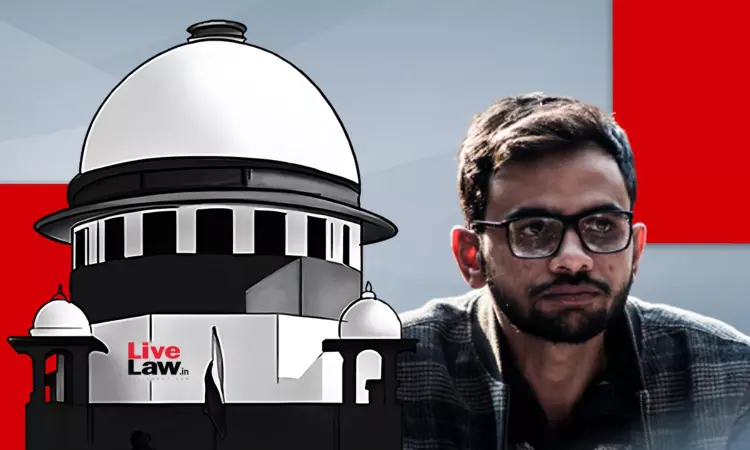
Former JNU scholar Umar Khalid has moved the Supreme Court seeking bail in the 2020 Delhi riots larger conspiracy case after the Delhi High Court denied him bail recently. He has submitted that the Supreme Court's one-year embargo imposed on the grant of bail was to expire soon. He also said that the other condition imposed by the Court for examination of protected witnesses by the prosecution cannot possibly be completed by January 5, 2027. Therefore, in light of prolonged incarceration, he be granted bail, the plea urged.
It may be recalled that on January 5, 2026, a bench comprising Justice Aravind Kumar and Justice NV Anjaria denied bail to Imam and former JNU scholar Khalid, calling them "ideological drivers" of the larger conspiracy. It, however, granted bail to five other accused persons, including Gulfisha Fatima, by distinguishing the roles played by them in the alleged conspiracy.
While denying bail, the Court imposed a one-year embargo on the grant of bail and stated that Imam and Khalid can approach the Court upon the completion of protected witnesses' examination or upon expiry of 1 year from passing the order, "whichever is earlier".


On September 30, a division bench of the Delhi High Court comprising Justice Prathiba M Singh and Justice Dinesh Bhatt denied bail on grounds that it can't modify the Supreme Court's order.
Khalid has stated that since the charges are yet to be framed and the prosecution has failed to examine witness, the Supreme Court's condition "whichever is earlier" can't be expected to take place within the outer limit of January 5, 2027.
The accused has also relied upon Justice Aravind Kumar's May 22 order referring the matter to larger bench on the "perceived conflict" among different benches of the Supreme Court in its interpretation of the KA Najeeb judgment, which held that a long period of incarceration can melt down the rigours of stringent bail provisions under UAPA.
The conflict occurred after a two-judge bench comprising Justice BV Nagarathna and Justice Ujjal Bhuyan in Syed Ifthikar Andrabi criticised the Gulfisha Fatima judgment for taking a narrow view regarding bail in UAPA by diluting the verdict of Najeeb.
Considering the reservations expressed by Justice Nagarathna's bench, Justice Kumar's bench referred the matter to a larger bench while granting interim bail to co-accused Tasleem Ahmed and Khalid Saifi for six months.
While granting bail to Tasleem Ahmed and Khalid Saifi , the Court noted: "Having said so, we cannot lose sight of the fact that the present appellants have undergone substantial incarceration; that the trial is not likely to conclude immediately; that the appellants themselves have invoked the principle of calibrated constitutional discretion recognised in Gulfisha Fatima; and that the determination of the issues may consume further time. The appellants cannot be made to suffer continued incarceration merely because an important question of law has arisen for authoritative settlement. Without expressing any opinion on merits, and subject to stringent safeguards, we are inclined to grant interim bail to the appellants pending further orders.”
These findings on prolonged incarceration and the impossibility of conclusion of trial in the near future have been relied upon by Khalid to argue that this is a fit case for violation of speedy trial.
FIR 59 of 2020 is being probed by Delhi Police's Special Cell. The case has been registered under various offences under the Indian Penal Code, 1860 and the Unlawful Activities (Prevention) Act, 1967.
The accused in the case are Tahir Hussain, Umar Khalid, Khalid Saifi, Isharat Jahan, Meeran Haider, Gulfisha Fatima, Shifa-Ur-Rehman, Asif Iqbal Tanha, Shadab Ahmed, Tasleem Ahmed, Saleem Malik, Mohd. Saleem Khan, Athar Khan, Safoora Zargar, Sharjeel Imam, Faizan Khan and Natasha Narwal.