



- Home
- /
- Top Stories
- /
- WB SIR | Appeals May Take Time, But...
WB SIR | Appeals May Take Time, But Can't Order Interim Inclusion Of Deleted Voters Just Because They're Earlier Mapped: Supreme Court
Amisha Shrivastava
7 April 2026 6:31 AM IST
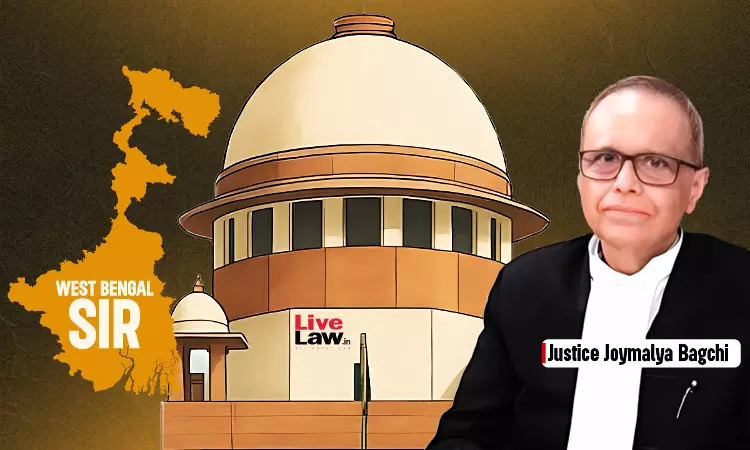
The Court said that appeals cannot be rushed and interim inclusion cannot be allowed merely because voters were earlier mapped.
The Supreme Court today declined to permit the interim inclusion of voters, who failed verification by judicial officers during the Special Intensive Revision (SIR) of electoral rolls in West Bengal, when their appeals are pending.Justice Joymalya Bagchi said that the appellate process may take some time but the Court cannot allow inclusion of some persons on that basis merely because...
This is a premium content
Available exclusively to
Our subscribers
Subscribe Premium 
INR 1099+GST
Your support helps us to bring you more content at
an affordable subscription scheme !!!
All payment options available
The Supreme Court today declined to permit the interim inclusion of voters, who failed verification by judicial officers during the Special Intensive Revision (SIR) of electoral rolls in West Bengal, when their appeals are pending.
Justice Joymalya Bagchi said that the appellate process may take some time but the Court cannot allow inclusion of some persons on that basis merely because they appeared in the 2002 roll.
“Persons aggrieved are entitled to file an appeal. Appellate authorities will formulate a fair procedure and natural justice is followed and the final order is passed. That may take a month, that may even take 60 days. We cannot on that contemplation allow some people because they were earlier mapped”, he said.
A bench of Chief Justice of India Surya Kant, Justice Joymalya Bagchi, Justice Vipul Pancholi, was dealing with the batch of pleas challenging the Special Intensive Revision of electoral roll of West Bengal ahead of the upcoming Assembly elections.
On February 20, the Court directed deployment of judicial officers to adjudicate claims and objections relating to inclusion and exclusion of voters, noting a “trust deficit” between the two constitutional authorities. On February 28, the final voter list of West Bengal was published, with about 63 lakh names deleted. Over 60 lakh names were said to be under adjudication.
Subsequently, on March 10, the Court directed constitution of appellate tribunals comprising former High Court Chief Justices and judges to hear appeals against decisions of these judicial officers, in view of the absence of an independent appellate mechanism.
Senior Advocate Shyam Divan for the State Chief Minister Mamata Banerjee submitted that out of these 60 lakh cases, data for 44 lakh cases was available. He said the inclusion rate was about 55%, amounting to 24 lakh persons, while the exclusion rate was about 45%, amounting to 20 lakh persons. He said the rejection rate appeared high despite judicial safeguards and stressed that these were individuals who had been in the voter list in 2002.
Divan told the Court that out of the 20 lakh deleted electors, 7 lakh had already filed appeals and several lakh appeals were in the process of being filed. He pointed out that although appellate tribunals were notified on March 10, they had not become fully operational and only a few cases had been taken up so far.
Thus, he suggested that appellate tribunals be directed to dispose of all appeals by April 15, 2026 so that the final supplementary electoral roll could be published by April 18, 2026, five days before polling. He further urged that in cases where appeals remain pending beyond April 15, such voters should be allowed to be included in the rolls to avoid disenfranchisement.
Senior Advocate Kapil Sibal supported the request and suggested that appellate tribunals be given the power to pass interim orders in cases where a prima facie case is made out. He illustrated that a prima facie case can be made out if the deleted voter has a passport.
However, Justice Bagchi observed that there cannot be an interim relief in such cases. He said the verification had already been done at the first instance by the judicial officers and the process now had to be frozen at a certain point. He said that that while supplementary electoral rolls would include those cleared during verification, appellate tribunals would continue to hear appeals separately. He said that the appeal process should not be rushed.
“ECI was flagging very peculiar discrepancies. We needed to have a first instance adjudication, rather verification. That verification is done. Now the last day of nomination, if the verification of all the logical discrepancy is done, we will allow those who have been given the nod to be incorporated in the supplementary list. But the tribunals will go on hearing (appeals). That we do not rush these exercises”, he said.
Divan contended that the tribunal mechanism should not be rendered ineffective by not allowing a supplementary voter list after appeals are adjudicated.
However, the Court declined to pass any order on this issue, which the CJI responding, “We are completely silent on this issue. Let the tribunals evolve their own procedure.”
Also from the hearing - 'Serious Allegations Against State Police' : Supreme Court Directs NIA To Investigate Judges' Gherao During West Bengal SIR
Case no. – W.P.(C) No. 1089/2025
Case Title – Mostari Banu v. Election Commission of India and Ors.
Tags

Amisha Shrivastava
Amisha Shrivastava is a Senior Correspondent with LiveLaw, covering the Supreme Court of India. She can be reached at amisha@livelaw.in

