'What Is This Scant Attitude To Court?' : Supreme Court Rebukes Centre For Non-Compliance On Welfare Of Disabled Military Cadets
Amisha Shrivastava
7 Oct 2026 4:11 PM IST
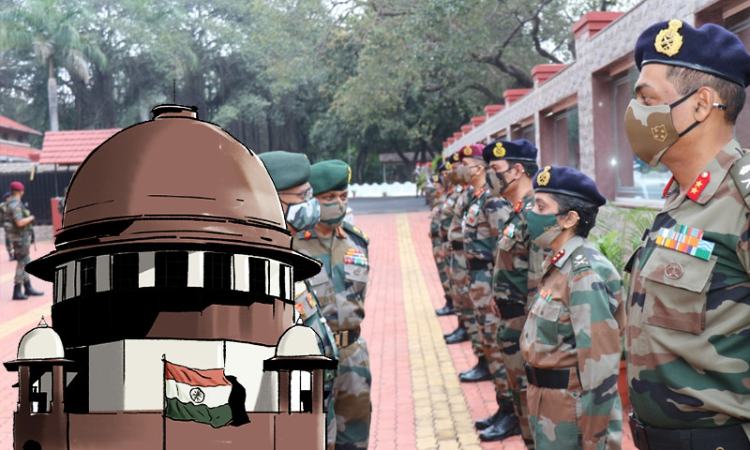
The Court pulled up the Centre for not complying with its order to freshly consider the recommendations to grant Ex-Serviceman status and disability pension to such boarded out cadets.
The Supreme Court on Tuesday strongly criticized the Union government for failing to comply with its earlier directions to reconsider welfare measures for officer cadets boarded out of military training due to injuries or disabilities.
A bench of Justice BV Nagarathna, Justice R Mahadevan and Justice DK Upadhyaya was hearing the suo motu case concerning the plight of such cadets. The Court expressed sharp dissatisfaction over the Centre's affidavit, noting that there had been no genuine reconsideration of the recommendations of the 2015 Sabharwal Committee report despite clear directions issued on August 4, 2026.
The recommendations included granting Ex-Serviceman status and disability pension to such boarded out cadets. The Union had in 2022 rejected these recommendations.
“What is this scant attitude you are showing to the court? You say we disposed it of in 2022 and there ends the matter. What is the attitude on the part of the department?” Justice Nagarathna observed during the hearing.
The bench pointed out that the Centre's affidavit merely referred to meetings held in 2022 and extracted earlier decisions rejecting disability pension and ex-servicemen (ESM) status for out-boarded officer cadets. There was “no whisper” that the Sabharwal Committee recommendations had been reconsidered in light of the court's intervention, the judges said.


Justice Mahadevan noted that one of the key recommendations relating to disability pension had not been revisited after the August 4 order. “Pursuant to our 4th August direction, there is no reconsideration,” he said.
The Court observed that ordinary recruits who are boarded out receive disability pension and other benefits, while officer cadets - whose numbers are relatively small (around 400 over many years, or roughly 40 per year) - are denied similar treatment. Amicus Curiae Senior Advocate Rekha Palli highlighted this disparity and submitted that the cadets were seeking parity.
The Centre, represented by Additional Solicitor General Aishwarya Bhati, maintained its long-standing position that granting ESM status or disability pension at officer rates was not feasible under existing policy. It informed the court that the 8th Central Pay Commission would examine the pension issue.
On skill development, Additional Solicitor General Venkatraman told the court that the government has proposed 8-10 week job-oriented courses through the Directorate General of Resettlement, covering areas such as cyber security, logistics, data analytics and technical trades. However, he clarified that it would not guarantee employment after the courses.
Justice Nagarathna pressed the Centre to at least cover educational expenses for diploma-level courses to improve future employment prospects.
"At least educational expenses must be provided...We are not saying you provide them a graduate course, at least educational expenses for a diploma course can be provided if they want to have any future employment."
Venkatraman undertook to seek instructions on this point.
In its order, the bench recorded that the August 4 direction to reconsider the Sabharwal Committee recommendations in a favourable light had not been complied with. Giving the government one more opportunity, the court directed it to hold a proper meeting, reconsider the recommendations, and place the minutes on record. It warned that non-compliance could lead to adverse orders, including a possible mandamus.
The amicus was asked to identify the specific benefits currently extended to boarded-out recruit soldiers so that comparable facilities for officer cadets could be examined. Justice Nagarathna reiterated that the court did not wish to issue a mandamus at this stage and urged the ASG to impress upon the department the need for a more responsive approach.
The matter relates to cadets discharged from institutions such as the National Defence Academy, Indian Military Academy and Officers Training Academy after sustaining disabilities during training. Many of them, particularly those with less than 40% benchmark disability, fall outside the full protection of the Rights of Persons with Disabilities Act, 2016. The suo motu proceedings were initiated to address their lack of status, pensionary benefits, and rehabilitation support.
What did the Court's August 4 order say?
In its order dated August 4, 2026, the Court, among other things, directed the respondent departments to reconsider the recommendations made by the Sabharwal Committee in its report, in light of the fact that the issue was before the Supreme Court, “in order to ameliorate the conditions of the outboarded cadets”.
The Court expressly stated that it “expect[ed] that certain favourable recommendations would be emanating from the respondent-Departments in this regard.”
The Court also appreciated the extension of lifelong ECHS benefits and medical cover to invalidated cadets as a “laudable measure”, while noting the disparity in monthly disability/ex-gratia payments, with officer cadets receiving ₹12,240 plus DA as against ₹18,000 for jawan recruits, and left the issue for consideration by the Eighth Pay Commission.
It further observed that the Rights of Persons with Disabilities Act, 2016 may not fully apply to cadets with less than 40% benchmark disability and directed the Centre to formulate a suitable welfare scheme for them. The Court held that outboarded cadets with benchmark disabilities are entitled to the 4% reservation under Section 34 of the Act. It also directed all States and Union Territories to consider granting reservation to such cadets under the “Ex-Military Personnel (Ex-MP)” quota, independently of the DoPT definition of “ex-servicemen”, and directed the Registry to circulate the order to all Chief Secretaries.