



Women Lawyers Must Have 1/3rd Representation On Government Panels : Justice BV Nagarathna
LIVELAW NEWS NETWORK
21 Nov 2026 12:03 PM IST
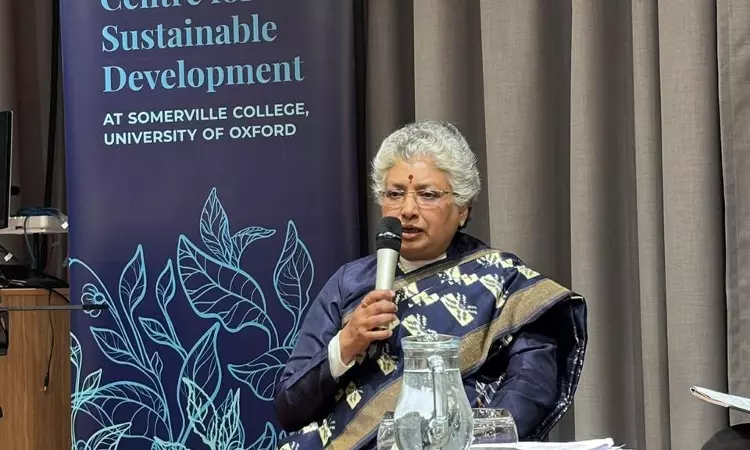
"Every girl child must have the right to be born and the right to pursue her choices, of course, in accordance with law. It is then only that Articles 14 and 15 would be more meaningful and have relevance for women of India," she said.
Supreme Court Judge Justice BV Nagarathna has called for ensuring one-third representation for women lawyers on government panels, including those representing public sector undertakings and providing legal aid, stressing that women's participation in the legal profession must extend beyond entry to opportunities for professional advancement and institutional leadership.
Delivering the inaugural Cornelia Sorabji Memorial Lecture at Somerville College, University of Oxford, on November 18, Justice Nagarathna said that if women were to participate equally in the administration of justice, their representation must extend to opportunities to represent the State, advise public institutions and participate in the exercise of legal authority.
"I have consistently advocated for one-third reservation for women lawyers on government panels, including those representing public sector undertakings and in the sphere of legal aid," she said.
Emphasising that the constitutional principle of meaningful representation must also inform the legal profession, she said:
"The door of the legal profession must, after all, remain open not only to entry, but to professional advancement and institutional leadership."


Justice Nagarathna drew a parallel with constitutional provisions providing for reservation of seats for women in local self-government institutions and the Constitution (106th Amendment) Act, 2023, which provides for women's reservation in the Lok Sabha and State Legislative Assemblies.
She observed that the 73rd and 74th Constitutional Amendments had reserved not less than one-third of seats for women in Village Panchayats and Municipalities, while Karnataka had provided for not less than one-half of the seats to be reserved for women.
These developments, she said, reflected an important constitutional insight that where historical exclusion had shaped the composition of institutions, formal equality alone might not be sufficient to secure meaningful representation.
"The same principle must inform the legal profession," she said.
The lecture, titled "The Doors She Opened: Cornelia Sorabji and the Progress of Women's Rights in India", examined the historical evolution of women's rights in India, tracing the journey from a colonial legal system in which women's rights were frequently mediated through family, custom and community to a constitutional framework recognising women as equal bearers of rights.
Cornelia Sorabji's struggle to enter the legal profession
Beginning her address by recalling the life and achievements of Cornelia Sorabji, Justice Nagarathna described her as a pioneering figure whose struggle illustrated the barriers women faced in accessing education and professional recognition.
Sorabji arrived at Somerville College in 1889 to study law, becoming the first woman to read law at Oxford and the first Indian woman to study at a British university. Despite passing her examinations in 1892, she could not receive the degree she had earned because Oxford did not then confer degrees upon women. She received her degree only in 1922, three decades later, when the university finally permitted women to graduate.
Her difficulties continued in India. Justice Nagarathna recalled that in 1916, the Calcutta High Court rejected Regina Guha's application for enrolment as a pleader, holding that the prevailing Legal Practitioners Act, 1879, did not permit women to enter the profession.
The position was eventually changed through legislative intervention, culminating in the Legal Practitioners (Women) Act, 1923, which removed the statutory barrier based on sex. Sorabji subsequently became the first woman vakil in India.
Justice Nagarathna said Sorabji's life demonstrated how a system could recognise a woman's academic ability while simultaneously restricting her professional standing.
She acknowledged Sorabji's contribution in providing legal assistance to vulnerable women, particularly pardanashin women, whose circumstances often prevented them from accessing legal institutions.
From formal equality to substantive equality
Referring to the Constituent Assembly, she recalled that fifteen women were members of the Assembly, including Hansa Mehta, Rajkumari Amrit Kaur, Durgabai Deshmukh, Dakshayani Velayudhan and Sarojini Naidu.
Their contributions, she said, deserved to be restored to the centre of constitutional history.
Justice Nagarathna particularly recalled Hansa Mehta's observation that the presence of a few distinguished women in public life could not represent the actual position of the average Indian woman.
She said the constitutional commitment to equality, reflected in Articles 14 and 21 and the Directive Principles of State Policy, had to be understood in terms of substantive equality.
For women, discrimination frequently operated within families, workplaces, educational institutions and professional organisations. The transformative potential of the Constitution lay in its ability to challenge the conditions through which such inequality was maintained.
Supreme Court's evolving jurisprudence on women's rights
Justice Nagarathna also traced the evolution of the Supreme Court's approach to gender equality through several landmark judgments.
Referring to Air India v. Nergesh Meerza (1981), she discussed the service regulations that required air hostesses to retire at 35 years, provided for termination upon marriage within the first four years of service and also provided for termination upon their first pregnancy. The Court struck down automatic termination upon first pregnancy as arbitrary under Article 14, although other discriminatory conditions remained.
She contrasted this with C.B. Muthamma v. Union of India (1979), in which the Supreme Court questioned service rules that discriminated against women on account of marriage and domestic responsibilities.
She also referred to Githa Hariharan v. Reserve Bank of India (1999), in which the Court interpreted the Hindu Minority and Guardianship Act to address the discriminatory position that recognised the father as the natural guardian of a minor child and the mother only "after him".
Discussing the transition towards substantive equality, Justice Nagarathna highlighted Shah Bano (1985), Vishaka v. State of Rajasthan (1997) and Anuj Garg v. Hotel Association of India (2008).
She described Vishaka as an important example of how judicial intervention, in the absence of legislation, could establish enforceable workplace protections. The guidelines laid down by the Supreme Court against sexual harassment continued until Parliament enacted the Sexual Harassment of Women at Workplace Act, 2013.
In Anuj Garg, the Court challenged protective paternalism by striking down restrictions on women's employment in establishments serving liquor, observing that restrictions imposed in the name of protecting women could themselves violate constitutional equality.
Justice Nagarathna also referred to Association of Old Settlers of Sikkim v. Union of India (2023), a judgment authored by her, in which the Supreme Court struck down a discriminatory tax exemption provision that denied certain benefits to Sikkimese women marrying non-Sikkimese men.
She said the judgment rejected the premise that a woman's marital choice could alter her legal identity and entitlements.
Equality must extend throughout an institutional career
She referred to Secretary, Ministry of Defence v. Babita Puniya (2020), which directed that women officers be considered for Permanent Commissions in the eligible streams on terms comparable to those applicable to male officers, and Union of India v. Annie Nagaraja (2020), concerning women officers in the Indian Navy.
She also discussed Lt. Col. Nitisha v. Union of India (2021), in which the Supreme Court found systemic discrimination in the assessment process for women officers seeking Permanent Commissions.
These judgments, she said, demonstrated that institutional exclusion could operate not merely through express prohibitions but also through selection practices, career structures and standards designed without considering the effects of historical disadvantage.
The same reasoning, according to Justice Nagarathna, must inform the legal profession, where women must have opportunities not merely to enter the profession but also to advance within it and occupy positions of institutional leadership.
Concluding her address, Justice Nagarathna said that while Cornelia Sorabji had opened doors through her struggle against exclusion, the responsibility of ensuring that those doors remained open rested with subsequent generations.
She said legislatures, courts, public institutions, civil society and citizens all had a responsibility to ensure that constitutional guarantees translated into meaningful equality.


