



- Home
- /
- Top Stories
- /
- Attempt By JPC To Meet Supreme...
Attempt By JPC To Meet Supreme Court Judges Was 'Shocking': Former SC Judges
Gursimran Kaur Bakshi
4 Oct 2026 9:54 AM IST
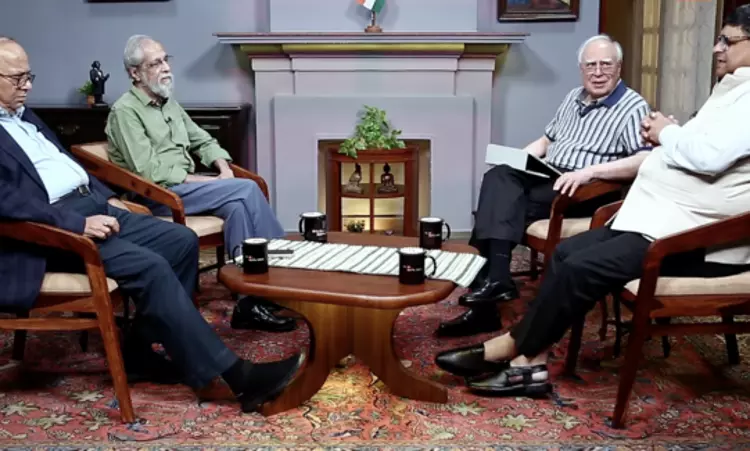
Former judges of the Supreme Court criticised the now-cancelled meeting of the Lok Sabha Joint Parliamentary Committee(JPC) on 'One Nation, One Election' with the Chief Justice of India and other Supreme Court judges as being against the tenets of separation of powers.The former judges questioned why the Supreme Court agreed to an "informal discussion" on the Constitution (One Hundred...
This is a premium content
Available exclusively to
Our subscribers
Subscribe Premium 
INR 1099+GST
Your support helps us to bring you more content at
an affordable subscription scheme !!!
All payment options available
Former judges of the Supreme Court criticised the now-cancelled meeting of the Lok Sabha Joint Parliamentary Committee(JPC) on 'One Nation, One Election' with the Chief Justice of India and other Supreme Court judges as being against the tenets of separation of powers.
The former judges questioned why the Supreme Court agreed to an "informal discussion" on the Constitution (One Hundred and Twenty-Ninth Amendment) Bill, 2024, and the Union Territories Laws (Amendment) Bill, 2024, when it will have to deal with its constitutionality later.
Justices Madan B. Lokur, Sudhanshu Dhulia, and A.K. Patnaik spoke in the episode of the'Dil Se' show, hosted by Senior Advocate Kapil Sibal, where significant issues were raised regarding the JPC's proposed visit. Notably, Sibal had revealed the proposed visit of the JPC on October 1 via a press conference. Hours later, the meet was called off because the Supreme Court declined.
Speaking on this, Justice Patnaik commented that pre-legislative discussions with the judiciary raise significant questions on the separation of powers.
He said: "There is separation of powers in our Constitution. As you rightly said, Parliament can make the law whatever it thinks should be proper, and those laws will be tested when challenged before the Supreme Court. So, if Parliament, before making a law or its Committee, starts meeting the judges to explain what the law is, that means a litigant is almost going and telling the Courts what their case is. That is not permissible. That will not just affect the separation of powers but also the independence of the judiciary."
On the other hand, Justice Lokur questioned the very reason behind the Supreme Court allowing such a visit. "Everyone knows, especially the Supreme Court, that 'One Nation, One Election' is going to be challenged someday...According to me, it's shocking from both sides that JPC said that they wanted to have an informal discussion. JPC, including the legislators, know that this is going to be challenged before the Supreme Court. And how did the Supreme Court permit the JPC's visit?"
He stated that it can't be presumed that the JPC decided to visit the Supreme Court without the top Court's knowledge, because the October 6 visit must have been decided in agreement with the top Court. However, he left it open for discussion as to whether the schedule was set in consultation with the CJI alone or with senior judges as well.
Agreeing to this, Justice Dhulia added that the judiciary is bestowed with the duty to uphold the checks and balances, including the excesses committed by the legislature and the executive. "It is only the power that can check other powers because it's very difficult for the people to check power all the time. So the executive power can only be checked by the judiciary."
Sibal revealed that many judges were not even aware that a Parliamentary delegation was proposing to visit the Supreme Court. To this, Justice Patnaik said: "When the Chief Justice sits, only one occasion he consults, that is, the morning assembly. He sits with the collegium of the senior judges and then the entire assembly. If he has anything to put, he puts...So these kinds of proposals are given in full assembly, but whether this was given or not, I don't know."
No reason why politicians should meet judges outside formal settings
Justice Patnaik stated that other than formal settings, there is no reason why the judiciary and the executive should meet and greet.
The former judge revealed that for his son's wedding, he didn't invite a single politician despite the fact that his family is very close to Naveen Patnaik, former CM of Odisha. "Naveen Patnaik is known to my family long back. I had to send a card and tell him, 'Please don't come; it will send a very bad message'. But these days, whenever I go to any marriage happening in a judge's family, all the politicians are there."
Quoting the 1997 Restatement of Values of Judicial Life and 2001 Bangalore Principles of Judicial Conduct, Lokur added: "If judges meet ministers, or go abroad, or meet at a party, it sends a wrong signal. It shouldn't happen. Bangalore principles apply across nations," he added.
Justice Dhulia interestingly referred to one incident of a formal dinner hosted by the then Prime Minister when Justice M. N. Venkatachaliah became the Chief Justice of India.
Quoting the book titled 'Justice MN Venkatachaliah, the Man and the Judge' by V. Sudhish Pai, he said: "He tells about an incident when Justice Venkatachaliah became the Chief Justice; the PM Narasimha Rao said to him, 'Now that you have become the CJI, our relationship should be cordial. So, Justice Venkatachaliah said, 'That's the last thing we can have. Our relationship can't be cordial because it sends the wrong signal for our democracy. Our relationship is going to be correct and proper, and I will ensure it."
Tags
Gursimran Kaur Bakshi
Gursimran is the Principal Correspondent with LiveLaw for the Supreme Court. She can be reached out at: simrankaurbakshi@livelaw.in

