


Articles

Review: Report on the working of Wildlife Protection Act, 1972 by Criminal Justice and Police Accountability Project
In September 2022, the Government of India brought a group of eight big cats/cheetahs from Namibia to Kuno National Park in Madhya Pradesh. Amidst the celebrations of this project, what went unnoticed was the displacement of Adivasis and other similarly marginalized communities from Bagcha village, surrounding the park. Due to this ambitious project, the Sahariya Adviasis (a particularly vulnerable tribal group) of the village have been forced to ‘relocate’, disrupting their livelihood and life....
Application Of Doctrine Of Repugnancy On Delegated Legislation
The relationship between the Parliament and the State Legislatures is demarcated in Chapter I of Part XI of the Constitution. Article 246, read with Schedule 7, deals with the subject matter of laws on which the Parliament and the State Legislatures can enact a law. Parliament and the State Legislatures are empowered to enact the laws on the subject matter provided in the Union List and State List, respectively. Parliament and the State Legislatures have concurrent power to enact laws on...
Renewable Energy Certificates – A New Dawn Or Just A False Positive?
The Renewable Energy market is booming because of its vitality and utility every which way be it ethically, morally or economically. India has been highly ambitious in declaring its Nationally Determined Contributions (NDCs) under the UNFCCC and Paris Agreement. It has been committed towards limiting its carbon footprint and switching towards cleaner and greener sources of energy. India has been ambitiously enhancing its NDCs which clearly demonstrates its commitment at the highest level...
Right To Shelter Can't Be Unconditionally Taken Away : How Supreme Court Stalled Unconstitutional Evictions In Haldwani
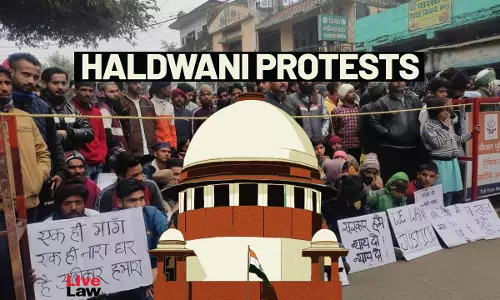
In India, the right to shelter has been one of the most controversial rights, because neither they are fully guaranteed nor the rehabilitation policies are very well implemented by the government. Right to shelter also serves as the basic unit of human settlements and as an Indicator of the duality of life of a city or a country's inhabitants. It reflects, among other things, the mobilization of resources and the distribution of space, as well as varied social and organizational aspects of the...
Conflicting Judgements Of Coordinate Benches
This article deals with the following issues in relation to coordinate bench judgments: law in relation to the conflicting judgments passed by the coordinate benches;recourse available to the latter coordinate bench; andconundrum which a lower court faces when conflicting judgments of co-equal benches are relied upon by the litigants before a lower court. What Is A Coordinate Or Co-Equal Bench? The term ‘coordinate bench’ or ‘co-equal bench’ is used with respect to...

Residential Status Of Firm And Company
The Income Tax Act, 1961 places a lot of importance on "Residential Status" because it has a significant impact on the calculation or ascertainment of tax liability. An Assessee is either (a) an Indian Resident or (b) not an Indian Resident.Individuals who are residents and HUFs may be either (a) Residents who are usual Residents or (b) Residents who are not usual Residents. Both Residents and Non-residents are the other Assessees.Residents of India and Non-Residents of India are the two...

The English-Driven, Exclusivist Nature Of The Common Law Admission Test (CLAT)
A position of power and privilege for an individual or institution tends to lend its own perspective of viewing the world. It is, more often than not, a tunnel vision which unquestioningly views the surrounding as ‘normal’ and ‘obvious’ and stays in the dark from recognizing the layers of inequality and oppression present within our society. The recently concluded Common Law Admission Test (CLAT) exists in the same darkness with a mode of testing which solely operates in the English...

Institutional Arbitration – Breaking The Deadlock In Small-Value Lending Disputes
A commercial court in Delhi recently rejected an application to enforce an arbitral award due to unilateral appointment of the sole arbitrator in the dispute. For the uninitiated, arbitration is an out-of-court process where, after hearing the parties, the arbitrator renders the decision in the form of an arbitral award. Unilateral appointment is the appointment of an arbitrator by an interested party to the dispute. In its decision, the court considered various factors including the...
Federal Disputes And Original Jurisdiction Of Supreme Court Of India
Federal polities or federal countries are ones which have different levels of State agencies (such as legislature, executive and judiciary). By levels what has to be understood is that there are different levels and authorities of governance at the federal/national, state and/or local levels.India is a federal (sometimes quasi-federal) country having governance/state authorities at the federal/national, state and local levels. It is often the case that such federal units (such as: federal/union...

Year End Review : Supreme Court's Highs & Lows In 2022
Sixty two year old Mohammad Qamir, who had been languishing in a detention centre since 2015 after being caught up in the legal cobwebs relating to citizenship, got freedom only due to an innovative and proactive intervention made by the Supreme Court. Though born in India in 1959, he had gone to Pakistan as a child along with his mother in 1967 to meet his relatives. He later returned to India in his late twenties. As an adult, he married and settled in India. Several years later, in 2011, he...
Shipping Industry – A Complex Saga
Taxability of shipping industry has always been tricky and complex saga comparing to other service industry. To understand the tax implication of Shipping Industry, it is pertinent to understand the revenue model of shipping industry.It is often seen that exporters have approached Freight Forwarding Agency or Shipping Agency to move their goods either from their place of business or from Port of lading to the Port of Destination located outside the geographical location of India, in short in the...
Simplification Of Voluntary Liquidation In India
Before the introduction of Insolvency and Bankruptcy Code (“IBC”) in 2016, there were multiple overlapping statutes to govern the insolvency proceedings like Sick Industrial Companies, Act, 1985, Provincial Insolvency Act, 1920, Code of Civil Procedure, 1908, and SARFAESI Act, 2002, all these legislations apparently failed to address the bankruptcy issues. So, the Government of India in 2016 introduced IBC to improve the insolvency and bankruptcy process and to alleviate the distressed credit...