


Articles
![Solid Waste [Mis]Management-NGT Directions Remain In Paper](https://www.livelaw.in/cms/wp-content/uploads/2017/03/Solid-Waste-Management.jpg "Solid Waste [Mis]Management-NGT Directions Remain In Paper")
Solid Waste [Mis]Management-NGT Directions Remain In Paper
Mahatma Gandhi had famously said – “Sanitation is more important than independence”. When he remarked this, he was only underlining the immense priority he gave to cleanliness in civic life signifying his dream of total sanitation for all. His perception of cleanliness was more holistic in nature, where he strongly emphasized on physical well being and a healthy environment.Collection of garbage annually in India is astronomical. India needs at least 1,240 hectares of land to fill the untreated...
SC Ruling On Strict Interpretation Of Ambiguous Tax Exemption-Advantage Revenue
A “Constitution Bench” (five Judges) of the Hon’ble Supreme Court of India set up via a reference in the recently decided matter of Commissioner of Customs (Import), Mumbai v. M/S. Dilip Kumar And Company , dated 30 July 2018, has emphatically adjudicated in revenue’s favor, with respect to the applicable principles of law for statutory interpretation of (taxation) exemption notifications/clauses after framing the terms of reference as follows -“what is the interpretative rule to be applied...
'One Nation,One Poll'- Good Economics Need Not Be Good Policy
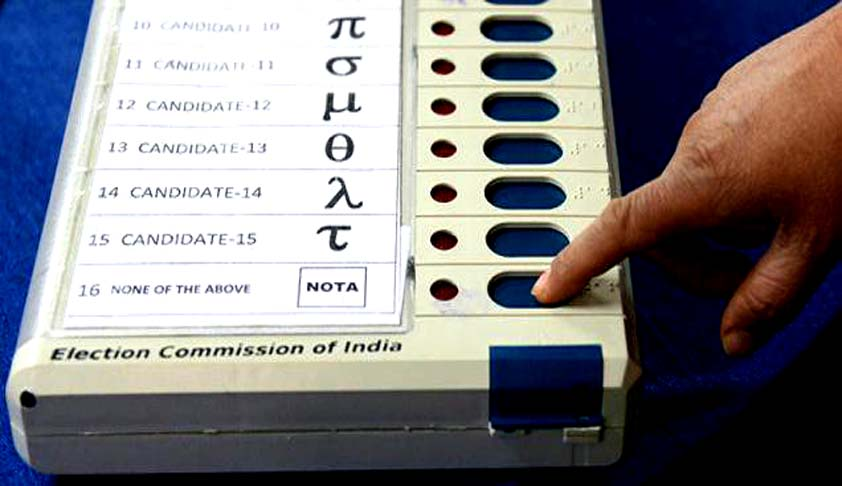
“The proposal is designed to favour majoritarian politics and centralization of power, and will give room for manipulation of election results through high-voltage campaigns buoyed by money power, and will cut at the root of healthy democratic conventions”.The Law Commission of India(LCI) has favoured the idea of “one nation one poll” and has recommended necessary amendments in Constitution and statutory law to bring in ‘simultaneous elections’. The concept of ‘simultaneous elections’, envisages...

Phone-Tapping And Recording Of A Phone Conversation By A Private Party: Issues Relating To Legality And Admissibility
“Who are you? Why do you hide in the darkness and listen to my private thoughts?” [1]Is Privacy history? The sheer number of court trials where a telephone recording is sought to be used by either party as evidence, suggest that private thoughts are not private anymore. Use of such recordings in court cases has risen enormously in the recent past. In this background, the Authors examine the very legality of the act of recording of a phone conversation by a private party to the conversation,...
Exploring The Law Of Unjust Enrichment In India
The principle of unjust enrichment is an underlining principle behind a plethora of daily orders and judgments of our judiciary. Though the principle may not be tagged specifically by our Courts in each case, its adaptation has found wide usage in our judiciary to bring justice and uphold the pillars of equity.What is the principle of Unjust Enrichment?A person who has obtained a benefit at the expense of another should be liable to restitute the other from whom he has gained. This field of law...
Satyameva Jayate- Nanritam; Truth Alone Triumphs- Not False Hood
‘Satyameva Jayate,’ (Truth Alone Triumphs) is part of the first stanza of Shloka 3.1.6 of Mundakopanishad[1]. Satyameva Jayate was adopted as the motto of the Nation, on India becoming a Republic on 26.1.1950. Mahamana Pandit Madan Mohan Malaviya, during his second term as the president of the Indian National Congress in 1918, chose the slogan ‘Satyameva Jayate’. The choice of the slogan ‘Satyameva Jayate’ might have been to counter the propaganda of the ruling British, who made efforts to...

One Year From Puttaswamy : Data Protection On The Touchstone Of SC Judgment
'The Data Protection Bill may be considered as one step in achieving the objective of optimal protection of privacy'Privacy has been given many definitions and connotations over the ages. In the Indian context, the momentous judgement of the Supreme Court in Justice K. S. Puttaswamy (Retd.) and Anr. vs Union Of India And Ors[1] is a remarkably concrete touchstone upon which developments that deals with privacy may be examined. The judgement affirms that privacy in India is a right that protects...

The Economy Behind Cybersecurity
The fight against cybercrime needs a comprehensive approach. Given that technical measures alone cannot prevent any crime, it is critical that law enforcement agencies investigate and prosecute cybercrime effectivelyCyber-attacks such as WannaCry and NotPetya, affected thousands of computers, disrupting businesses and public institutions around the world. Investigation of cybercrimes often has an international dimension, and it is an arduous task to identify and catch the culprits. However, the...

Online Registration Of FIRs- Need Of The Hour
FIR or first information report, means the information, by whomsoever given to the officer in charge of police station in relation to the commission of a cognizable offence and which is first in point of time, on the strength of which the investigation into that offence is commenced. It is the earliest report made to the police officer with a view to taking action in the matter, and its principal object from the point of view of the informant is to set the criminal law in motion. Such is the...
Data Theft And The Indian Criminal Law
A woman with her computer can steal more than a hundred women with guns[1]Data is the “new oil”, and has arguably replaced oil as the world’s most valuable resource. Internet and smartphones have made data ubiquitous, plentiful and more valuable than ever before. Other than the data voluntarily shared, every technological action leaves digital footprints, which are harvested by algorithm-wielding companies, to know more about us. The digital traces that one unwittingly leaves carry valuable...
Private Sector (Commercial Organisations) Brought Under The Net Of Indian Anti-Corruption Law
India has a long history when it comes to regulation of corruption, commencing from the enactment of the Criminal Law (Amendment) Ordinance, 1944 under the Government of India Act, 1935. The first consolidated law in independent India was the Prevention of Corruption Act, 1947. The 1947 Act was replaced with the Prevention of Corruption Act, 1988 (PC Act) whereby the scope of the definition of a public servant was widened. The instant amendment that received the assent of the President on 26th...

Children’s Online Rights And Privacy: New Challenge
Children should have the right to privacy and protection of their personal online data. They should be educated, informed and empowered to protect their data The Internet is inherently public, but that doesn’t mean we give up our children’s rights to privacy and security. Kids as young as five already know how to download and play games and these days, we can find just about everyone on social networking sites. Every time a child posts a photo on social media browses for products or searches for...