




Articles
Fractured World Order: War Beyond Law and Lawlessness
Wars are often narrated as discrete events, bounded by geography and driven by immediate triggers. The ongoing conflict involving the United States, Israel and Iran resists such containment. What appears as a regional escalation is, in reality, a systemic disturbance, one that is simultaneously testing legal norms, economic structures and geopolitical alignments. Recent developments only reinforce this character: the conflict has expanded across multiple theatres, drawn in non-state actors and...
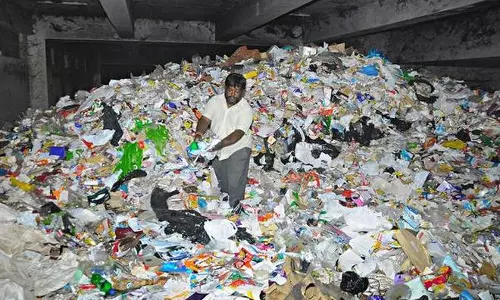
From Aspiration To Accountability: Plastic Waste Management (Amendment) Rules, 2026 And India's Evolving War On Plastic Pollution
On 31 March 2026, the Ministry of Environment, Forest and Climate Change (“MoEFCC”) notified the Plastic Waste Management (Amendment) Rules, 2026 (“2026 Amendment Rules”), vide notification G.S.R. 237(E), further amending the Plastic Waste Management Rules, 2016 (“Principal Rules”). The Rules came into force on the date of their publication in the Official Gazette, following the publication of a draft notification, G.S.R. 365(E), on 3 June 2025 and the consideration of representations received...

Law On Reels- Why Does The Show 'Chiraiya' Legally Matter To Women?
The marital contract The idea that marriage confers a blanket consent has long embedded the Indian law. Section 375 of the IPC which is now Section 63 (exception 2) of the Bharatiya Nyaya Sanhita, says that if a wife is over a certain age, a husband cannot be charged with rape. The JioHotstar show 'Chiraiya', which stars Divya Dutta, goes against this idea. The story follows Kamlesh, a woman who at first follows traditional rules, and her sister-in-law Pooja, who is forced to have sex by her...

The Unbroken Nib
When the state kills, who bears the weight, and why the death penalty must endThere is a moment near the end of Maamla Legal Hai Season 2 that stops being funny altogether. A Principal District Judge sits alone in his chamber, a case file open before him. He must decide whether another man should live or die. He signs the order. He awards the death penalty. And then, he does not break the nib.The breaking of the nib is not law. It appears in no statute, no schedule of the Constitution. It is...

Nazi Germany And Legal Ambiguity
Did you know there were laws similar to the Transgender Persons (Protection of Rights) Amendment Bill 2026 in Nazi Germany? Germany, as a democracy (roughly 1919 to 1933, after 1933 Hitler came into power), was known for its legal frameworks of queer rights of its time. This was also a result of Germany being home to one of the world's first “organized” queer rights movements (Wissenschaftlich-humanitäres Komitee), founded in 1897. In addition to this, it also was home to one of the world's...
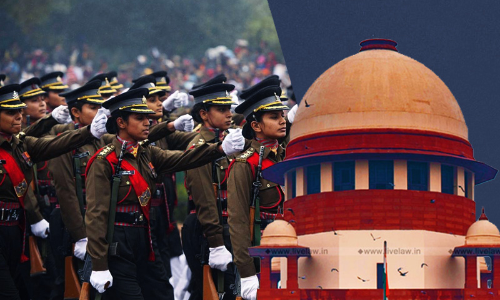
Swords, Stars And Equality: Supreme Court's Definitive Verdict On Women Officers And Long Arc Of Constitutional Justice
“It is not enough to proudly state that women officers are allowed to serve the nation in the Armed Forces when the true picture of their service conditions tells a different story.” These words, articulated by the Supreme Court in Lt. Col. Nitisha v. Union of India (2021), have long served as a mirror to the institutional soul of the Indian military. On March 24, 2026, that mirror finally reflected a finished portrait of justice. In a landmark decision that closes a twenty-three-year...
Insolvency And Bankruptcy Code (Amendment) Act, 2026 – Comprehensive Analysis
Executive Summary: The Insolvency and Bankruptcy Code (Amendment) Act, 2026 (enacted April 2026) implements a series of extensive reforms to India's corporate insolvency regime. Building on the IBC 2016 framework and prior amendments, the new Act introduces creditor-driven mechanisms (notably a Creditor-Initiated Insolvency Resolution Process, CIIRP), strengthens creditor and Committee of Creditors (CoC) powers, tightens timelines, and broadens scope (e.g. for group and cross-border insolvency)....

Much Ado About Rs.80/-
The move by Punjab Government to impose Rs.80 for downloading a FIR from its Sanjh Portal met with such a resistance that it had to be withdrawn no sooner than it was implemented. It was quite surprising that a small amount of Rs.80/- could have invited such an outrage from the social activists, Politicians and Advocates. State government tried to reason out by telling that this charge would...

Liability Without Accountability: Rethinking Space Debris Law After Iridium-Cosmos Collision
As a matter of fact, outer space is progressively experiencing congestion because of the increasing rate of launching satellites used in various operations ranging from communication, navigation to military activities. The phenomenon of space debris has emerged from the accumulation of inactive satellites, fragments, and other elements resulting from previous space accidents. For instance, in February 2009, the collision between Iridium 33, an operational U.S. communication satellite and Cosmos...

Artificial Intelligence And Competition Law: Can Algorithms Collude Without Human Intent?
The rapid growth of digital markets and the use of artificial intelligence in business decision-making have fundamentally transformed how firms compete. Pricing, product recommendations, advertising and matching of buyers and sellers are increasingly driven by algorithms rather than direct human decision-making. In this background, competition law faces a novel question: can algorithms used by competing firms collude or achieve cartel-like outcomes without any express human agreement or...
Regulating Intimacy Or Violating Privacy? A Constitutional Challenge To Mandatory Live-In Registration Under Gujarat Uniform Civil Code 2026
The Gujarat Uniform Civil Code, 2026 introduces a significant shift in India's regulation of personal relationships, particularly through its mandate on live-in relationship registration reflecting a shift from mere recognition to active State involvement in intimate matters. Although intended to protect vulnerable partners, particularly women, the measure raises an important constitutional question: can the State require disclosure of such personal relationships without infringing the right to...
Ending PMLA Procrastination: How 'Wherewithal' Test Reclaims Constitutional Liberty
For nearly a decade, Section 45 of the Prevention of Money Laundering Act, 2002 (PMLA) has been the primary site of a constitutional struggle in India. It is a place where the fundamental right to liberty frequently clashes with the State's interest in tackling systemic financial crime. The "Twin Conditions" of Section 45, which effectively require a court to be satisfied of an accused's innocence even before a trial has commenced, have created a legal landscape where bail is often viewed as a...