




Articles

What If Your Weight Could Make Your Holiday Illegal?
From Santorini to Shimla, the question is no longer just about holiday and travel, but about the invisible weight animals are forced to carry.On the steep stone paths of Santorini, something quietly radical has entered the tourism economy: a weighing scale. Since 2018, tourists over 100 kg (200 pounds) have not been allowed to ride donkeys, and no animal may carry more than one-fifth of its body weight. What seems like a minor inconvenience is, in fact, a profound legal shift. For decades,...

Digitising Justice: A Blockchain Blueprint For Resolving Land Acquisition Conflict
The shadow of judicial pendency in India is often cast longest by the complexities of land acquisition. As of early 2026, the National Judicial Data Grid (NJDG) reports a staggering backlog exceeding 92,000 cases in the Supreme Court alone, a significant portion of which involves civil disputes over the State's power of eminent domain. These legal marathons typically hinge on two pivots: the justification of the acquisition and the adequacy of the compensation. However, the path to de-clogging...

Tax Searches, Digital Data And Privacy Concerns
The Ministry of Finance has issued a notification on the Income-tax Rules, 2026 on March 20, 2026. The Rules will come into effect on April 1, 2026. The Rules were framed under the Income-tax Act, 2025, and they implement search and seizure powers provided in Section 247. As we approach a new system, an extension of search and seizure powers in the digital sphere sparks an...
Juridical Debates From Banerji To Nine-Judge Bench On 'Industry' Under Industrial Relations Law
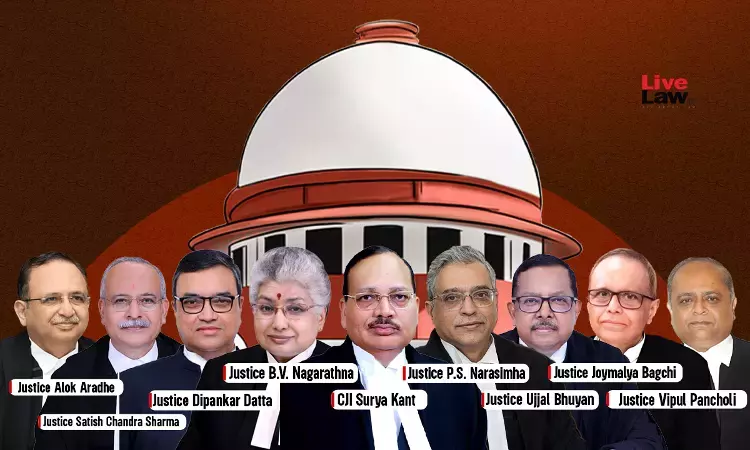
The seven decades old judicial debates on 'industry' under the Industrial Relations Law started with the interpretation of the definition Section 2 (j) of the Industrial Disputes Act, 1947. The first few years of interpretative battle was around the terminology 'undertaking' in the definition. After a 'zigzag' from broader to narrower interpretation, it settled over 'triple test' in Bangalore Water Supply and Sewerage Board v. A. Rajappa, (1978) 2 SCC 213. However, the inconclusive debate...

Why Supreme Court's Call For Statutory Paternity Leave Law Is A Major Step Forward
The arrival of a child is often described as one of life's most profound milestones. However, in India, the laws and social norms have long been focused towards the single narrative that childcare is almost exclusively the mother's responsibility. While our laws have made significant strides in protecting the rights of working mothers, the role of the father has remained largely invisible in our statutes. This long-standing imbalance has recently come under the judicial scanner. The Supreme...

Euthanasia & Morality Of Chosen Death
On March 11 2026, the Supreme Court in a historic first permitted a plea seeking passive euthanasia. Understandably, a question as fundamental as life and death and the extent to which human intervention may be permitted in altering the cycle of life is a polarizing one. It helps greatly if the legal thing to do corresponds with the moral thing to do. The question of euthanasia, like the question of capital punishment, produces moral discomfort in both the legislature and the judiciary. Since...
Constitutional Morality: Assault On Judicial Independence
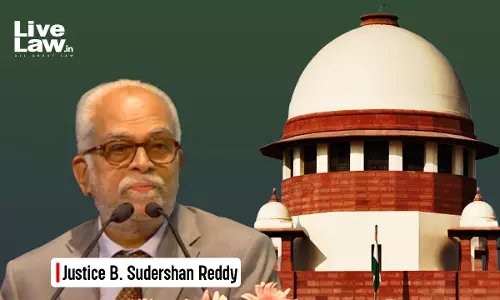
The Unjust Vilification of Justice B. Sudershan ReddyIs it an acceptable precedent in the world's largest democracy to brazenly brand a former judge of the Supreme Court an "Urban Naxal"? Can a constitutional adjudicator be subjected to a campaign of character assassination simply for discharging his judicial duties? When the Supreme Court of India strikes down a state policy as unconstitutional, is it justifiable for the Parliament or the Executive to categorically condemn the adjudicator?The...

Empowering SEBI: Case For Statutory Framework To Compensate Victims Of Corporate Fraud
The Securities and Exchange Board of India (SEBI) is the market regulator focused on protecting investor interests. However, its role in settling disputes between investors and companies is still debated. While SEBI regulates and enforces rules, it does not have a solid system for providing remedies that focus on investors.Since the Securities and Exchange Board of India Act was introduced in 1992, SEBI has slowly expanded its power over intermediaries and listed companies. However, it has not...

Identity Under Scrutiny
On March 25, Parliament passed the Transgender Persons (Protection of Rights) Amendment Bill, 2026 ("Bill"). Despite strong objections from the opposition, including a motion by DMK MP Tiruchi Siva to refer the Bill to a Select Committee, the Rajya Sabha nevertheless approved the Bill that very day.A decade ago, the Supreme Court in NALSA v. Union of India (2014), affirmed a simple but transformative principle: gender identity belongs to the individual, and the State cannot condition its...
Who Qualifies As Scheduled Caste?
The Supreme Court clarified the constitutional framework governing the Scheduled Caste Status; Conversion to any other religion other than Hindu, Sikh, and Buddhist would lead to loss of the benefits of the Scheduled CastesThe Story so farThe Supreme Court, recently in the case of Chinthada Anand v. State of Andhra Pradesh (March 2026), has decided a complex and constitutional question of who is entitled to be recognised as a Scheduled Caste. This question arose while deciding a criminal...
From Regulation To Expropriation: Draconian Provisions Of FCRA Amendment Bill, 2026
The preamble in Foreign Contribution (Regulation) Act of 2010 says that this Act is to regulate acceptance and utilisation of foreign contribution by individuals and associations. This Act provides reasonable mechanism to supervise and regulate foreign contributions to coming to India through individuals and associations. As per this Act, no person or association can accept foreign contribution unless such person obtains a certificate of registration from the central government. Thus only those...
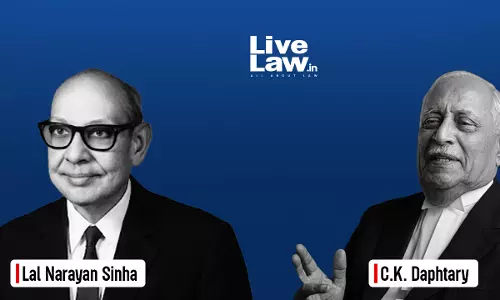
1st Of April – Two Stalwarts At The Bar
It is always in jest or laughter that references are made to the 1st of April – April Fools' Day – a day when practical jokes are customarily a part of life. For the banker, it is the beginning of the new financial year. For the history buff, it is the day on which Adolf Hitler was sentenced to five years imprisonment for his participation in the Beer Hall Putsch. The day, however, commemorates the birth anniversary of two legends of the law who walked the corridors of the Court – both of whom...