




Articles
The Charter's Silence
International Law, the West Asia War, and the Burden of Principled MultilateralismOn February 28, 2026, a United States-Israeli airstrike killed Ayatollah Ali Khamenei — the Supreme Leader of the Islamic Republic of Iran — along with senior members of his advisory council. The strike came in a war that had already claimed an estimated 1,255 lives. His son and successor, Ayatollah Mojtaba Khamenei, addressed the world on March 12, pledging to maintain the closure of the Strait of Hormuz and...
Halting The Pendulum: Imperative Of Finality In Judicial Eligibility
The seat of a Civil Judge (Junior Division) is not merely a bureaucratic rung on the administrative ladder; it is the foundational bedrock of the Indian adjudicatory machinery. It is within the austere, often overburdened walls of the mofussil courts that the common citizen first encounters the formidable apparatus of the State. Consequently, the criteria for occupying such a profound constitutional office must be rooted in unshakeable clarity. Yet, for over three decades, the...
When Biography Ends But Biology Remains: Constitutional Right To Let Go
The cold, clinical hum of the ventilator and the rhythmic drip of the feeding tube have become the modern world's most ambivalent totems. In our age of advanced medicalization, technology has achieved the miraculous—the preservation of biological function long after the light of consciousness has been extinguished. Yet, this triumph carries a dark corollary: the "technological trap," where the machinery of healing becomes an apparatus of incarceration. On March 11, 2026, the Supreme Court of...
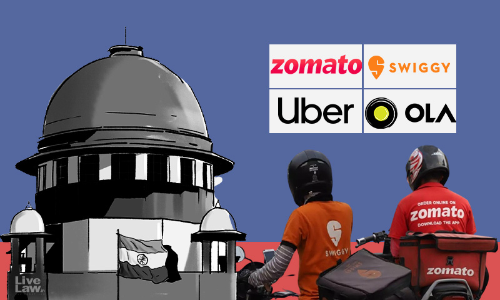
Logged In, Left Out: How Code On Social Security, 2020 Only Mentions About India's Gig Workers
Every morning, lakhs of delivery riders log onto Swiggy and Zomato. Many of them, simultaneously, are running Magicpin or have Urban Company bookings lined up for the afternoon. They are not employees. They are not contractors in any traditional sense. They are, in the words of the Code on Social Security, 2020, 'gig workers' viz. a category India's Parliament finally saw fit to acknowledge. But acknowledgment, as it turns out, is not protection.This piece argues that the Code on Social...
The Jurisprudence Of Command And The Constitutional Impasse
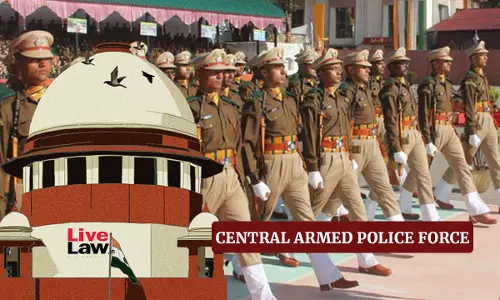
The Indian constitutional project currently faces a defining moment of friction, a precipice where the destiny of thirteen thousand Group-A cadre officers and the institutional integrity of the Supreme Court of India stand in the balance. At the heart of this storm lies the decision in Sanjay Prakash & Ors. v. Union of India & Ors. (2025 INSC 779), a judgment that did not merely settle a service dispute but sought to restore a foundational compact between the State and those...
Hostilities At Sea: Violations Of International Naval Warfare Norms
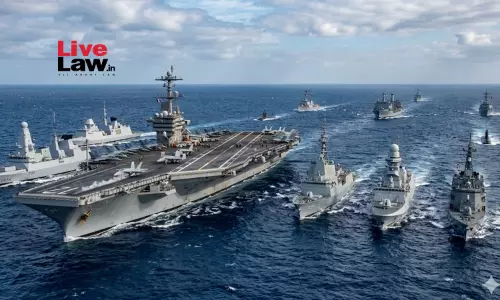
On 4 March 2026, the US submarine torpedoed and sank the Iranian ship (IRIS Dena) when it was returning home after participating in the Milan multilateral naval exercise hosted by India. The incident occurred about 40 nautical miles off the coast of Sri Lanka, killing around 87 Iranian sailors.Classification of Maritime Zones:The United Nations Convention on the Law of the Sea (UNCLOS) governs control of the seas. The UNCLOS divides the maritime spaces into distinct zones with varying...

India's Foreign Policy Falters When It Abandons Its Own Goalposts
From Non-Alignment to Selective Silence - India's 'wishy-washy' stance is neither a 'careful restraint' nor a 'responsible silence' in the US - Israel intervention in Iran.A strategy adopted by a nation-state on any international issue must have a practical aspect, one that seeks to maximize benefits, while sustaining the gains of long-standing trade relationships and international agreements. These very strategies form a precedential pattern when it comes to assessing a sovereign State, in...
Remembering Professor M.P. Singh: When I Visited His Village
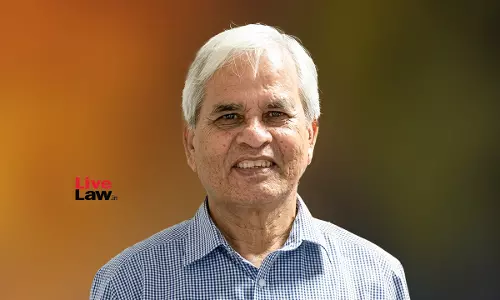
Professor M.P. Singh passed away on 7 March 2026. For many of us who studied constitutional law, his presence was felt long before we ever encountered him in person. Most often, it was through his work on VN Shukla's Constitution of India. For a student, his name carried a certain authority.I consider myself fortunate that I was able to meet him.My first interaction with him was in 2019, when he visited Dr. Ram Manohar Lohiya National Law University (RMLNLU), Lucknow, to deliver a lecture on...
The New Transgender Bill Pushes India Back In Its Fight For Transgender Rights
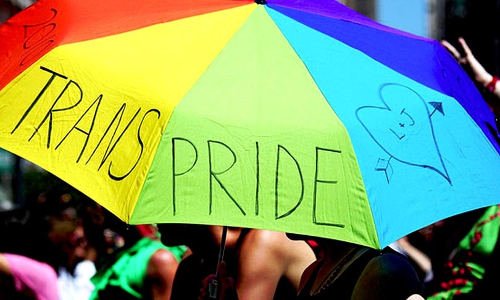
Last week a bill was introduced in the Lok Sabha to amend the Transgender Persons (Protection of Rights) Act, 2019 [the 2019 Act]. From a bare reading of the Statement of Objects and Reasons of the Amendment Bill it appears that there are two primary reasons for introducing the amendment. Firstly, to tighten the definition of “transgender persons” under the Act. And secondly, to scrap the scheme of penalising offences against transgender persons under the 2019 Act, and introduce in its place...
An Analysis Of The Transgender Persons Act And The 2026 Amendment Bill
Legislative changes and constitutional protections are crucial in the context of the Transgender Persons Act and the 2026 Amendment Bill. The struggle for transgender rights in India has been long, marked by systemic discrimination and exclusion. Historically, the legal system criminalised transgender identities, a stance that has only recently, and with some hesitation, shifted towards recognition. The Transgender Persons (Protection of Rights) Act, 2019, was largely seen as a way to put...
Why Judges Differ And How Far They Should
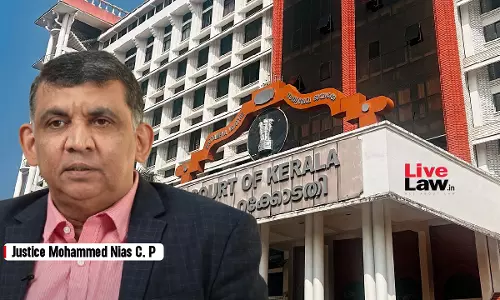
The primary question for consideration before the Apex Court in Centre for Public Interest Litigation v. Union of India1 was whether Section 17A of the Prevention of Corruption Act, 1988, was constitutionally valid. The Bench delivered a split verdict, with two divergent but carefully reasoned opinions, leading to a reference to the Hon'ble Chief Justice of India for the constitution of a larger Bench. Justice B.V. Nagarathna held Section 17A to be constitutionally infirm in its very...

What If I Never Was Me: A lesser Mortal's Tearful Thanks
In the hush of an early morning, as the first light pierced the veil of dawn, I sat in silence, eyes closed, breath steady. Meditation clears my mind's noise. But on this day, something extraordinary happened. A sudden gush of thoughts flooded in, unbidden and vivid, each was a “what if” that shook me. They were not mere hypotheticals; They felt real, like lives I almost lived. By the time I opened my eyes, tears poured down my face. I was sobbing not from sorrow, but from an overwhelming...