Justice Satish Chandra Sharma Retires, Propriety Question Remains
Manu Sebastian
28 Nov 2026 5:33 PM IST
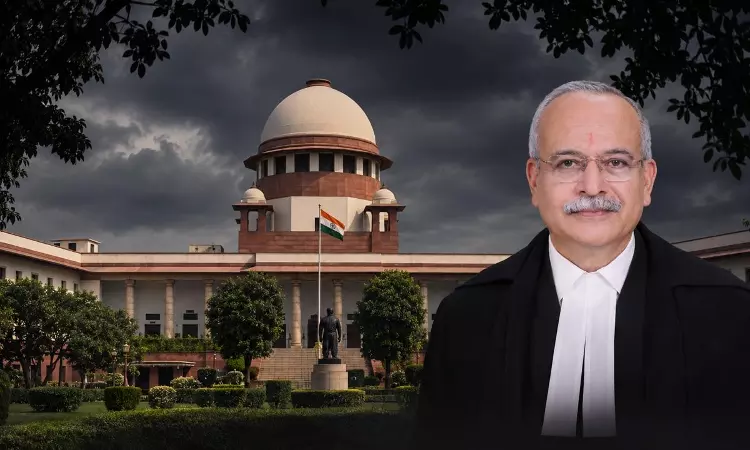
A cloud of perceived bias hangs over Justice Sharma's CEC verdict.
Justice Satish Chandra Sharma of the Supreme Court is retiring by leaving a grave propriety concern unanswered. To be seen as free from bias, whether actual or perceived, is one of the most important qualities associated with a judge. Judges are therefore known to cautiously guard the reputation of being unbiased. Nothing can be more damning to a judge's reputation than being labelled as biased.
So, when LiveLaw reported that Justice Sharma's son was a standing counsel of the Election Commission of India, after his decision in the crucial case relating to the validity of the law governing the appointment of the Chief Election Commissioner and the Election Commissioners, it naturally sent shock waves not only across the legal fraternity but also among the general public. Justice Sharma disagreed with Justice Dipankar Datta's view that the matter does not require a larger bench reference. Ultimately, Justice Sharma's view led to the matter being referred to a larger bench, a demand which the Union and the ECI put forth.
However, at no point during the hearing did Justice Sharma disclose that his son was a standing counsel for the ECI at the Madhya Pradesh High Court. Judges declaring their or their family members' professional associations with the parties of a case before them, and offering to recuse, is a well established propriety norm, which has close nexus with the principle of natural justice that no one shall be a judge in one's own cause. For reasons only known to him, Justice Sharma suppressed this association, and insisted on hearing and deciding the matter. Justice Sharma also granted interim relief to Medha Roopam IAS, the daughter of the Chief Election Commissioner Gyanesh Kumar, in another matter, where the High Court had passed strictures against her for ordering the NSA detention of a student activist as the Noida District Magistrate. The listing of the Medha Roopam case before Justice Sharma had also raised questions, as it was not as per the prevailing roster.


After the discovery regarding his son's link to the ECI, petitioners in the CEC matter filed applications seeking recall of the judgment, contending that it has been vitiated due to the likelihood of bias.
In a recent judgment (Ku. Kiran D/o Purushottam Bhujade v Sudhir Shikshan Sanstha & Ors), the Supreme Court explained the law on bias, stating that "the test is not whether actual bias is proved, but whether there exists a 'reasonable likelihood of bias' or 'real possibility of bias', in the mind of a reasonable person as distinguished from a merely fanciful apprehension." “ The requirement of impartiality is not restricted to the absence of direct pecuniary interest, but encompasses every circumstance that creates a reasonable apprehension that the proceedings were pre-determined or biased,” the Court explained in the judgment. Going by these principles, Justice Sharma's CEC verdict can be said to be marred by a reasonable perception of likelihood of bias. Justice Sharma never made any statement, even in his farewell address, as to why he chose to hide the potential conflict of interest in the CEC matter.
In his retirement speech, Justice Sharma asserted that he had endeavoured to perform with fairness:
"I leave with a sense of satisfaction not because I believe that I have been perfect in discharging my duties but because I can say with sincerity that I have always endeavoured to perform them with fairness, independence, humility and abiding commitment to the Constitution and rule of law. I have always believed that the true worth of a judicial career lies not merely in offices one has held or the judgments one has delivered, but in the sincerity with which one has discharged one's responsibility, the fairness with which one has approached every cause and respect one has maintained for the institution."
Whether these assertions reconcile with the manner in which the CEC Act case was decided will be a looming question with an unpleasant answer.
It is interesting to note that the CEC judgment found an implicit mention in Justice Sharma's farewell address, with the Attorney General citing it. "A couple of months ago, Justice SC Sharma and Justice Datta delivered an important judgment. I carefully listened again to the concerns behind every statement, sentence, proposition you penned in that judgment. I think you will be remembered for that," Attorney General R Venkataramani said.
Surely, Justice Sharma will be remembered for the verdict, but whether for the right reasons is a matter of debate. To retire with a cloud of bias on a judgment is undoubtedly a serious blot not only on one's judicial career but also on fairness in the administration of justice