




Criminal Law
Mere Demand Of Exorbitant Amount As Settlement To Withdraw Litigation Not "Extortion": Bombay High Court
The Bombay High Court has held that merely demanding an exorbitant or disproportionate amount during settlement talks does not by itself attract Section 385 of the Indian Penal Code or constitute an offence of extortion. The Court observed that an intentional threat or fear of injury is an essential ingredient of the offence, and quashed the FIR against the flat purchasers. Justice...
Body Shaming Woman's Physical Appearance Is Not Offence Of Insulting Modesty Under Section 509 IPC: Karnataka High Court
The Karnataka High Court has recently quashed criminal proceeding for outraging the modesty of a woman, against two person accused of body-shaming and verbally abusing the complainant, noting that body shaming alone does not by itself constitute offence of outraging a woman's modesty under Section 509 IPC. [ 2026 LiveLaw (Kar) 399]Section 509 states that whoever, intending to insult the...
Pillion Rider Not Covered Under Act-Only Motor Insurance Policy Without Additional Premium: Tripura High Court
The Tripura High Court has held that a pillion rider travelling on a two-wheeler is not covered under a statutory 'Act-only' or liability insurance policy unless the risk of the pillion rider is specifically covered by payment of an additional premium.Justice Dr. T. Amarnath Goud held that: “Therefore, a pillion rider is not covered under a statutory/Act-only policy and that the insurer is...

ED Attachment Of Property Can Be Challenged Under Article 226, But Entertaining Writ Is Court's Discretion: Karnataka High Court
The Karnataka High Court has refused to entertain a writ petition challenging an order confirming attachment of properties under the PMLA despite the predicate offence having been quashed. The Court held that since the PMLA constitutes a “complete Code” providing a hierarchy of authority and remedies, and while Article 226 petition is maintainable against attachment order however...
Sikkim High Court Upholds 20-Year POCSO Sentence, Holds Minority Of Survivor Proved Through Birth Certificate And Other Records
The Sikkim High Court has upheld the conviction and 20-year rigorous imprisonment awarded to a man under Sections 5(j)(ii) and 5(l), punishable under Section 6 of the Protection of Children from Sexual Offences Act, 2012 (POCSO Act), observing that the prosecution had sufficiently established that the survivor was a child at the time of the offence.A Division Bench comprising Chief Justice...
Court May Waive Remaining Sentence & Direct Deportation Of Foreign National Upon State's No-Objection: Tripura High Court
The Tripura High Court has modified the sentence of a Bangladeshi woman convicted for illegally entering India, restricting her imprisonment to the period already undergone and directing the State authorities to deport her to Bangladesh. The Court took a lenient view after noting that the appellant had no criminal antecedents, had pleaded guilty, and that the State Government had no objection...

Cattle Transport Can't Be Presumed To Be For Slaughter Due To Mere Absence Of Documents : Supreme Court
The Supreme Court has observed that a mere absence of transport documents cannot give rise to a presumption that the cattle were being transported for slaughter. A bench of Justice J.B. Pardiwala and Justice K. Vinod Chandran set aside the conviction of a man under the Chhattisgarh Agricultural Cattle Preservation Act, 2004 (“Act”), accused of transporting 32 bullocks for...
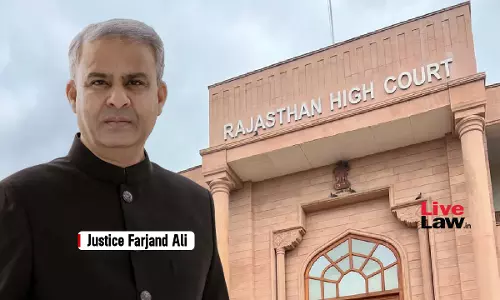
Motor Accident: Rajasthan High Court Directs Insurer To First Pay Minor's Compensation Despite Policy Breach
While hearing a Motor Accident Claim case, considering that the claimant was a minor, Rajasthan High Court directed the insurance company of the offending vehicle to satisfy the award granted in favour of the claimant, despite the vehicle's owner being in breach of the insurance policy, with a liberty to recover it from the owner of the vehicle. The bench of Justice Farjand Ali made a...

Gujarat High Court Grants Bail To Man Accused Of Leaking Re-NEET Exam Paper On Telegram, Says Chargesheet Filed
The Gujarat High Court has granted bail to a man accused of advertising access to Re-NEET Exam papers on Telegram channels, after observing that the prosecution had failed to point out the circumstances to continue or prolong the accused's detention. [2026 LiveLaw (Guj) 270]Justice Hasmukh D Suthar in his order noted that the allegation against the applicant is that he had hatched a...
That Trafficking Victim Is A Bangladeshi Immigrant Is No Defence : Bombay High Court Upholds Brothel Owner's Conviction
Labels 'illegal immigrant' or 'sex worker' will not deprive a person of the right to dignity, the Court said.
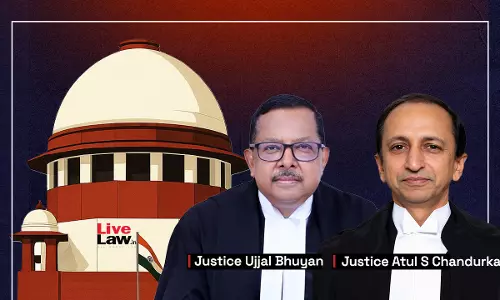
S. 313 CrPC | Statement Of Accused Cannot Be Used To Complete An Unestablished Chain Of Circumstances : Supreme Court
While acquitting a man convicted of raping and murdering his six-year-old maternal niece, the Supreme Court on Thursday (October 1) held that the conviction cannot be recorded solely based on defence statements under Section 313 Cr.P.C. / Section 351 BNSS when the prosecution otherwise failed to prove the guilt of the accused beyond a reasonable doubt. In other words, the accused's answers...

Motor Accident | Insurer Must Prove Tanker Was Carrying Hazardous Goods Before Alleging Want Of Licence Endorsement: Allahabad High Court
The Allahabad High Court has held that an insurer cannot avoid liability under a motor accident award by pointing to the absence of an endorsement on the driver's licence authorising carriage of hazardous goods, unless it also establishes that the substance actually being carried was one of the goods listed as hazardous under the Central Motor Vehicles Rules, 1989.Rule 9(3) of the Central...