



- Home
- /
- High Courts
- /
- Allahabad High Court
- /
- Article 161 | Governor's Power To...
Article 161 | Governor's Power To Grant Premature Release Cannot Be Exercised Arbitrarily: Allahabad High Court
Sparsh Upadhyay
15 Aug 2026 10:28 PM IST
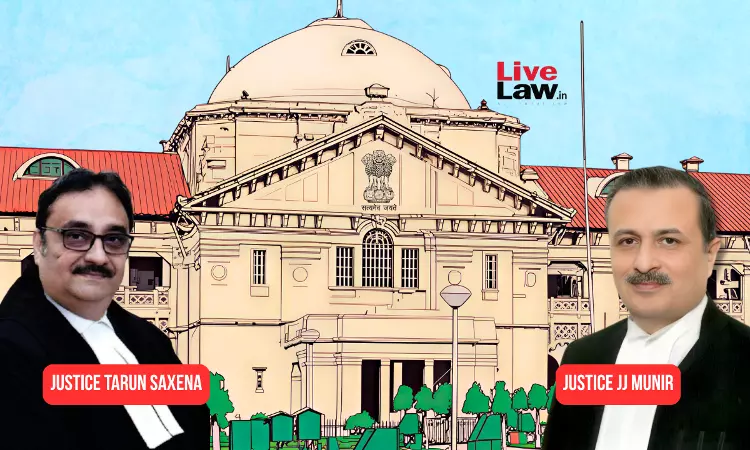
The Allahabad High Court has observed that the power of the Governor to grant premature release under Article 161 of the Constitution of India is a sovereign executive power, but it cannot be exercised arbitrarily, as it remains regulated by the applicable Rules and remission policy.A Bench of Justice JJ Munir and Justice Tarun Saxena made this observation while quashing an order...
This is a premium content
Available exclusively to
Our subscribers
Subscribe Premium 
INR 1099+GST
Your support helps us to bring you more content at
an affordable subscription scheme !!!
All payment options available
The Allahabad High Court has observed that the power of the Governor to grant premature release under Article 161 of the Constitution of India is a sovereign executive power, but it cannot be exercised arbitrarily, as it remains regulated by the applicable Rules and remission policy.
A Bench of Justice JJ Munir and Justice Tarun Saxena made this observation while quashing an order refusing premature release to a convict who had been sentenced to 7 years' rigorous imprisonment.
The Court found that the decision refusing premature release suffered from an "error apparent on the face of record", as it incorrectly recorded the period of incarceration undergone by the petitioner.
Case in brief
The petitioner (Ram Pratap Singh), had been convicted in an Attempt to Murder case under Section 307/34 IPC by the Additional Sessions Judge, Fatehpur, in 2002 and sentenced to 7 years' rigorous imprisonment along with a fine of ₹2,000.
His appeal before the High Court was dismissed in 2019 and thereafter, the Supreme Court had also dismissed his Special Leave Petition.
In September 2022, a proposal for his premature release was sent to the jail authorities and to the District Magistrate, Fatehpur, but it remained pending. The petitioner later made an application in February 2025 seeking a decision on the proposal wherein he pointed out that he had served more than half of his sentence.
The jail report recorded that he had undergone 4 years, 6 months and 6 days without remission and 5 years and 4 months with remission, against the total 7-year sentence. His conduct was recorded as satisfactory.
However, in June 2025, a decision was communicated refusing his premature release on the ground that he had served only 2 years and 6 days without remission and 2 years, 1 month and 27 days with remission.
Before the High Court, the petitioner argued that the decision had ignored the jail report and wrongly calculated his period of incarceration. He also contended that the order did not disclose any adverse material against him and failed to consider his satisfactory conduct in jail.
High Court's observations
Agreeing with the petitioner's arguments, the High Court noted that under sub-Rule (iii) of Rule 4 of the Uttar Pradesh Prisoners' Release on Probation Rules, 1938, a convict in the applicable category becomes eligible for premature release after serving one-third of the sentence without remission.
Since the petitioner had actually served 4 years, 6 months and 6 days without remission against a seven-year sentence, the Court found that he had served more than half of the sentence. The Bench observed:
"There is absolutely no basis to this finding, except that it is borne of on an error apparent and also betrays a case of non-application of mind to the record".
The Court also termed the misreading of the period of incarceration a “manifest illegality”.
On the nature of the Governor's power under Article 161, the bench observed that the same can't be exercised arbitrarily. The Bench stressed that the power is regulated by the Rules and the remission policy.
"Even (though) power under Article 161 is a constitutional power, as distinguished from the statutory power of the State Government under Section 432 Cr. P.C., the decision cannot be arbitrary or borne on an error apparent, as important as the period of incarceration suffered by the convict".
The Court, however, noted that if the correct period of detention had been communicated to the respondents, the conclusion might have been different.
The High Court also took note of the fact that the rejection order relied upon the District Magistrate and Superintendent of Police's recommendations against premature release. However, neither the impugned order nor the State's response disclosed the contents of those reports.
The Bench observed that if the recommendations were "without reasons and ipse dixit of the officers", fresh comments would have to be obtained from the concerned officers. It consequently held that the impugned order cannot be sustained.
Consequently, the High Court allowed the writ petition and quashed the June 26, 2025 order refusing premature release to the petitioner.
The matter was remitted to the Government for a fresh decision on the petitioner's plea for premature release, to be taken within 1 month from receipt of the High Court's order.
Counsel for Petitioner: Syed Mohammed Jafer Husain, Syed Wajid Ali
Case title - Ram Pratap Singh vs. State of U.P. and others 2026 LiveLaw (AB) 588
Case Citation: 2026 LiveLaw (AB) 588
Tags

Sparsh Upadhyay
Sparsh Upadhyay is an Associate Editor with LiveLaw.

