Azam Khan ED Arrest | Allahabad High Court To Pass Order On Interim Relief; Allows ED To File Detailed Counter-Affidavit
Sparsh Upadhyay
17 Nov 2026 12:15 PM IST
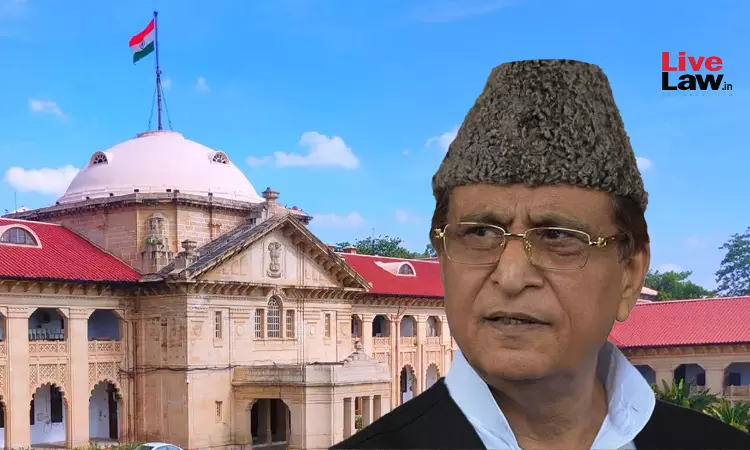
The Allahabad High Court on Tuesday indicated that it would pass an appropriate order on the interim relief sought by former Uttar Pradesh Minister Azam Khan in his plea challenging his arrest by the Enforcement Directorate (ED).
The Court, meanwhile, granted the agency 1 week to file a detailed counter-affidavit in the matter.
A bench of Justice Rajiv Gupta and Justice Devendra Singh-I was hearing Khan's plea challenging his October 31 arrest under the Prevention of Money Laundering Act (PMLA).
Khan is before the HC pursuant to a November 5 order of the Supreme Court transferring his writ petition challenging ED arrest to the Allahabad High Court. The petition also seeks Khan's release from custody.
Khan has alleged mala fides on the part of the ED in arresting him. Senior Advocate Kapil Sibal had argued on Monday that Khan's arrest, barely 40 minutes after he walked out of jail upon securing release in the dual PAN card case, was part of a political vendetta intended to keep him behind bars until the 2027 Uttar Pradesh Assembly elections.


Yesterday, the HC directed the ED to file an affidavit clarifying whether the grounds of arrest were offered/served to Khan when he was arrested on October 31.
Now today, at the outset, the Court took on record a supplementary affidavit filed by Khan's counsel and a short counter-affidavit filed by the ED. The agency sought time to file a detailed counter-affidavit, while Khan's counsel sought time to file a rejoinder to the short counter-affidavit.
The Court granted the ED one week to file its detailed counter-affidavit and allowed the petitioner one week or 10 days to file a rejoinder. The matter has been listed for further hearing on December 10.
During the hearing, the ED opposed the grant of interim relief. The Court indicated that it would pass appropriate orders in that regard.
Appearing for Khan, Senior Advocate Imran Ullah relied on the Supreme Court's judgment in Vihaan Kumar v. State of Haryana, particularly paragraph 37, to argue that once an arrested person alleges that the grounds of arrest were not communicated to him, the burden is on the arresting agency to establish effective compliance with Article 22(1) of the Constitution.
Reading from the judgment, Ullah submitted thus:
"If such an allegation is made in the pleadings, the entire burden is on the arresting agency of the State to satisfy the court that effective compliance was made in requirement of Article 22(1)".
Reading the relevant portion, he submitted that the purpose of communicating the grounds was "not merely a formality" but to enable the detained person to take immediate and prompt action to secure his release, as permissible under law.
Ullah then referred to the supplementary affidavit filed on Khan's behalf, submitting that it specifically disputed the ED's claim that the grounds of arrest had been offered to him at the time of his arrest on October 31.
It was contended that from around 7:10 PM on October 31, when Khan was arrested outside the jail premises, until the remand proceedings before the Magistrate were concluded, neither the arrest memo nor the grounds of arrest were offered to him.
Ullah submitted that the documents were handed over to the petitioner's counsel, Yasir Abbasi, only after the remand order had been passed. He argued that the acknowledgement of receipt on the remand order itself showed that the documents had not been supplied earlier.
He further submitted that the grounds of arrest were not even in existence at the time of Khan's arrest and appeared to have been prepared only on November 1, 2026, when the remand application was prepared and the remand proceedings commenced.
"The petitioner submits that the grounds of arrest were not in existence on such and such date when he was arrested from outside the jail premises, and even during his transportation", Ullah submitted, reading from the affidavit.
Ullah identified seven circumstances which, according to him, supported Khan's contention that the grounds of arrest were prepared only at the stage of remand proceedings.
He submitted that the grounds of arrest did not bear the place, date and time of their preparation; were not annexed to the email sent by the ED; and were not included in the WhatsApp communication relied upon by the agency.
He further pointed out that the letter intimating Khan's arrest to his relative did not mention the existence of the grounds of arrest.
Referring to the video footage shown by the ED during the previous hearing, Ullah argued that no video or photograph had been produced in which an officer was specifically seen asking Khan to receive the grounds of arrest and Khan declining to accept them.
He also alleged that the ED had made a false averment in its remand application dated November 1 that the arrest documents had been served through the email and WhatsApp communications.
"The petitioner, with folded hands, requests this Honourable Court to take notice of a false averment made by the Enforcement Directorate in the remand application", he submitted.
Ullah maintained that if the ED failed to explain the circumstances highlighted in the supplementary affidavit, Khan's arrest would be rendered illegal.
"If they discharge these seven points which I have raised, I don't have a case. And if they couldn't, then the arrest will be illegal", he told the Court.
Opposing the allegations, Senior Advocate Zoheb Hossain, appearing for the ED, maintained that the grounds of arrest had been supplied before the commencement of the remand proceedings. He said multiple officers had attempted to serve the documents on Khan, but he had repeatedly refused to accept them.
Hossain informed the Court that the agency was filing affidavits of four officers to substantiate its version.
He also disputed the allegation that the ED had failed to communicate with Khan's relatives. Referring to the Panchnama, he submitted that the agency had contacted the police, obtained multiple telephone numbers and attempted to reach the persons concerned. However, the numbers provided were found to be incorrect.
On the question of supplying the grounds of arrest to a relative, Hossain argued that the obligation to nominate a person rested on the arrested individual. He referred to the Panchnama, claiming that Khan had declined to nominate a relative to receive information about his arrest.
Additional Solicitor General and Senior Advocate SV Raju suggested that the Court could call for a report from the Magistrate concerned to resolve the dispute over whether the arrest documents were supplied before or after the remand order was passed.
The Court, however, said it would first examine the affidavits filed by the parties and that it could call for a report from the Magistrate if the need arose.
Hussain also sought time to file a detailed counter-affidavit dealing with the other aspects of the case, including the alleged proceeds of crime. The Court granted the ED one week to file the same.
The matter will now be taken up on December 10.
Counsels for Mohd. Azam Khan: Kapil Sibal, Sr. Adv., N.I. Jafri, Sr. Adv., Imran Ullah, Sr. Adv., Nizam Pasha, Adv., Mohd. Khalid, Adv. and Shashwat Anand, Adv.
Counsels for ED: SV Raju, Sr. Adv. (ASG), Zohaeb Husaain, Sr. Adv., Sushant Chandra, Adv.