



- Home
- /
- High Courts
- /
- Allahabad High Court
- /
- Allahabad High Court Rejects Plea...
Allahabad High Court Rejects Plea For FIR Against Jagadguru Rambhadracharya Over Alleged Remarks Against Upadhyay Community
Sparsh Upadhyay
4 Sept 2026 10:32 PM IST
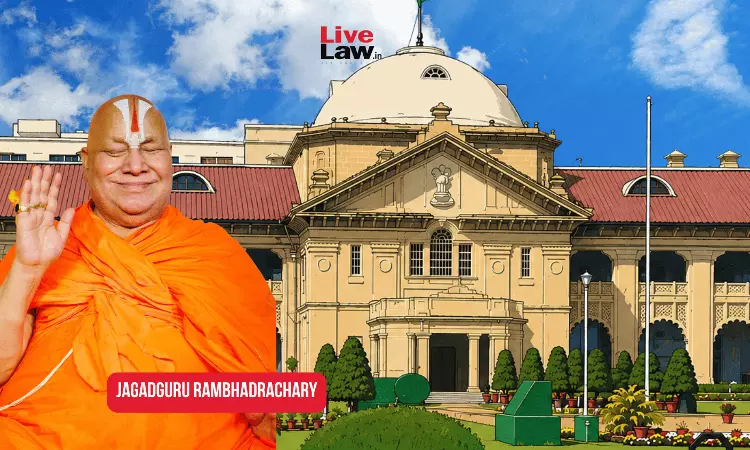
The Allahabad High Court on Tuesday rejected a plea filed by a practising advocate seeking a direction for registration of an FIR against Jagadguru Rambhadracharya over his alleged remarks concerning the 'Upadhyay' community and revered religious personalities, including the Shankaracharyas. A Bench of Justice Chandra Dhari Singh and Justice Tarun Saxena observed that a person aggrieved...
This is a premium content
Available exclusively to
Our subscribers
Subscribe Premium 
INR 1099+GST
Your support helps us to bring you more content at
an affordable subscription scheme !!!
All payment options available
The Allahabad High Court on Tuesday rejected a plea filed by a practising advocate seeking a direction for registration of an FIR against Jagadguru Rambhadracharya over his alleged remarks concerning the 'Upadhyay' community and revered religious personalities, including the Shankaracharyas.
A Bench of Justice Chandra Dhari Singh and Justice Tarun Saxena observed that a person aggrieved by non-registration of an FIR must ordinarily first exhaust the statutory remedies available under the Bharatiya Nagarik Suraksha Sanhita (BNSS) before invoking the High Court's extraordinary jurisdiction under Article 226.
The Court thus dismissed the writ petition filed by Advocate Ramesh Upadhyay. However, he was granted liberty to avail an appropriate remedy under law.
Case in brief
In his Criminal Writ petition, the petitioner claimed that he belongs to the 'Upadhyay' community and alleged that certain statements made by Jagadguru Rambhadracharya caused "grave mental agony, humiliation and insult" to him and other members of the community.
The petitioner alleged that Jagadguru Rambhadracharya referred to Upadhyays as "नीच/अधम" (low/inferior) and also described the four Shankaracharyas as 'फर्जी' (fake), thereby hurting the religious sentiments of several followers.
The petitioner alleged that the statements and videos containing them were publicly circulated on social media platforms, including YouTube.
The petitioner further expressed apprehension for his own safety and that of his family, alleging that Rambhadracharya could use his influence to harm him or potential witnesses.
The petitioner apprised the Court that he had submitted a complaint through the Commissioner of Police, Varanasi, on October 8, 2025, seeking registration of an FIR against Rambhadracharya under appropriate penal provisions; however, no FIR had been registered.
The State, on the other hand, opposed the petition, contending that the petitioner had not approached the concerned police station and had directly approached the High Court without first availing the remedy under Section 175(3) BNSS before the Magistrate.
The State also disputed receipt of the October 8 letter, pointing out that there was no proof of receipt or postal tracking on record.
High Court's observations
At the outset, the bench noted that although the High Court has the power to issue writs under Article 226, such jurisdiction is discretionary and ordinarily should not be exercised where an efficacious alternative remedy is available. The Court remarked thus:
"This Court is of the considered view that if a person has a grievance that his FIR has not been registered by the police, or that having been registered, a proper investigation is not being done, then the remedy of the aggrieved person is not to apporach the High Court under Article 226 of the Constitution, but to approach the Magistrate concerned under Section 156(3) CrPC. [Section 175(3) BNSS].”
The Bench further held that the remedy before the Magistrate is "not merely an alternative" but "the primary and preferred remedy that must be exhausted before approaching the High Court under Article 226".
The Court emphasized that Sections 173(4) and 175(3) BNSS provide an effective statutory mechanism for grievances relating to FIR registration and investigation.
"To entertain a writ petition in the first instance, without the petitioner having approached the Magistrate, effectively results in this Court acting as a forum of first instance, thereby completely bypassing the structured statutory scheme, which is impermissible".
The Court said the statutory scheme is not a mere formality but reflects a deliberate legislative design to ensure that grievances are addressed at the appropriate level before constitutional remedies are invoked.
Furthermore, the Court noted that it was itself disputed whether the petitioner had approached any police authority for lodging the FIR before filing the writ petition.
In this context, the Court expressed concern about a "growing trend" of litigants approaching the HC under Article 226, seeking directions to the police to register an FIR, without first exhausting the statutory remedies available under the BNSS.
Apart from this, in its order, referring to Lalita Kumari Judgment, the Court also observed that the police cannot avoid their statutory duty of registering an offence where a cognizable offence is disclosed.
However, the Court clarified that 'Lalita Kumari' does not permit an aggrieved person to bypass the statutory remedies when the police fail to discharge that duty.
The writ petition was accordingly dismissed as devoid of merit. However, the Court granted the petitioner liberty to avail an appropriate remedy under law, if advised.
Case title - Ramesh Upadhyay vs. State Of U.P. And 4 Others 2026 LiveLaw AB) 653
Case Citation: 2026 LiveLaw (AB) 653
Tags

Sparsh Upadhyay
Sparsh Upadhyay is an Associate Editor with LiveLaw.

