



- Home
- /
- High Courts
- /
- Madras High Court
- /
- Madras High Court Reserves Verdict...
Madras High Court Reserves Verdict On AIADMK Plea Challenging Acceptance Of 4 MLAs' Resignations Who Joined TVK
Upasana Sajeev
1 Sept 2026 7:05 PM IST
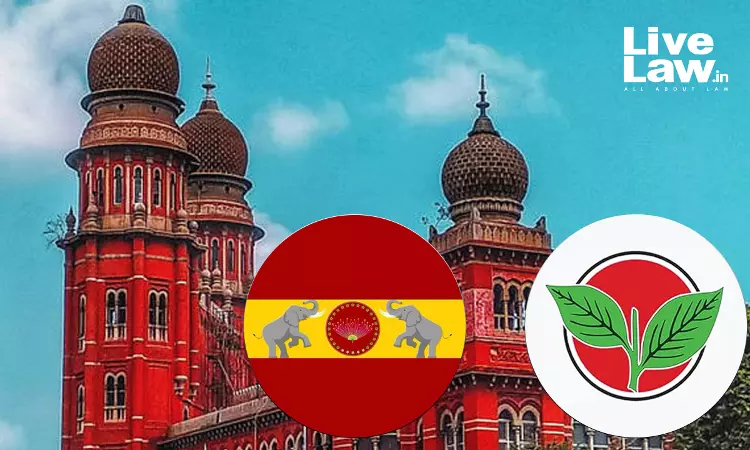
The Madras High Court has reserved orders on a plea filed by the whip of the All India Anna Dravida Munnetra Kazhagam (AIADMK) party, challenging the acceptance of the resignation of 4 MLAs who contested the assembly elections as AIADMK members but quit after the polls and joined CM Joseph Vijay's Tamilaga Vettri Kazhagam (TVK) party on the same day.The bench of Chief Justice SA Dharmadhikari...
This is a premium content
Available exclusively to
Our subscribers
Subscribe Premium 
INR 1099+GST
Your support helps us to bring you more content at
an affordable subscription scheme !!!
All payment options available
The Madras High Court has reserved orders on a plea filed by the whip of the All India Anna Dravida Munnetra Kazhagam (AIADMK) party, challenging the acceptance of the resignation of 4 MLAs who contested the assembly elections as AIADMK members but quit after the polls and joined CM Joseph Vijay's Tamilaga Vettri Kazhagam (TVK) party on the same day.
The bench of Chief Justice SA Dharmadhikari and Justice G Arul Murugan reserved orders after hearing the arguments on behalf of the party whip, the Speaker, the Secretary of the Legislative Assembly, and the MLAs who resigned from the party.
It may be noted that the results of the Tamil Nadu General Assembly Elections were declared on May 4th, 2026, with former actor Vijay's TVK party emerging victorious with the highest number of votes. However, since the party had secured 108 votes, which was less than the majority needed to form a government (118), the party sought support from other political parties. Following this, the TVK formed a government, and a confidence motion was held on the assembly floor on 13th May, in which the party secured 144 votes in its favour.
As per the party, soon after the declaration of election results, on May 11, 2026, the party had issued a whip to its members asking them to oppose the vote of confidence. However, on the day of the confidence motion on 13th May, 25 MLAs voted in favour of TVK, against the party whip. Since the MLAs voted against the party mandate, proceedings were initiated against them under Schedule 10 of the Constitution of India on May 14, 2026.
The facts were brought to the notice of the Speaker, informing him that there was cross-voting and possible horse trading. However, since some of the MLAs apologised for cross-voting, the proceedings against them were dropped. Later, on May 25, the respondent MLAs tendered their resignation to the Speaker and on the same day, they met the General Secretary of TVK. It was submitted that the resignation was accepted by the Speaker on the same day and a publication was made in the Gazette, and the MLAs joined the TVK party.
The party argued that as per Article 190 of the Constitution, the Speaker was bound to conduct some enquiry to ensure that the resignation was given voluntarily. He argued that in the present case, the resignation was given at around 2:30 pm on May 25, and on the same day it was accepted and a gazette notification was made. It also argued that the MLAs were given membership in the TVK party on the same day, which points to possible horse-trading. It was also argued that if the Speaker had conducted a proper enquiry, he should have issued notice to the AIADMK party, so that the party could oppose the same. He thus submitted that there was a sham of compliance with the procedure contemplated under Article 190 of the Constitution.
The Legislative Assembly Secretary, on the other hand, argued that acceptance of the resignation of a legislative assembly member did not absolve that member from the consequences of a disqualification with respect to his/her conduct before resignation. It was argued that the petition was wholly misconceived and proceeded upon a fundamentally erroneous legal premise that acceptance of a member's resignation operates to extinguish, defeat, or render infructuous the disqualification proceedings pending against the member under the 10th Schedule of the Constitution.
The Speaker also argued that the MLAs' resignation was accepted after being satisfied that their resignations were voluntary. The Speaker stated that when the resignations were handed over to him, he had inquired with each MLA to determine whether their decision to resign was voluntary or not. He further submitted that the resignations were accepted after being satisfied that it was made in free will and of their own volition and that there was no element of undue influence or coercion behind their decision to resign.
When the matter was taken up today, Senior Advocate CS Vaidyanathan argued that as per Article 190(3)(b) of the Constitution, the Speaker was not bound to enquire into the motive behind the resignation of a member. He argued that the Speaker was only expected to inquire into the genuineness of the resignation, which was done in the present case. He argued that in the present case, there was no allegation that the letter was written by anyone else, other than the member. It was thus argued that the Speaker's decision was as per the Constition and there was nothing improper in it.
"There's no allegation that the letter was written by any other party. The word genuine only related to authenticity of the letter. Here all letters were by members in their own writing...When member comes and says he's resigning on his own, there's nothing else to be said...My enquiry has to be limited only to asking whether it is genuine and voluntary. Art 190(3)(b) does not permit the speaker to enquire into the motive of resignation. When a member is resigning even under political pressure, he's still doing it voluntarily," Vaidyanathan argued.
Appearing on behalf of the MLAs who resigned, Senior Advocate Menaka Guruswamy argued that not every vacation of seat is due to corruption or any other malpractice. It was argued that in the present case, the members had chosen to resign from their seats before joining another party and thus, it could not be said that the action was with malice. It was also argued that the present scenario was a clear way of practicing dissent and democracy where a member had the right to resign from his party.
"Article 190 deals with vacation of seats. Not all vacations of seats are due to corruption. I accept that this would be an action of malice if I chose to retain that seat and act on behalf of another political party. That was not the case here. We have resigned and joined another party. This is neither a corrupt practice nor antithetical to democratic politics. If anything, this is in line with democratic politics. This is the real way of practicing dissent. This is the clear way of practicing democracy," the court said.
After hearing the parties, the court reserved orders.
Counsel for Petitioner: Mr. V.Giri Senior Counsel for Mr. S.Inbadurai, Mr SR Rajagopal
Counsel for Respondents: Mr CS Vaidyanathan, Senior Advocate, Ms Menaka Guruswamy, Senior Advocate, Mr. Vijay Narayan, Advocate General Assisted by Mr.Mohammed Fayaz Ali Government Pleader, Mr. Niranjan Rajagopalan Standing Counsel, Dixita Gohil, Pranjal Agarwal, Yash S Vijay
Case Title: Agri SS Krishnamurthy v The Speaker and Others
Case No: WP 23081 of 2026
Tags

Upasana Sajeev
Upasana Sajeev is a Principal Correspondent with LiveLaw, covering Madras High Court

