


Supreme court
After Rejection Of Objection To Impleadment, Subsequent Application To Delete Party Barred By Res Judicata : Supreme Court
The Supreme Court held that the principle of res judicata applies to impleadment proceedings under Order I Rule 10 of the CPC. This means that if a party had the opportunity to raise objections regarding their impleadment or non-impleadment at the appropriate stage but failed to do so, they cannot raise the same issue later, as it would be barred by the doctrine of constructive res...
Standard Form Employment Contracts : Supreme Court Lays Down Principles Of Interpretation
The Supreme Court recently outlined the legal principles applicable to interpreting standard form contracts often viewed as weaker contracts from the employee's perspective typically drafted unilaterally by employers (such as corporations or institutions) and offered to employees on a “take-it-or-leave-it” basis. The bench comprising Justices PS Narasimha and Joymalya Bagchi laid down...
No Lunatic Can Be Convicted As He Can't Exercise Right To Defend Under Article 21 : Supreme Court
The Supreme Court set aside the conviction of a man who was sentenced to life imprisonment for murder, on the ground that there was more than a reasonable doubt regarding his mental condition at the time of the offence.A bench of Justice Abhay S Oka and Justice Ujjal Bhuyan stated that a lunatic cannot be held criminally liable as he is not in a position to defend himself, and the right to...
2025 LiveLaw (SC) 617 | In Re: Right To Privacy Of Adolescents
Click the link below for the report and the judgment :Supreme Court Refrains From Sentencing POCSO Convict After Noting That Victim Is Now Married To Him & Didn't See It As CrimeSupreme Court Seeks Centre's View On Suggestions To Improve Sex Education & Real-Time Tracking Of POCSO...
S. 11 SARFAESI Act | DRT Can't Decide Disputes Between Banks Over Secured Assets; Must Be Referred To Arbitration : Supreme Court
In a significant ruling under the SARFAESI Act, 2002 (“Act”), the Supreme Court today (May 23) held that inter-creditor disputes (between secured creditors) must be resolved through arbitration under Section 11 of the Act read with the Arbitration & Conciliation Act, 1996 (“Arbitration Act”). Unlike the Arbitration and Conciliation Act, which requires a written agreement...
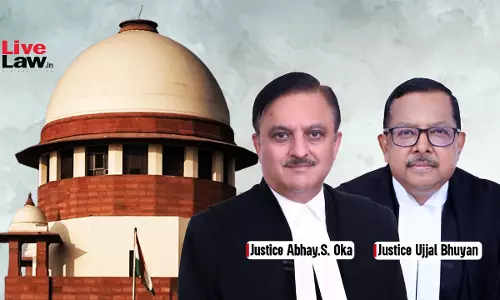

Maternity Leave Part Of Reproductive Rights: Supreme Court Sets Aside Denial Of Maternity Leave For Third Child
The Supreme Court has set aside the order of the Division Bench of the Madras High Court which had denied maternity leave to a government teacher for the birth of her third child, citing State policy restricting benefits to two children.A bench of Justice Abhay Oka and Justice Ujjal Bhuyan held that maternity benefits are part of reproductive rights and that maternity leave is integral to...
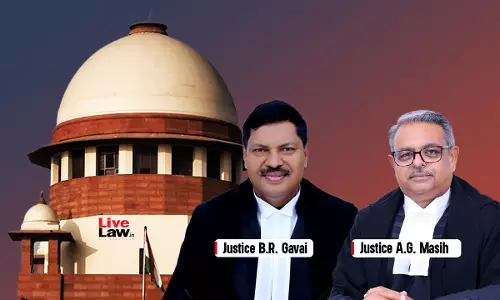
'Cheap Publicity' : Supreme Court Dismisses PIL Seeking Action Against Maharashtra Officials For Protocol Lapse During CJI's Visit
The Supreme Court on Friday (May 23) came down heavily on a petitioner who filed a PIL seeking action against Maharashtra officials for their protocol lapse during the visit of the Chief Justice of India to Mumbai last week.A bench comprising Chief Justice of India BR Gavai and Justice AG Masih dismissed the petition filed by lawyer Shailendra Mani Tripathi, observing that it was a...