



- Home
- /
- Top Stories
- /
- 'Govt Biggest Litigant Adding To...
'Govt Biggest Litigant Adding To Pendency' : Supreme Court Pulls Up Union For Unnecessarily Challenging Relief To CISF Constable
Amisha Shrivastava
1 April 2026 2:51 PM IST
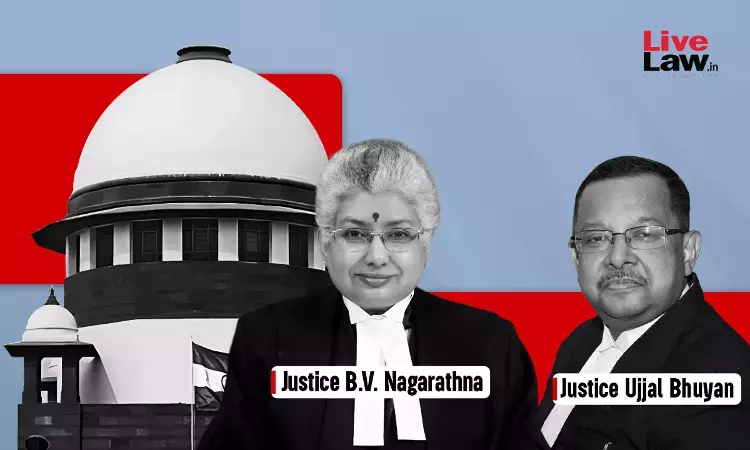
The Court expressed that the dismissal of the constable for absence of 11 days was a disproportionate punishment.
The Supreme Court today imposed cost of ₹25,000 on the Union of India for challenging a Punjab and Haryana High Court judgment that had set aside the dismissal of a CISF constable and granted him 25% back wages.A bench of Justice BV Nagarathna and Justice Ujjal Bhuyan dismissed the SLP, criticising the Union for pursuing it.“We fail to understand why the Union of India and others...
This is a premium content
Available exclusively to
Our subscribers
Subscribe Premium 
INR 1099+GST
Your support helps us to bring you more content at
an affordable subscription scheme !!!
All payment options available
The Supreme Court today imposed cost of ₹25,000 on the Union of India for challenging a Punjab and Haryana High Court judgment that had set aside the dismissal of a CISF constable and granted him 25% back wages.
A bench of Justice BV Nagarathna and Justice Ujjal Bhuyan dismissed the SLP, criticising the Union for pursuing it.
“We fail to understand why the Union of India and others have approached this court by assailing the order of the Division Bench of the High Court. We dismiss this SLP with cost of Rs. 25000”, the Court ordered.
During the hearing, Justice Nagarathna highlighted that the Union of India is the largest litigant, contributing to heavy pendency in the Court. “This is a case for imposing costs with dismissal. We have been shouting. Keep aside your argument. Pendency, pendency; who is the biggest litigant?”
Justice Nagarathna said there should be a legal opinion in such cases that if a High Court has found a punishment disproportionate and granted relief by setting aside the orders, the matter should not be taken to the Supreme Court.
“Why can't the law officer be of the opinion for the absence of 11 days, dismissal is disproportionate, the High Court has granted relief setting aside all the orders, and we shall not go to the Supreme Court? Instead of giving such an opinion, you will proceed against him?”, she said.
The case relates to a CISF constable who was dismissed after around ten years of service on two charges. The first was unauthorised absence from duty for 11 days. The second was alleged misconduct for conniving with the daughter of another CISF constable to leave Mumbai and attend her wedding with his younger brother at Arya Samaj Mandir, Raipur.
The absence period was during sanctioned medical leave, though the constable was not found available during an inspection. On the second charge, the woman concerned appeared in the disciplinary proceedings and stated that she had no grievance. It was also not disputed that she had married the constable's brother. The Single Judge set aside the punishment orders, re-instating the constable with continuity of service.
The Division Bench upheld that decision and dismissed the Union's appeal, holding that there was no illegality or perversity in the Single Judge's findings and that no misconduct was made out to justify removal from service. Thus, the Union approached the Supreme Court
During the hearing, Justice Nagarathna referred to the circumstances behind the constable's absence and highlighted that he was also dealing with a family situation involving an elopement. She said, “Do you know the tension of a family if there is an elopement? He had to set right his family, get them married, and he returned after that.”
Counsel for the Union pressed for setting aside the back wages, relying on the principle of “no work, no pay” and highlighted that the matter had remained pending in the High Court for six years for which back wages would have to be paid.
However, the Court refused, only agreeing to condone the delay on part of the Union in filing the SLP. When the counsel continued to press for removal of back wages, the Court decided to impose costs while dismissing the SLP.
Justice Nagarathna also referred to discussions at the recent Supreme Court Bar Association conference in which participants, including her, highlighted unnecessary litigation by the Union contributing to pendency.
She said, “We have taken the conference very seriously. It was not just to go to some resort and come back. Many judges travelled and we have made preparation, we have done homework.”
Case no. – SLP(C) No. 12124 / 2026
Case Title – Union of India v. Sukhwinder Singh
Tags

Amisha Shrivastava
Amisha Shrivastava is a Senior Correspondent with LiveLaw, covering the Supreme Court of India. She can be reached at amisha@livelaw.in

