



- Home
- /
- Top Stories
- /
- Voter Listed In Electoral Roll...
Voter Listed In Electoral Roll Cannot Be Deleted Without Notice Except In Case Of Dead Voter : Justice Ujjal Bhuyan
Amisha Shrivastava
5 Oct 2026 7:11 PM IST
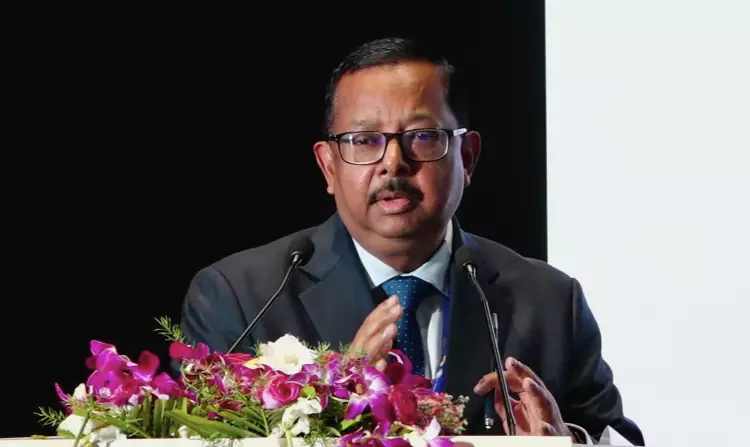
Supreme Court Justice Ujjal Bhuyan on Sunday emphasised that the name of a voter once entered in the electoral roll cannot be deleted without notice and an opportunity of hearing, except where the voter is deceased.Justice Bhuyan highlighted that Section 22 of the Representation of the People Act, 1950 permits deletion of an entry in the voters' list only after the voter has been given...
This is a premium content
Available exclusively to
Our subscribers
Subscribe Premium 
INR 1099+GST
Your support helps us to bring you more content at
an affordable subscription scheme !!!
All payment options available
Supreme Court Justice Ujjal Bhuyan on Sunday emphasised that the name of a voter once entered in the electoral roll cannot be deleted without notice and an opportunity of hearing, except where the voter is deceased.
Justice Bhuyan highlighted that Section 22 of the Representation of the People Act, 1950 permits deletion of an entry in the voters' list only after the voter has been given a reasonable opportunity of being heard.
He then referred to Lal Babu Hussain v. Electoral Registration Officer, in which the Supreme Court had laid down guidelines for deletion of voters, including issuance of notice and providing the affected voter an opportunity of hearing.
“Except in the case of a dead voter, the name of a voter once enlisted in the electoral roll cannot be deleted without notice and hearing,” he highlighted.
Justice Bhuyan made the observation while explaining the constitutional framework governing the right to vote during his valedictory address at the 19th NALSAR-Justice B.R. Sawhney Memorial Moot Court Competition in Hyderabad on October 4.
Justice Bhuyan traced the evolution of universal adult franchise in India, noting that the idea had figured in India's constitutional history well before Independence.
He noted that the Government of India Act, 1935 had introduced only a highly restricted form of franchise, with qualifications based on factors including residence, taxation, property, literacy, community and marital status. This covered only about 14% of the population.
The Constituent Assembly ultimately adopted universal adult suffrage despite concerns about the scale of the exercise and the large proportion of India's population that was illiterate. Justice Bhuyan described the decision to extend the vote without qualifications based on literacy, property or taxation as a “bold experiment”.
Justice Bhuyan cited Dr BR Ambedkar's closing speech in the Constituent Assembly, where Ambedkar had argued that the right to vote and entitlement to adult suffrage should be written into the Constitution rather than left to the discretion of parliamentary legislation.
He said the constitutional adoption of universal adult franchise was an “act of faith” in the common citizen and the first step towards achieving equality in India.
“Therefore, it was an act of faith for our founding fathers in the common man of India and in his pragmatism and wisdom. It was the first step taken to achieve equality in India. One may be a billionaire, and one may be a rickshaw puller; yet both will have their votes, and the value of their votes would be equal. Likewise a socially high placed temple priest on the one hand and a person belonging to the lowest strata of the society compelled to work as a manual scavenger have an equal vote with equal value. This is the transformational vision of the Indian Constitution”, he said.
The principle of “one man, one vote and one vote, one value”, he said, represented a facet of equality that was central to the Constitution.
Article 325 of the Constitution provides for one general electoral roll for every territorial constituency and prohibits exclusion from an electoral roll on grounds only of religion, race, caste or sex.
Article 326 provides for elections to the Lok Sabha and State Legislative Assemblies on the basis of adult suffrage. Thus, every Indian citizen who has attained the age of 18 years and is not disqualified under the Constitution or a law made by the appropriate legislature is entitled to be registered as a voter.
“Emphasis in Article 326 is on every citizen of India,” Justice Bhuyan said. “Unless a citizen of India is disqualified on the grounds mentioned in Article 326 itself, he is entitled to be registered as a voter.”
Justice Bhuyan then referred to the Constitution Bench judgment in Kihoto Hollohan v. Zachillhu, in which the Supreme Court declared democracy to be a basic feature of the Constitution and held that regular elections were essential to the democratic system.
“Democracy is sustained by free and fair elections,” he said, adding that free and fair elections at regular prescribed intervals had also been held to be a basic feature of the Constitution.
“Right to vote by a citizen is central to holding of free and fair elections. By extension it is an integral part of the democratic process,” he said.
Justice Bhuyan went on to state that, in his view, the right of an Indian citizen to cast a vote is central to the basic structure doctrine.
“In fact, the right of franchise is the very essence of citizenship. It is the only way an ordinary citizen of India can participate in the governance of the country”, he added.
While acknowledging that the Supreme Court has held in several cases that voting is not a fundamental right, Justice Bhuyan referred to People's Union for Civil Liberties v. Union of India, where the Court held that the right to vote, though not a fundamental right, is a constitutional right originating from Article 326.
He also referred to the distinction drawn in the judgment between the freedom of a citizen to participate in choosing a candidate and the exercise of the right as a voter, which is regulated by statutory provisions such as the Representation of the People Act, 1951.
Justice Bhuyan said the constitutional origin of the right means that legislation regulating voting must remain within the parameters prescribed by Articles 325 and 326. He said that no statute can completely negate the right to vote and that legislation could not impose disqualifications beyond those contemplated by Article 326.
“If this is true for a legislation, it is equally true, if not more, for any administrative exercise,” Justice Bhuyan added.
He subsequently referred to Anoop Baranwal v. Union of India, in which the Supreme Court observed that a citizen's right to vote cannot be divorced from the mandate of Article 326 and that the right to be a voter and to vote is of the greatest importance and forms the foundation of free and fair elections.
Turning to deletion of names from electoral rolls, Justice Bhuyan highlighted that Section 22 of the Representation of the People Act, 1950 permits deletion of an entry in the voters' list only after the voter has been given a reasonable opportunity of being heard.
He then referred to Lal Babu Hussain v. Electoral Registration Officer, in which the Supreme Court had laid down guidelines for deletion of voters, including issuance of notice and providing the affected voter an opportunity of hearing.
He emphasised that the right to vote or the right to be included in the electoral roll cannot be separated from a person's status as an Indian citizen.
“Indian Constitution does not provide for two classes of citizens: citizens with voting rights and citizens without voting rights,” he said.
Justice Bhuyan stressed that any process resulting in the wholesale disenfranchisement of Indian citizens would violate Articles 326 and 14. If millions of citizens are disenfranchised and effectively reduced to second-class citizens without voting rights, he said, such a process would be “intrinsically arbitrary”.
“No authority can do it; no court can condone it. No one is above the Constitution,” Justice Bhuyan said.
The remarks on deletion of names from electoral roll assume significance in the context continuing controversy over the Election Commission's Special Intensive Revision exercise.
Tags

Amisha Shrivastava
Amisha Shrivastava is a Senior Correspondent with LiveLaw, covering the Supreme Court of India. She can be reached at amisha@livelaw.in

