



- Home
- /
- Top Stories
- /
- 'Why One Year Needed To Place...
'Why One Year Needed To Place Front-of-Pack Labels On Packaged Food?' : Supreme Court Asks FSSAI, Reserves Judgment
Amisha Shrivastava
28 Sept 2026 5:15 PM IST
The Supreme Court on Monday (September 28) reserved its order in a PIL seeking the implementation of Front-of-Pack Labelling (FoPL) for packaged food products high in nutrients of concern such as sugar, fat and salt, while questioning the Food Safety and Standards Authority of India (FSSAI) over the proposed timeline for implementing the warning-label regime.A bench of Justice JB Pardiwala...
This is a premium content
Available exclusively to
Our subscribers
Subscribe Premium 
INR 1099+GST
Your support helps us to bring you more content at
an affordable subscription scheme !!!
All payment options available
The Supreme Court on Monday (September 28) reserved its order in a PIL seeking the implementation of Front-of-Pack Labelling (FoPL) for packaged food products high in nutrients of concern such as sugar, fat and salt, while questioning the Food Safety and Standards Authority of India (FSSAI) over the proposed timeline for implementing the warning-label regime.
A bench of Justice JB Pardiwala and Justice K Vinod Chandran questioned why FSSAI required a year-long voluntary compliance period under its latest proposal and why a fresh regulatory exercise involving stakeholder objections was necessary, given that the process had begun in 2022.
"Why voluntary compliance for a year? Why do you need so much time? Why do you want to start afresh with the exercise of hearing and calling for objections? You started in 2022, what did you do in the last 4 years," Justice Pardiwala asked FSSAI.
When Additional Solicitor General Brijender Chahar for FSSAI submitted that the process initiated in 2022 concerned a star-rating system based on entirely different criteria, Justice Pardiwala questioned, "Why do you want to waste so much time when we are so much concerned about the health issue?"
He said that while the court appreciated the steps taken by the regulator so far, much more needs to be done to give meaningful effect to the objective of introducing front-of-pack warning labels.
"We appreciate whatever you have done so far and we appreciate your initiative but there is a lot which is required to be done to give meaningful effect to what we want to achieve and where we want to reach," Justice Pardiwala observed.
He further emphasised that the court's forthcoming order would be binding on the regulator and expected FSSAI to implement the directions scrupulously and in their true spirit.
"Whatever order we now pass will be binding on you and we expect you to understand it and implement it scrupulously. We are undertaking this entire exercise for the good of the nation and for the good of the citizens," he said.
Justice Pardiwala cautioned the regulator against failing to comply with the directions.
"We will now pronounce the final order. And we will keep it after some time to report due compliance of each and every direction. Do not disappoint us on the day when the matter comes up for reporting compliance," the Court said.
He later remarked that the Bench had initially intended to tell the regulator not to make it "angry", but had chosen the expression "do not disappoint us" instead.
Advocate Rajiv Shankar Dvivedi for the petitioner raised several concerns regarding FSSAI's revised proposal, including the distinction between added sugar and total sugar, mandatory implementation of FoPL from the outset, delays arising from a fresh regulatory process, and the treatment of existing stocks of packaged food.
The petitioner also submitted that the implementation of warning labels should not be delayed pending the finalisation of a definition of ultra-processed foods, arguing that the two issues could be addressed independently.
The parties have been directed to file their written submissions within three days, following which the Court will pronounce its order.
Background
The Court has earlier questioned the Food Safety and Standards Authority of India (FSSAI) over its approach to warning labels for foods high in fat, sugar and salt. The Court disapproved of the Union's stand that it can't follow international standards when it comes to issuing interpretative warnings of high sugar, sodium or fat content on packaged food items. The Court questioned whether India should remain underdeveloped, ignoring that obesity remains a significant public health concern.
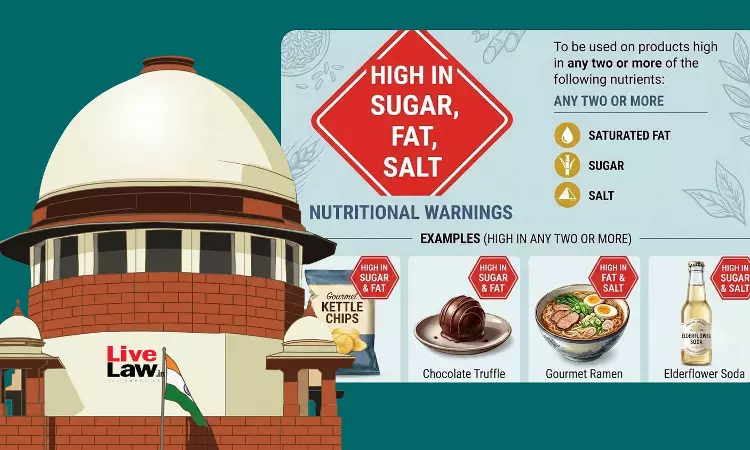
Following the Court's intervention, FSSAI initially proposed a two-phase regime under which warnings in the first phase would apply to products high in two or more specified nutrients, before extending the regime to products high in any one nutrient. The petitioner opposed the “two-or-more” threshold as scientifically unjustified.
On September 10, the Supreme Court raised questions over FSSAI's approach, particularly whether ultra-processed foods should be subjected to the same nutrient thresholds as other packaged foods. The Court referred to the 2024 Dietary Guidelines' classification of foods into Group A (minimally processed), Group B (moderately processed) and Group C (excessively processed, with additives), and questioned whether the distinction between Groups B and C should be reflected in the FoPL framework.
The Court also sought clarification on FSSAI's decision to use added sugar and added fat for determining the thresholds, noting that a 2021 stakeholder consultation had reached a consensus in favour of Total Sugar and Saturated Fat for FoPL purposes. It further questioned the treatment of trans-fat, the definition of sweetened beverages, the design and colour of the proposed warning, the possibility of increased use of additives following reformulation, and the timeline for mandatory implementation.
FSSAI has subsequently proposed that a warning be triggered when a product exceeds the prescribed threshold for any one of the specified nutrients. The revised proposal states that packaged foods would carry a red hexagonal warning on the front of the pack, placed against a white square background, identifying the nutrient or nutrients exceeding the prescribed threshold. The thresholds are proposed to be based on the Dietary Guidelines for Indians, 2024, issued by the ICMR-National Institute of Nutrition. FSSAI proposed that the regime would apply on the basis of nutrient content irrespective of the degree of processing of the food.
FSSAI's latest proposal envisages a red hexagonal warning (broadly based on the Canadian model) for products exceeding the threshold for one or more nutrients. It has maintained that the thresholds for added sugar, added fat and salt would apply irrespective of whether a product falls into different categories based on the extent of processing.
FSSAI has also proposed that products containing non-caloric sweeteners may carry a separate front-of-pack warning stating “CONTAIN NON CALORIC SWEETENER”. It has proposed a 365-day voluntary implementation period after notification of the regulations and said that approximately four months would be required to issue and finalise the draft regulations before they undergo the prescribed consultation process.
Case: 3S and Our Health Society v. Union of India | MA 1177/2025 in W.P.(C) No. 437/2024
Tags

Amisha Shrivastava
Amisha Shrivastava is a Senior Correspondent with LiveLaw, covering the Supreme Court of India. She can be reached at amisha@livelaw.in

