


Arbitration
Not Awarding LD- Finding Of Fact By Arbitrator, Need Not To Be Interfered: Calcutta High Court
The Calcutta High Court has reiterated that damage or loss is sine qua non for the applicability of Section 74 of the Indian Contract Act, 1872 and thus, in the absence of loss, penalty/liquidated damages cannot be claimed on breach of contract. The bench of Justices I. P. Mukerji and Md. Nizamuddin ruled that the finding arrived at by the Arbitrator, to the effect that the party...
Challenge Relating To The Bias Of An Arbitrator Cannot Be Raised Under Section 14 Of The A&C Act: Delhi High Court
The High Court of Delhi has held a challenge to the mandate of the arbitrator on the ground of bias and a justifiable doubt with respect to the independence and impartiality cannot be raised under Section 14 of the A&C Act. The bench of Justice Yashwant Varma held that Section 14 of the Act confers the power on the Court to terminate the mandate of the arbitrator and...
Application Of Hudson's Formula For Computation Of Loss In Construction Contract, Not Unreasonable: Bombay High Court
The Bombay High Court has ruled that while deciding the petition under Section 34 of the Arbitration and Conciliation Act, 1996 (A&C Act), the Court is not precluded from considering the findings and conclusions contained in the dissenting opinion of a minority member of the Arbitral Tribunal. The bench of Justice Manish Pitale observed that the majority opinion in the arbitral...

Arbitration Cases Weekly Round-Up: 4 December To 10 December, 2022
Bombay High Court: Clause Merely Providing Departmental Remedies, For Faster Resolution Of Disputes; Does Not Constitute An Arbitration Agreement: Bombay High Court Case Title: M/s. Mehra & Company versus State of Maharashtra The Bombay High Court has ruled that the power of appointment of arbitrator by the High Court under Section 11 of the Arbitration and Conciliation...
Signing A Blank Discharge Voucher Indicates That A Party Was Acting Under Pressure And Compulsion: Delhi High Court
The High Court of Delhi has held that the fact that a party signed on a blank Discharge Voucher indicates that it was acting under pressure and compulsion and did not sign the document out of free will. The bench of Justice C. Hari Shankar held that a discharge voucher signed out of economic duress and compulsion would not extinguish the legitimate claims of a party and it would be...
Disclosure By The Arbitrator Is Not A Discretionary But A Mandatory Requirement, Non-Disclosure Vitiates The Award: Delhi High Court
The High Court of Delhi has held that disclosure by the arbitrator under Section 12 r/w 6th Schedule of the A&C Act is not a discretionary but a mandatory requirement. The Court held that the failure of the arbitrator to disclose a fact that might give rise to a justifiable doubt as to his impartiality vitiates the arbitral proceedings as well as the consequent award. The bench...

SAMA Hosts The 6th Indian Mediation Week
Indian Mediation Week, 6th Edition witnessed Enterprises discussing potential of ODR and top ADR/ODR professionals being felicitated in 'Resolutionary of the Year' Ceremony.To ease the growing burden on India's judiciary, Mediation is an accessible alternative whose awareness remains critically low. This gap in awareness is the chief problem IMW seeks to address while also recognising...
High Court Cannot Review The Order Passed Under Section 11 Of The A&C Act: Delhi High Court
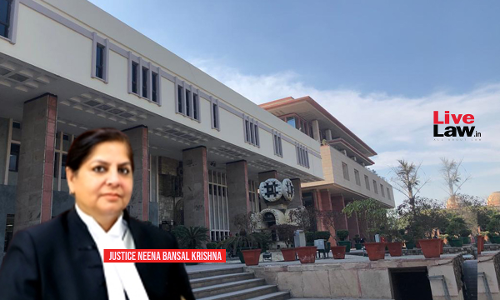
The High Court of Delhi has held that the High Courts cannot review an order passed under Section 11 of the A&C Act as the Act does not contain any provision for review. The bench of Justice Neena Bansal Krishna held that power of review is not an inherent power but the creation of a statute, therefore, it cannot be exercised absence of a provision. The Court held that unlike...

Clause Merely Providing Departmental Remedies, For Faster Resolution Of Disputes; Does Not Constitute An Arbitration Agreement: Bombay High Court
The Bombay High Court has ruled that the power of appointment of arbitrator by the High Court under Section 11 of the Arbitration and Conciliation Act, 1996 (A&C Act), cannot be deemed to have a precedential value. However, the Court held that the same cannot be a reason to completely ignore the interpretation placed by the High Court in its previous decisions, in respect of...
An Issue As To Which Party Would Bear The GST Expenses Under The Agreement Is Arbitrable: Delhi High Court
The High Court of Delhi has held that an issue that purely relates to the inter se liability of the parties regarding the burden of GST is not related to the taxing power of the State, therefore, the same is arbitrable. The bench of Justice Yashwant Varma held that a dispute surmised on the Pricing Clause in an agreement wherein the inter se liabilities of the parties regarding...

A&C Amendment Act of 2015 Applies Even If Arbitration Commenced Prior, In Case It Is Stated That Amendment Act Applies: Bombay High Court
The Bombay High Court has ruled that where an arbitration agreement between the parties provided for the application of the Arbitration & Conciliation Act, 1996 (A&C Act), along with any statutory modification or re-enactment to the A&C Act, existing at the time being in force, it constituted an agreement between the parties as contemplated under Section 26 of the...
![[Arbitration & Conciliation Act] Proceedings U/S 9 Interim In Nature, Not Meant For Enforcement Of Conditions Of Contract: JKL High Court](https://www.livelaw.in/h-upload/2022/09/20/500x300_435912-justice-wasim-sadiq-nargal-jammu-and-kasmir-and-ladakh-high-court.jpg "[Arbitration & Conciliation Act] Proceedings U/S 9 Interim In Nature, Not Meant For Enforcement Of Conditions Of Contract: JKL High Court")
[Arbitration & Conciliation Act] Proceedings U/S 9 Interim In Nature, Not Meant For Enforcement Of Conditions Of Contract: JKL High Court
The Jammu and Kashmir and Ladakh High Court on Monday ruled that final relief cannot be granted under Section 9 of the Arbitration and Conciliation Act, 1996 as proceedings under the said provision are of interim measure and are not meant for enforcement of the conditions of the contract, which can be done only when the rights of the parties are finally adjudged or crystallized by...