




Articles
Court Auction Sale Certificates And Stamp Duty
The Indian Registration Act, 1908 and the Indian Stamp Act, 1899 are two distinct statutes governing separate aspects of the legal validity of instruments. Though both statutes may operate upon the same instrument, they function independently and serve different legislative purposes.Whenever an instrument that is chargeable with stamp duty is executed, it must be engrossed on stamp paper of sufficient value as prescribed under the Schedule to the Stamp Act. Even where an instrument is not...

Weaponizing Judicial Delay. How Insurance Companies Convert Pending Trials Into Profits
Insurance Contracts are fundamentally anchored as the instruments of social and financial security. Drawing its purpose from the principle of uberrimae fidei (utmost good faith), these contracts are not merely commercial arrangements, but are a welfare-oriented mechanism that provides financial stability in times of crisis. However, the operational reality of the insurance industry goes far from the moral standards and is dictated by corporate profit motives, wherein the insurers seek to...
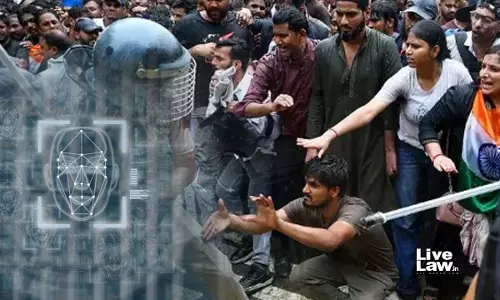
When State Watches Protest: Constitutional Limits Of Facial Recognition Surveillance
Last month, as students gathered at Jantar Mantar demanding accountability for the NEET paper-leak scandal, a mobile command vehicle rolled in behind them, its telescopic mast fitted with cameras sweeping a 360-degree arc over the crowd. Photographs circulated of the vehicle, of AI-enabled smart spectacles worn by personnel, and of handheld scanners pointed at faces in the assembly. Within days, two separate constitutional challenges had been filed one by student activist Aishe Ghosh before the...

Cannabis, Caste, And NDPS Act's Unexamined Asymmetry
Start with two scenes, both in March, both in India. In Varanasi, a government-licensed shopkeeper ladles bhang thandai outside his stall. Crowds move through the ghats. Nobody is arrested. Somewhere else, a basti, a migrant workers' colony, a daily-wage worker is stopped by police and five grams of ganja are found on him. He is arrested under the Narcotic Drugs and Psychotropic Substances Act, 1985. Getting bail may not be straightforward. Depending on the circumstances, he could spend months...

India's AI Boom Is Heading For Water Reckoning
The country wants to be the back-end of the global AI economy. Its water tables may not survive the ambition, and its law has little to say about the danger.Artificial intelligence lives in the cloud, but the cloud must be cooled on land. Increasingly, that land is water-stressed India.In December 2025 Satya Nadella, Microsoft's chief executive, stood beside Prime Minister Narendra Modi to pledge $17.5 billion for data centers across India, its largest in Asia. Google had already promised $15...
Madhya Pradesh's New E-Sakshya Rules Solve Custody, Not Proof
Madhya Pradesh has carefully built the digital "plumbing" for handling electronic evidence. But three choices in the design - an imbalance that favours the police, a fee rule that can quietly discourage genuine challenges, and a storage system that still depends on borrowed infrastructure will decide whether that plumbing actually delivers a fair trial.On 25 June 2026, the Madhya Pradesh Home Department notified the Madhya Pradesh Electronic Records Rules, 2026. These Rules apply to every...
Logjam In MSME Recovery Mechanism
The micro, small and medium enterprises (MSMEs) of our country have often been referred to as the backbone of India's growth. Data from official sources would reveal that in the year 2009 there were only 3.62 crore registered units. Today, there are more than 8.87 crore such enterprises accounting for about 35% of India's total manufacturing capabilities and 31% of the total GDP. Various schemes have been established over the years to ensure that that the MSME sector thrives, such as subsidies,...
Five Two-Judge Benches, No Referral: Supreme Court's Unfinished Business On Grounds Of Arrest
The Conflict the Court left UnresolvedOn 9 July 2026, a Supreme Court bench did something Indian criminal jurisprudence rarely witnesses. It acknowledged that the Court's own precedents were in conflict. A bench comprising Justice Manoj Misra and Justice Shree Chandrashekhar was hearing a petition challenging the grant of bail to Sonam Raghuvanshi. During the hearing, Justice Misra placed before the Solicitor General a series of irreconcilable authorities: Pankaj Bansal, requiring that the...

Development Of The First Information Report: From Police Record To Constitutional Protection
The most immediate difficulty regarding E-FIR concerns the three-day signature requirement. An informant may be hospitalised, physically incapacitated, displaced, residing outside the jurisdiction, or otherwise unable to comply with the requirement within the stipulated period. In such circumstances, a rigid insistence upon physical signature may convert an access-enhancing mechanism into an additional procedural obstacle.

APAAR Opt-Out Mandate And DPDP Act: Reinstating Parental Choice In Student Surveillance
Who decides how long a child's disciplinary record at school is maintained? Along the same lines, when your child's admission card comes with a lifelong digital surveillance tag, can a parent say no, or just put his signature across the dotted lines?The "One Nation, One Student ID" framework through the Automated Permanent Academic Account Registry (APAAR) scheme brought these questions to the forefront, with the enormity and diversity of student data being collected and recorded by schools as...
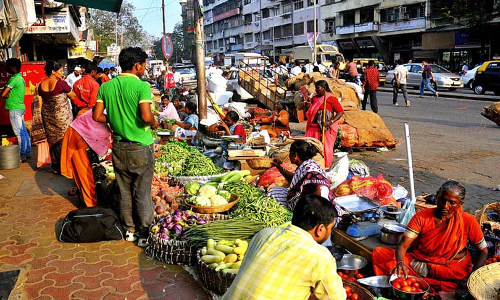
Footpaths, Freedom And Livelihood: Reconciling Right To Walk With Right To Vending
The Supreme Court, in Maniyar Iliyaz v. P. Ayyappan & Ors., has recognised the right to walk as an fundamental right of the Constitution. By elevating unobstructed pedestrian movement to the status of a constitutional right, the Court has reinforced the principle that public footpaths exist primarily for pedestrians and that safe, convenient, and unhindered movement is an essential element of human dignity and personal liberty. The judgment thus strengthens the constitutional obligation of...
Flat Fine Fallacy: How Jan Vishwas Betrays Equality It Promised
On 2nd April, 2026, the Parliament passed the Jan Vishwas (Amendment of Provisions) Act, 2026, (“the 2026 Act”) with the Lok Sabha and Rajya Sabha clearing it a day apart. The Act touches 784 provisions across 79 Central laws, carrying forward the decriminalisation drive that began with the 2023 Act of the same name. The applause was justified. Sending someone to jail for a paperwork slip is a colonial hangover nobody should miss.However, three and a half months on, the Act is being notified in...