Explained | Controversy Surrounding UP Judge Ravi Kumar Diwakar
Sparsh Upadhyay
12 Sept 2026 12:03 PM IST
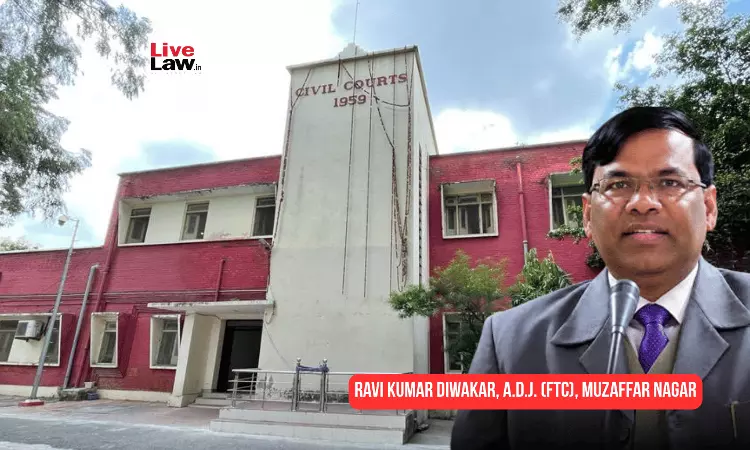
From praising the UP Chief Minister and handing down 22 death sentences in nearly 5 months, Judge Ravi Kumar Diwakar has repeatedly found himself at the centre of controversy.
Posted in Uttar Pradesh's Muzzaffarnagar District, Additional District and Sessions Judge Ravi Kumar Diwakar is back in the news following a September 7, 2026, judgment in which he said he would "rather die than be called a coward judge".
Judge Diwakar's observations appear to be a response to the administrative action that withdrew 97 pending murder and other serious-crime cases from his court. The September 7 sentence was his 23rd death sentence in roughly five months: he had awarded 22 death sentences across 10 cases between April and August 2026.
The 38-page judgment imposed the death penalty on Nadeem, a resident of Shahpur in Muzaffarnagar, for killing his 23-year-old wife, Shahzadi, by pouring kerosene on her and setting her on fire. The judgment records that she suffered burns over 98 percent of her body.
These developments have brought renewed attention to a judge whose orders have made headlines several times in recent years.
Judge Diwakar first came into the spotlight in 2022, when he was serving as a civil judge in Varanasi, passed orders for the sealing of the spot in the Gyanvapi mosque case, where a Shivling was claimed to have been found during a commission survey.


His role in the Gyanvapi case brought considerable public attention. In his subsequent judicial orders, he also referred to pressures and threats he and his family said they faced after issuing those orders in the case.
"An atmosphere of fear prevails in my family and me in such a way that it is not possible to express it in words. Everyone in the family is worried about each other's safety. One has to think many times before leaving the house. Especially, my mother remains worried about my safety," he had said.
His latest judgment also records that the Uttar Pradesh Anti-Terrorism Squad registered a case in 2025 against a person accused of threatening him on social media in connection with the Gyanvapi proceedings.
Earlier, in March 2024, Judge Diwakar also made headlines while posted in Bareilly. While summoning Maulana Tauqeer Raza Khan to face trial in connection with the 2010 Bareilly riots, he praised Uttar Pradesh Chief Minister Yogi Adityanath as an example of the "religious person" that power needs.
Comparing CM to Plato's concept of the Philosopher King, Judge Diwakar observed thus:
"...the head of power should be a religious person because the life of a religious person is not one of enjoyment but of sacrifice and dedication. An example of this is the Peethadeshwar of the great Siddhapeeth Gorakhnath Temple, Mahant Baba Shri Yogi Adityanath ji, who is the current chief minister of Uttar Pradesh, and has proven the above concept to be true…If a religious person sits on the seat of power, it gives very good results, as propounded by the philosopher Plato in his concept of the 'Philosopher King' in his book Republic. Plato said that there would be no end to suffering in our city-state until it had a philosopher king".
This order again referred to Judge Diwakar's earlier Gyanvapi orders and the threats he said his family had faced since then.
On March 19, 2024, the Allahabad High Court had expunged Judge Diwakar's remarks about the Chief Minister, describing them as an “unwarranted expression containing political overtones and personal views”.
Series of death sentences
Judge Diwakar's latest judgment and several of his preceding verdicts have brought a different aspect of his judicial work into focus, the number and frequency of death sentences awarded by his court.
Between April and August 2026, he awarded death sentences to 22 people in 10 cases. On September 7, he awarded the 23rd death sentence to Nadeem.
In the Nadeem case, Judge Diwakar relied on several Supreme Court judgments dealing with capital punishment, including Machhi Singh v. State of Punjab and Bachan Singh v. State of Punjab. He concluded that the case fell within the "rarest of rare" category and that life imprisonment would not meet the ends of justice.
In the judgment, Judge Diwakar also posed a direct question to the public while explaining his decision. He wrote that he wanted to ask "the great people of India" how a court should treat a person who had burnt a woman alive, and whether such a person deserved sympathy.
He then answered that, in his view, such a person was not entitled to sympathy and that the maximum punishment, the death penalty, was appropriate.
The judgment also records the prosecution's submissions on the law-and-order situation in Muzaffarnagar.
The public prosecutor submitted that the Uttar Pradesh Government's policy of taking stringent action against criminals, including police encounters, seizure of criminals' property and detention under the National Security Act, had contributed to a decline in crime in the district. Judge Diwakar recorded that the court found this submission “correct”.
However, his observations on the UP Govt policies in question sit at odds with the record of the Allahabad High Court. In the past months, the Allahabad HC has been critical of UP Police's encounter incidents and NSA detention.
In his judgment, Judge Diwakar also criticized the recall of 97 cases from his court.
Judge Diwakar wrote that he knew why the files had been recalled but chose not to elaborate, stating that "the office too has its dignity". He, however, added that the purpose of the decision was to give a reprieve to Mafia/Gangsters.
In his judgment, he also stated that he had received a message from a person describing himself as "a mafia or gangster from the west-UP".
According to the judgment, the person said that only the files had been removed for the time being and warned that, if Judge Diwakar pursued the matter or commented on it, his court could be changed or he could be transferred out of the district because their "contacts reach very high levels".
In the judgment, Judge Diwakar said that such threats would not deter him and wrote that he would "rather die than be called a coward judge".
He also directed that a copy of the judgment be sent to the Uttar Pradesh Chief Secretary. He said that in the future, when serious criminal cases are transferred from one court to another, the District Government Counsel should be given an opportunity to place the State's position before the transfer.
The judgment also contains several pages on the recall of the cases and related issues, alongside discussions on religion, morality and literature, including accounts of Adam and Eve and the stories of Laila-Majnu and Shirin-Farhad.
His September 7 death sentence is not final at this stage. As per Sections 407-412 BNSS, a death sentence passed by a Sessions Court must be submitted to the High Court for confirmation before it can be executed.
Judge Diwakar has been posted in Muzaffarnagar since November 2025.
Earlier, in December 2024, referring to the selfless love between Lord Rama and Bharata in the Hindu epic Ramayana, Judge Diwakar, then posted in Bareilly, sentenced a father-son duo to death for killing the father's brother over a property dispute.
Judge Diwakar had observed that while Lord Rama's brothers Lakshman and Bharata fulfilled their duties as brothers, setting an example of great sacrifice and devotion, the actions of the accused, on the other hand, starkly contrast with this ideal.