




Supreme court
FERA Complaint Cognisance Vitiated If There Was No Notice To Accused : Supreme Court
The Supreme Court on Tuesday held that a Magistrate cannot validly take cognizance of a criminal complaint under the repealed Foreign Exchange Regulation Act, 1973 (FERA) if the mandatory "opportunity notice" required under Section 61(2) of the Act was not served upon the proposed accused.“…the service of an opportunity notice under the proviso to Section 61(2) of FERA is a...
'Even In Terror Cases, Constitutional Safeguards And Right To Fair Trial Cannot Be Diluted': Supreme Court
'The greater the public outcry, the greater becomes the responsibility of the Court to ensure that the determination of guilt is based solely upon law and evidence' - Court
Supreme Court Upholds Husband's Conviction For Wife's Murder, Finds Extra Marital Affair Motive Established
The Supreme Court on Monday (July 20) upheld the conviction of a husband for the murder of his wife, holding that the substantial number of call exchanges with his lover constituted valid circumstantial evidence establishing both the existence of an affair and the motive to remove the wife as a barrier to their relationship.A bench of Justice Dipankar Datta and Justice Satish Chandra...
1996 Samleti Bus Bomb Blast: Supreme Court Orders Fresh Trial Of Death Row Convict Citing Ineffective Legal Representation
The Supreme Court on Tuesday (July 21) set aside the death penalty of Dr. Abdul Hameed, who was convicted in the 1996 Samleti Bus Bomb Blast involving an IED which detonated on a passenger bus travelling from Agra to Bikaner near Samleti village, killing 14 persons and injuring 37 others.The bench of Justices Vikram Nath, Sanjay Karol and Sandeep Mehta set aside the 2019 Rajasthan High...
LiveLaw Supreme Court Half-Yearly Digest 2026 - Arbitration and Conciliation Act
A party at fault cannot be permitted to set up a bar of non-performance of prerequisite obligations to exclude the operation of an arbitration clause - If a party's conduct such as failing to adhere to strict timelines for Engineer decisions or Adjudicator recommendations disables preceding steps, those procedural prerequisites are deemed waived. [Relied on M.K. Shah Engineers &...
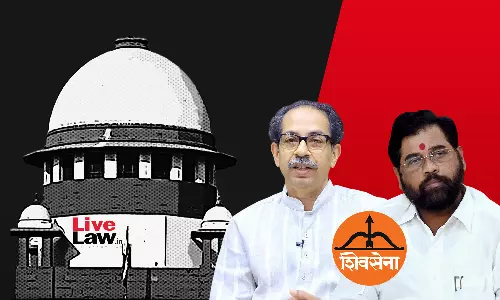
Shiv-Sena UBT Moves Supreme Court Against Lok Sabha Speaker Approving Merger Of Its 6 MPs With Shinde Sena
Shiv Sena Uddhav Balasaheb Thackeray faction approached the Supreme Court on Tuesday (July 21) against Lok Sabha Speaker approving merger of its 6 Members of Parliament with the Eknath Shinde-led Shiv Sena. The matter was mentioned by senior advocate Devadatt Kamat before a bench led by Chief Justice Surya Kant seeking urgent listing of the plea. As the court asked about the urgency, Kamat...
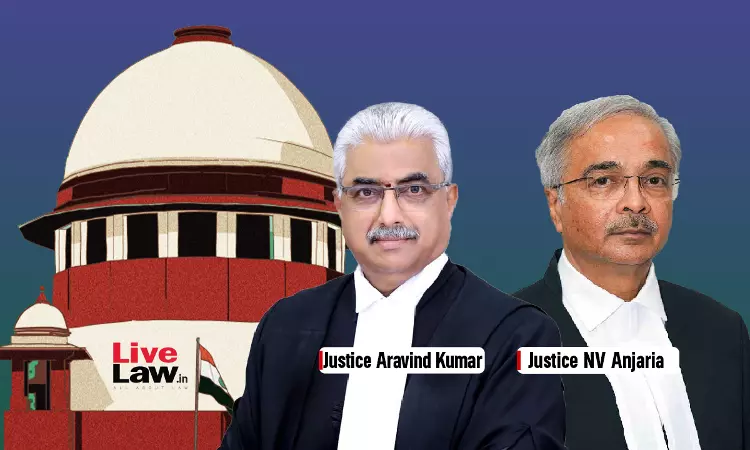
Supreme Court Revives Over ₹16 Crore Service Tax Demand Against BPCL & HPCL For Facilitating CNG Sales For Mahanagar Gas
The Supreme Court on Monday (July 20) restored the service tax demands exceeding ₹16 Crore against the Bharat Petroleum Corporation Ltd. (BPCL) and Hindustan Petroleum Corporation Ltd. (HPCL), who acted as 'commission agents' of the Mahanagar Gas Limited (MGL) while selling Compressed Natural Gas (CNG) through their retail outlets. Referring to the agreement, a bench of Justice Aravind...
'Was Aged Only 25 Yrs, Reformation Possible' : Supreme Court Reduces Life Term Of Gang Rape Convict To 20 Yrs
The Supreme Court on Monday (July 20) modified the sentence of a life convict in a gang rape case to a minimum sentence of twenty years, after noting that the convict is young, has no criminal antecedents, and there's a possibility of reformation. “When a sentence is imposed on an offender, it is done so with trifold purpose i.e. punitive, deterrent and protective. The overall objective is...
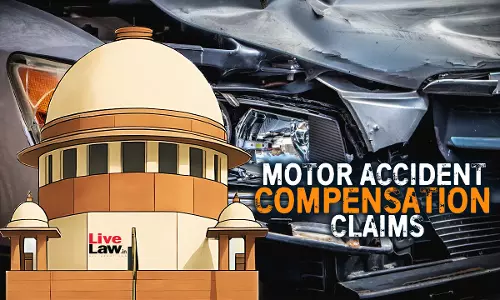
Supreme Court Expresses Concern Over Quality Of MACT Judgments, Calls For Clear And Reasoned Findings
The Supreme Court on Monday (July 20) expressed displeasure with the lack of legal reasoning in the Motor Accident Claim Tribunals' decisions. The Court observed that many tribunal orders merely reproduce pleadings and evidence without adequately explaining how the facts lead to the ultimate conclusion. “The Tribunals are bodies that people approach, seeking compensation as a consequence...
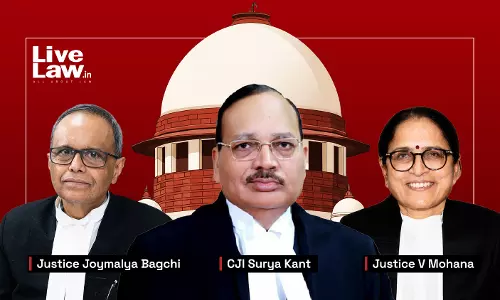
HC Judges' Post-Retirement Benefits Must Be Uniform Across Country : Supreme Court Asks Centre To Form Committee
The Supreme Court on Monday directed the Union Government to constitute a committee within two weeks to frame uniform guidelines on post-retirement facilities for former Chief Justices and judges of High Courts, observing that essential amenities currently vary widely from State to State.A Bench led by Chief Justice of India Surya Kant, along with Justice Joymalya Bagchi and Justice V Mohana,...
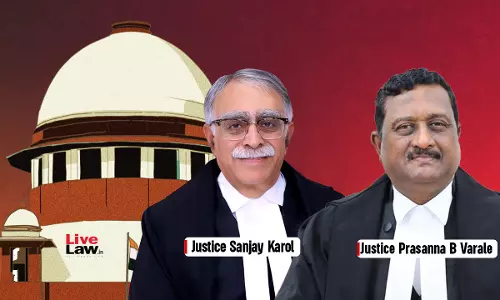
Prescribing Minimum Viva Voce Cut-Off For Judicial Appointments Is Reasonable: Supreme Court
The Supreme Court recently dismissed a civil appeal by a judicial aspirant challenging a proviso to Rule 41 of the Rajasthan Judicial Service Rules, 2010, on the grounds that he had participated in the whole process without raising any issue. The proviso prescribed a minimum of 25% marks in the interview for the appointment of Additional District Judges from the advocates' quota before it...

LiveLaw Breaking News Alerts: 20/07/2026
LiveLaw is introducing a new feature —'Breaking News Alerts' — designed to keep our readers instantly updated on the most important judicial developments. With real-time coverage of urgent pronouncements and orders from the Supreme Court and High Courts, this feature ensures that critical updates reach you the moment they happen. Whether it's a landmark ruling or an urgent interim...