



Supreme court
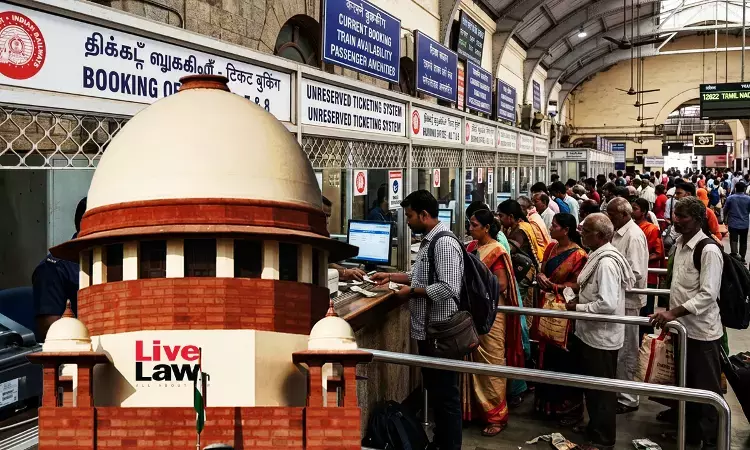
Give Insurance Cover To Tickets Sold Over Counter Like Online Tickets : Supreme Court Directs Railways
In a significant case, the Supreme Court has ordered Indian Railways to provide insurance coverage to tickets purchased at the railway reservation counters within two weeks, with effect from October 27. It said the insurance coverage should be the same as when tickets are purchased online. A bench comprising Justice Ahsanuddhin Amanullah and Justice R. Mahadevan passed this order while hearing a matter pertaining to the safety of the common man and prevention of untoward incidents while...

Income Tax | Fresh Claim Cannot Be Raised Before Revisional Authority Without Timely Revised Return : Supreme Court
The Supreme Court has held that a fresh claim before the Revisional authority cannot be filed by the assessee without filing a revised return in accordance with law. A bench of Justice Prashant Kumar Mishra and Justice Shree Chandrashekhar dismissed an assessee's plea against the Orissa High Court's decision to uphold the income tax authority's decision to decline the fresh claim of the assessee without filing a revised return within a stipulated time period. Briefly put, for the assessment...
Non-Signatories Can Be Joined In Arbitration If Dispute Affects Their Rights: Supreme Court
The Supreme Court has held that a non-signatory to an arbitration agreement may be included in arbitration proceedings when the dispute substantially affects their rights, emphasising that the determination of whether someone is a “veritable party” depends on the facts and circumstances of each case. A bench of Justice J.B. Pardiwala and Justice K. Vinod Chandran observed that the question cannot be resolved through a rigid formula, as the relationship between the parties and their interests in...
Drug Users Are Victims, Focus Should Be On Breaking Supply Chain Rather Than Punishing Them: Supreme Court
Prosecuting alleged drug users and incarcerating them pending trial may push them further into the narcotics supply chain through prison associations, the Court cautioned.
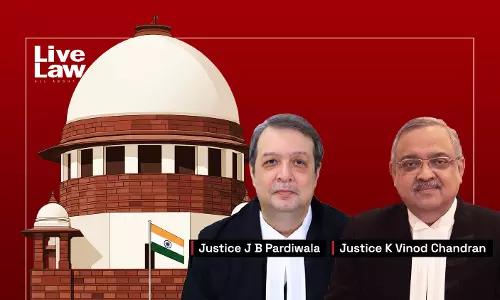
Section 161 CrPC Statements Cannot Be Relied On At Trial But Can Be Considered At Cognizance Stage : Supreme Court
The Supreme Court has held that although the statements recorded by the police under Section 161 Cr.P.C./Section 180 BNSS cannot be relied on at trial, they can be considered at the cognizance stage. “Section 161 CrPC statements, obviously, cannot be relied on at the trial, but definitely could be gone into at the time of cognizance, since that is the material available before the Court,...
Supreme Court Daily Round-Up : October 12, 2026
Links to the reports of October 12 :SCAORA Moves Supreme Court Seeking Probe Into Delhi Police Actions Against Lawyers During CEC Protest'Every Lawyer Has Right To Be Part Of Peaceful Protests': CJI Surya Kant Amid Protests Against CEC Gyanesh KumarThere Should Be No Impediment In Movement Of Lawyers, Court Staff : CJI Surya Kant Amid CEC ProtestsSCBA Moves Supreme Court Over Lawyers'...
Arbitration | Governing Law Clause Relevant For Seat Determination Where Agreement Mentions Two Venues : Supreme Court
The Supreme Court on Monday (October 12) held that where an arbitration clause mentions two places for arbitration without clearly designating one as the juridical seat, the governing law clause conferring exclusive jurisdiction on courts at a particular place becomes relevant in determining the parties' intention to identify the seat of an arbitration. “that mere expression “place...
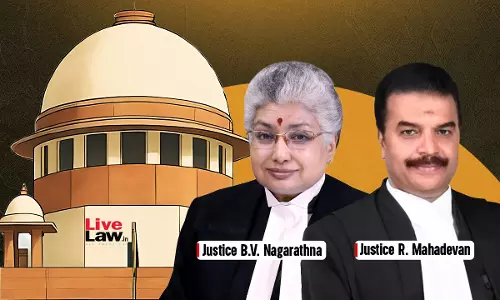
Order VI Rule 17 CPC | Amendment Permissible If Additional Facts & Reliefs Have Direct Nexus With Existing Controversy: Supreme Court
"The real inquiry is whether the amendment introduces a distinct and independent controversy having no connection with the original cause of action, or whether it merely brings on record additional facts and consequential reliefs having a direct nexus with the existing controversy."
Past Ad Hoc Service Can Count For Pension, Not For Seniority Claim Over Direct Recruits: Supreme Court
The Supreme Court has held that the temporary or ad hoc appointees cannot claim parity in matters of the determination of seniority with the direct recruitment appointees. In essence, an ad hoc / temporary appointees seniority would be determined from the date of their confirmation in service, not from the date of their initial appointment. The bench comprising Justice SVN Bhatti and...
LiveLaw Supreme Court Weekly Digest: September 1 - 10, 2026
Administrative Law — Precedents & Internal Departmental Notings — Legal Efficacy - Internal Departmental File Notings — Held - Departmental file notings do not carry the sanction of law to become an executable order - A noting recorded by an officer (such as the Executive Director / LAD of SEBI) represents mere internal viewpoints/opinions expressed for internal deliberations...
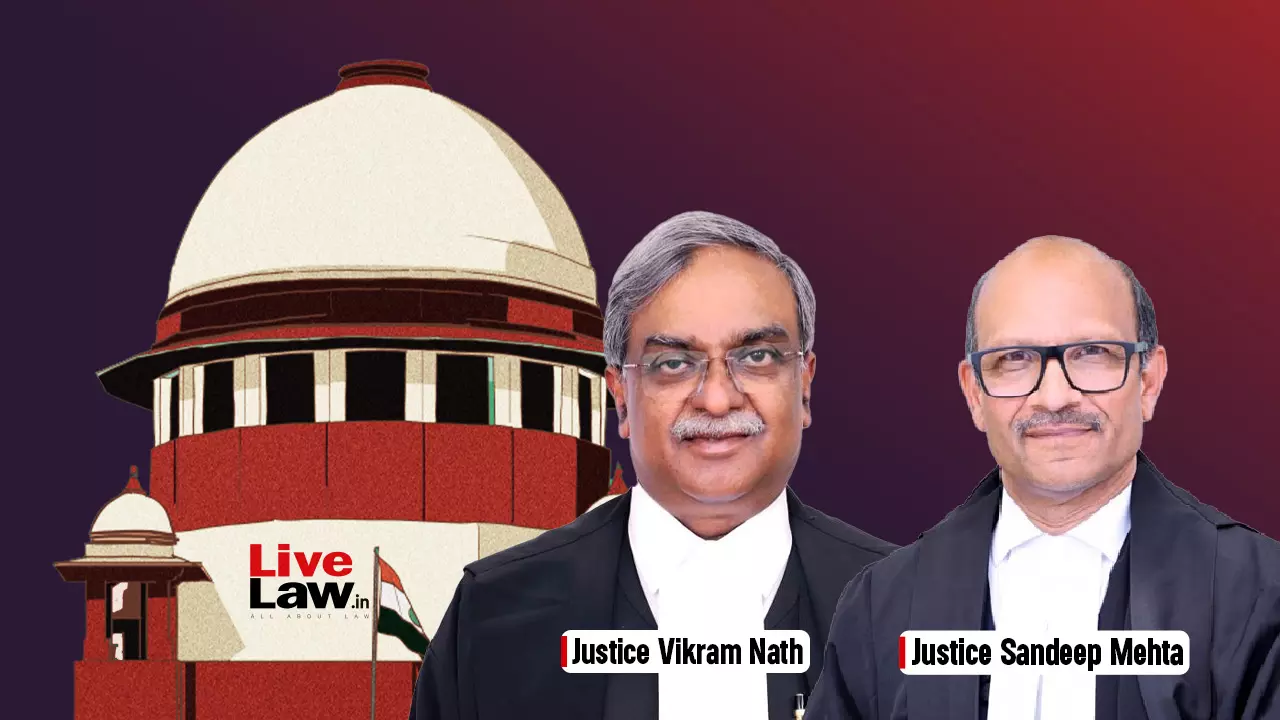
Supreme Court Acquits Man In POCSO Case Over Victim's Failure To Identify Him In Court, Unexplained Delay In FIR
The Supreme Court on Friday (October 9) has acquitted a man convicted under Section 6 of the Protection of Children from Sexual Offences Act, 2012 (POCSO Act) for sexually assaulting a minor girl with intellectual disability, holding that the prosecution had failed to prove his guilt beyond reasonable doubt.A bench of Justice Vikram Nath and Justice Sandeep Mehta set aside the concurrent...
Lawyers' Body Moves Supreme Court; Says Protests Cannot Paralyse Delhi, Impede Lawyers' Livelihood
A lawyers' body has moved the Supreme Court alleging that successive demonstrations by Cockroach Janta Party (CJP) in Delhi are aimed at attracting media attention and are disrupting the livelihood and professional functioning of advocates.The plea has been filed by Lawyers Voice seeking permission to intervene in contempt proceedings arising out of a plea concerning protests called by CJP....