



- Home
- /
- Top Stories
- /
- Supreme Court 7-Judge Bench...
Supreme Court 7-Judge Bench Disposes Reference On Legislative Privilege As Infructuous
Debby Jain
6 Oct 2026 11:05 AM IST
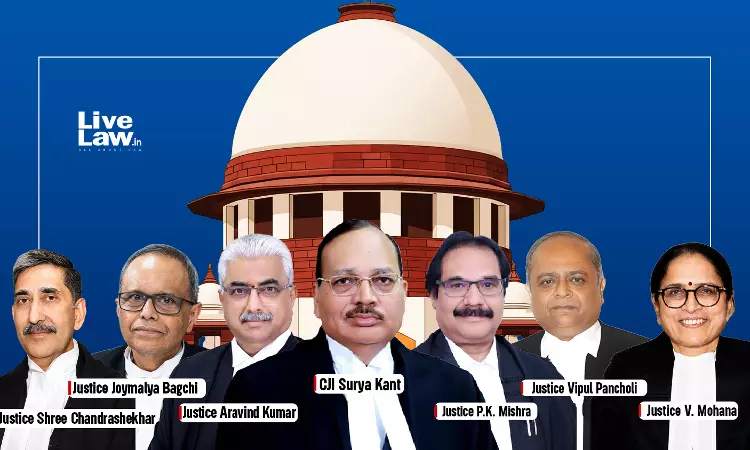
The Supreme Court today closed the 7-judge reference on the issue of legislative privileges vis-a-vis free speech, noting that the 2003 resolution of the Tamil Nadu legislative assembly, which was the trigger for the case, was withdrawn in 2004.A bench comprising CJI Surya Kant, Justice Aravind Kumar, Justice PK Mishra, Justice Joymalya Bagchi, Justice Vipul Pancholi, Justice Shree...
This is a premium content
Available exclusively to
Our subscribers
Subscribe Premium 
INR 1099+GST
Your support helps us to bring you more content at
an affordable subscription scheme !!!
All payment options available
The Supreme Court today closed the 7-judge reference on the issue of legislative privileges vis-a-vis free speech, noting that the 2003 resolution of the Tamil Nadu legislative assembly, which was the trigger for the case, was withdrawn in 2004.
A bench comprising CJI Surya Kant, Justice Aravind Kumar, Justice PK Mishra, Justice Joymalya Bagchi, Justice Vipul Pancholi, Justice Shree Chandrashekhar and Justice V Mohana was constituted to hear the matter, which had been pending for nearly 2 decades.
Today, while disposing of the matter as infructuous, the bench noted that the withdrawal of the impugned resolution skipped the notice of the Court while passing the reference order.
The bench observed that the cause of action for the reference has become infructuous, and closed the matter. However, the bench left the questions of law open for adjudication in an appropriate case.
After the order was dictated, Senior Advocate AM Singhvi commented in a lighter vein that the Court has set two records - shortest hearing and quickest disposal of a 7-judge matter.
Yesterday, on mentioning of the matter, CJI Surya Kant had expressed that the reference might be disposed of as an academic issue.
The reference originated from the 2003 case N. Ravi v. Speaker, Legislative Assembly, Chennai, challenging the 2003 decision taken by the Tamil Nadu assembly to sentence 5 journalists of The Hindu for articles criticizing the State Government. The matter was ultimately referred to the 7-judge bench to examine the interplay between Articles 194(3), 19(1)(a) and 21 of the Constitution. The reference remained pending for over two decades, and the Court, in August 2026, decided to commence the hearing from October 6.
Yesterday, Senior Advocate Raju Ramachandran, for the State of Tamil Nadu, informed a 3-judge bench led by CJI Surya Kant that the 2003 resolution of the Assembly was revoked in 2004 itself. Though an affidavit was filed in the Court regarding this development, this fact was omitted to be noticed in the reference order. Since the cause of action for the case no longer survived, the reference may have become academic, Ramachandran suggested.
Ramachandran also said that he was making the mentioning so that the 7-judge bench was not taken by surprise on the hearing day.
Solicitor General of India Tushar Mehta also said that the issue may have become academic in the light of the information. The Chief Justice expressed that the Court will not indulge in a mere academic exercise. "If the issue survives, we will decide. If it doesn't, we can wait for a proper opportunity. Other part-heard cases can be heard instead," CJI said.
The CJI added that the 7-judge bench will assemble on the scheduled date at 10.30 AM and formally dispose of the reference by recording the fact that the impugned resolution had been withdrawn. The CJI said that the 7-judge bench could be discharged, and the time could be used to hear other part-heard matters.
During the mentioning, Senior Advocate Kapil Sibal also remarked that the issue regarding misuse of legislative privileges was of "great significance", though the reference may have become academic.
Background
The case has its origins in an incident involving The Hindu newspaper in Tamil Nadu in 2003. In April that year, the newspaper published an editorial titled “Rising Intolerance”, which criticised then Chief Minister J. Jayalalithaa and her government. The Tamil Nadu Assembly subsequently alleged that the newspaper had distorted proceedings of the House and had made remarks amounting to a breach of privilege.
On November 7, 2003, then Speaker K. Kalimuthu passed a resolution holding that the publication amounted to a breach of the privileges of the House. The Assembly later resolved to arrest members of the newspaper's editorial staff.
Within hours of the resolution, police arrested The Hindu Editor N. Ravi, Executive Editor Malini Parthasarathy, Bureau Chief V. Jayant, Special Correspondent Radha Venkatesan and Publisher S. Rangarajan.
The journalists approached the Supreme Court challenging the Assembly's action. On November 10, 2003, a division bench comprising Justices Y.K. Sabharwal and S.B. Sinha stayed the arrests, observing that the House appeared to have misread the law while initiating proceedings against the journalists.
The proceedings, however, raised a larger constitutional question because of apparently conflicting Supreme Court decisions on legislative privilege and fundamental rights.
In Pandit M.S.M. Sharma v. Shri Krishna Sinha, the Supreme Court had held that the freedom of speech and expression guaranteed under Article 19 was not unaffected by the law relating to legislative privilege. In another decision, In Re: Under Article 143, the court had observed that fundamental rights could not simply prevail over legislative privileges.
The apparent conflict led the Supreme Court to consider the relationship between Articles 19(1)(a), 21 and 194. In December 2003, a two-judge bench referred the matter to a five-judge Constitution Bench, observing that substantial questions of law were involved.
The five-judge bench subsequently found that there were conflicting views on the issue and referred the matter to a seven-judge bench for authoritative determination.
The case remained pending for over two decades before it was decided in August 2026 that the final hearings will commence on October 6.
Ahead of the hearing, the Editors Guild of India, satirist Kunal Kamra, CPI(M) member Subhashini Ali,prominent journalists Ajit Anjum, Seema Chishti, Dhanya Rajendran, Paranjoy Guha Thakurta etc., sought to intervene in the matter, arguing that legislative privileges shouldn't be invoked against non-members in a manner curtailing press freedom.
Case : N. Ravi v. Speaker, Legislative Assembly Chennai | W.P. (Cri.) No. 206 - 210/2003
Tags
Debby Jain
Debby Jain is a Correspondent with LiveLaw, covering the Supreme Court of India

