


Articles
Important Judgments Pronounced By The Supreme Court In August 2020
The Supreme Court of India has pronounced numerous judgments in the month of August, 2020. In this write-up, some of the important judgments are briefly discussed. Mukesh v. State (Narcotic Branch ofDelhi), Special Leave Petition (Criminal) Diary No. 39528/2018 (Decided on31/08/2020). A Constitution Bench of the Supreme Court comprising Justices Arun Mishra, Indira Banerjee, Vineet Saran, M.R. Shah and S. Ravindra Bhat, held that in a case where the informant himself is the...

The Legal Quandry Over E-Pharmacies In India: Immediate Need For A Regulatory Framework
The advent of E-Commerce has changed lives around the World. Individuals have transitioned from brick and mortar stores to online platforms for procuring everything imaginable. One such ground-breaking development is the E-Pharmacy Sphere in India. E-Pharmacies are virtual platforms that take an order of medicines over the internet and deliver them to patients via mail or dedicated delivery companies. However, all isn't gold for the Industry players as they are riddled with a fair share of...

The Mess That Was NLAT 2020
Lord Hewart, the then Lord Chief Justice of England in the case of Rex v. Sussex Justices, gave the world the oft-quoted aphorism we all fall back to every once in a while - "Justice must not only be done, it must also be seen to have been done"The conduction of NLAT today, with supposedly good intentions and nothing more than an below average usage of technology to catch the cheaters, gave a huge dent to the perception of fairness of the law entrance examinations, the narrative which was so...
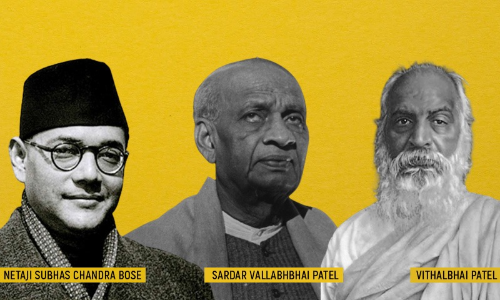
When Netaji Subhas Fought A Case In The Bombay HC
It was November 10, 1933. SS Narkunda had just dropped anchor at the Bombay Port. It had ferried the mortal remains of an elder brother who had passed away in Geneva on October 22, 1933 at 1 pm. On October 28, 1933, the embalmed body, in a sealed coffin, had been taken by road to Marseilles for this last journey by sea. Sarojini Naidu and Jamnadas Mehta had been cabled the sad news. The deceased had executed a Will which read: "In the event of my death in Europe, I desire ...
Parliamentary Privileges And The Fundamental Right To Free Speech: A Conundrum Of The Conflicting Entitlements
"There are more instances of the abridgment of the freedom of the people by gradual and silent encroachments of those in power than by violent and sudden usurpations." -- James MadisonIt is axiomatic that the parliamentary functioning forms the bedrock upon which a democratic structure and the whole constitutional system rest. The hallmark of a democratic country is a free, open and fearless discussion in the parliament. A variety of rights have been given to all the members of the houses to...
Importance Of Question Hour In A Parliamentary Democracy
The Hon'ble Supreme Court in the Keshavanada Bharti[1] case established that Parliamentary democracy is an integral part Basic Structure of our Constitution. The basic concept of the parliamentary governance is that it owes a collective responsibility towards the parliament and it holds the government accountable. Essentially, in a Parliamentary Democracy, the executive is made answerable to the parliament. The Indian democracy is completely based on the principles of debates and...

NLSIU's Home Proctored NLAT: How Far Equitable, Transparent & Secure
In my previous article, I had examined the issues of zero year and repeated postponements of CLAT and demonstrated that there is no danger of zero year even in trimester system and Consortium cannot be blamed for the postponements except September 7 as no national level admission was conducted before September. If Act of God defence is available to the government for the minus 23.9% GDP, it should equally be available to Consortium of National Law universities for the CLAT postponements ...
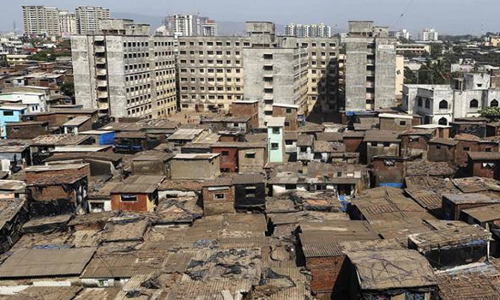
Supreme Court Order Evicting Slum Dwellers Violates Their Basic Human Rights To Housing, Shelter And Livelihood
In August 2020, a three-judge bench of the Supreme Court of India ordered removal of 48000 slum dwellings that were around a 140-km railway track in Delhi without providing for any rehabilitation scheme (henceforth called the "Supreme Court Order").[1] They were ordered to be removed as they were considered to be in the Railway safety zone. The order asks the stakeholders to come up with a comprehensive plan for removal of the slums within just three months. In the middle of a pandemic,...

Arjun Panditrao Decision- The Time To Revisit S.65B Of Indian Evidence Act: A Scientific Legal Analysis
"Every new time will give its law" - Maxim Gorky, The New Lawyer's Wit and Wisdom In its quest to emplace the judicial discipline relating to admissibility of any electronic record and to obviate the controversies created by the previous judgments as to whether certificate under Section of the 65B of the Indian Evidence Act, 1872 ('the said Act') is a condition precedent for admissibility of any Secondary electronic record and at what stage the same may be produced; a Three...
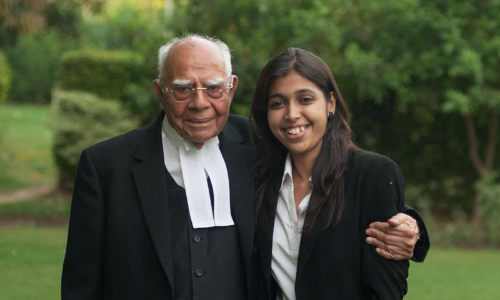
Ram Jethmalani : Extremely Charismatic, Sternly Majestic And Exceptionally Erudite Lawyer - A Tribute To My Mentor
Words are not enough to describe this fearless, courageous, outspoken and unapologetic personality. To say that he led an illustrious life, would be an understatement. My first meeting with Ram Sir was as a law student, who was extremely fortunate to get an opportunity to intern with the legal legend himself. On the first day of my internship, I was informed that I need to accompany Ram Sir to the Patiala House Court, where he was going for a cross-examination. Having heard a lot...

The California Senate Bill 132: A Step Towards Preserving The Respect And Dignity Of Incarcerated Transgender Individuals
In a historic move, the state of California in the USA by a vote of 43-13 moved the Senate Bill 132 which if passed by Governor Newsom, would allow Transgender inmates to opt-out of being housed in men's or women's prisons. The bill introduced by Senator Wiener is aimed at safeguarding the basic rights and dignity of gender non-conforming people and seeks to establish "The Transgender Respect, Agency and Dignity Act." It is an evident fact that the transgender community still faces...