


Articles
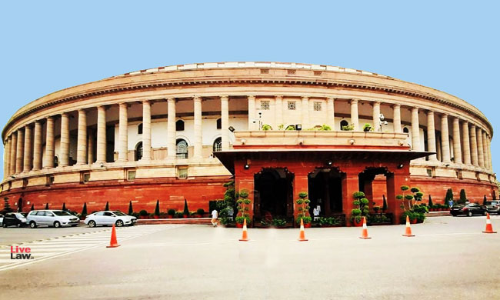
Importance Of Question Hour In A Parliamentary Democracy
The Hon'ble Supreme Court in the Keshavanada Bharti[1] case established that Parliamentary democracy is an integral part Basic Structure of our Constitution. The basic concept of the parliamentary governance is that it owes a collective responsibility towards the parliament and it holds the government accountable. Essentially, in a Parliamentary Democracy, the executive is made answerable to the parliament. The Indian democracy is completely based on the principles of debates and...

NLSIU's Home Proctored NLAT: How Far Equitable, Transparent & Secure
In my previous article, I had examined the issues of zero year and repeated postponements of CLAT and demonstrated that there is no danger of zero year even in trimester system and Consortium cannot be blamed for the postponements except September 7 as no national level admission was conducted before September. If Act of God defence is available to the government for the minus 23.9% GDP, it should equally be available to Consortium of National Law universities for the CLAT postponements ...
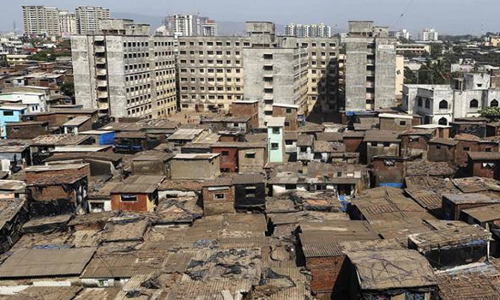
Supreme Court Order Evicting Slum Dwellers Violates Their Basic Human Rights To Housing, Shelter And Livelihood
In August 2020, a three-judge bench of the Supreme Court of India ordered removal of 48000 slum dwellings that were around a 140-km railway track in Delhi without providing for any rehabilitation scheme (henceforth called the "Supreme Court Order").[1] They were ordered to be removed as they were considered to be in the Railway safety zone. The order asks the stakeholders to come up with a comprehensive plan for removal of the slums within just three months. In the middle of a pandemic,...

Arjun Panditrao Decision- The Time To Revisit S.65B Of Indian Evidence Act: A Scientific Legal Analysis
"Every new time will give its law" - Maxim Gorky, The New Lawyer's Wit and Wisdom In its quest to emplace the judicial discipline relating to admissibility of any electronic record and to obviate the controversies created by the previous judgments as to whether certificate under Section of the 65B of the Indian Evidence Act, 1872 ('the said Act') is a condition precedent for admissibility of any Secondary electronic record and at what stage the same may be produced; a Three...
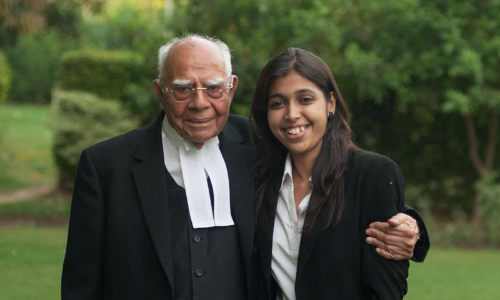
Ram Jethmalani : Extremely Charismatic, Sternly Majestic And Exceptionally Erudite Lawyer - A Tribute To My Mentor
Words are not enough to describe this fearless, courageous, outspoken and unapologetic personality. To say that he led an illustrious life, would be an understatement. My first meeting with Ram Sir was as a law student, who was extremely fortunate to get an opportunity to intern with the legal legend himself. On the first day of my internship, I was informed that I need to accompany Ram Sir to the Patiala House Court, where he was going for a cross-examination. Having heard a lot...

The California Senate Bill 132: A Step Towards Preserving The Respect And Dignity Of Incarcerated Transgender Individuals
In a historic move, the state of California in the USA by a vote of 43-13 moved the Senate Bill 132 which if passed by Governor Newsom, would allow Transgender inmates to opt-out of being housed in men's or women's prisons. The bill introduced by Senator Wiener is aimed at safeguarding the basic rights and dignity of gender non-conforming people and seeks to establish "The Transgender Respect, Agency and Dignity Act." It is an evident fact that the transgender community still faces...
![[NLAT] Myth Of Zero Year & Five CLAT Postponements](https://www.livelaw.in/h-upload/2020/09/07/500x300_381084-dr-faizan-mustafa.jpg "[NLAT] Myth Of Zero Year & Five CLAT Postponements")
[NLAT] Myth Of Zero Year & Five CLAT Postponements
We live in post truth era and therefore facts do not matter anymore. We keep on saying that India's Covid-19 management is the best in the world yet the fact is that today we have second highest number of Covid-19 positive cases in the world and for last two weeks have been registering world's highest number of positive cases and deaths per day. We have been asserting that our economy won't be affected by Covid-19 and is doing well yet today we are the worst performing economy in the...
Prompt Judicial Review Of Trade Remedies Not Yet A Reality
Trade remedies is an exception to the guiding principle, that each member nation must extend equal treatment to other member nations and not discriminate between its trading partners. It is only in special circumstances of unfair trade; member countries can impose duties to offset the injurious effects of dumping or subsidization. The legal basis for trade remedies flows from Article VI of the GATT Agreement, WTO Agreement on Anti-dumping, and WTO Agreement on Countervailing duties. In...
Internship And Exploitation Of Labour
The Ministry of Human Resource Development, India has released the National Education Policy, 2020. Among other things, it provides that- for gathering hands-on experience of vocational subjects, school and under-graduate students shall undertake research assignments and internships to enhance their employability as part of their curriculum. Courses for engineering, law etc. already have prerequisite mandatory internship requirements. While this is a welcome stratagem, the lacuna in...
Privacy Versus Morality: An Indian Gordian Knot
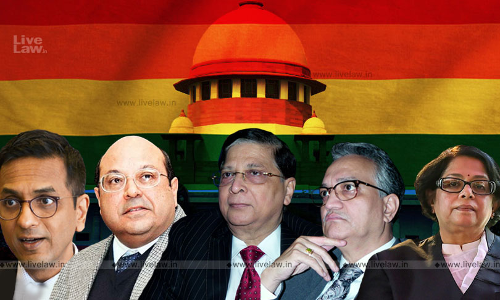
Two years after historic judgment in Navtej Singh Johar case, an age-old debate in legal philosophy is revisitedSir Edward Coke, in his The Institutes of the Laws of England, (1628) famously said: "a man's house is his castle" What was meant by 'castle' was defined in 1763 by the British Prime Minister Sir William Pitt: "The poorest man may in his cottage bid defiance to all the forces of the crown. It may be frail - its roof may shake - the wind may blow through it - the storm may enter...
Sub-Classification And Reservation
In State ofPunjab v. Davinder Singh (27 August 2020), a Constitution Bench of the Supreme Court headed by Justice Arun Mishra recently referred E.V. Chinnaiah v. State of AP, (2005) 1 SCC 394, to a larger bench for reconsideration. In Chinnaiah, the court had held that governments cannot introduce a special sub-quota, within the SC and ST quota, in favor a few castes or tribes who are more backward than others on the list. Davinder Singh's judgment now disagrees with this view but raises...