Articles
Future Of Mediation In Insolvency Proceedings
Alternate Dispute Resolution method for resolving the disputes is relatively new trend in India. Mediation being one of the alternate dispute resolution methods in India is a voluntary process where the disputing people decide to mutually find a solution to their legal problem by appointing a mediator and entering a mutual understanding. The decision making power lies with the parties in dispute, with the mediator acting as an intermediary to bring them to an understanding. India started...

Of Lawyers,Court And "The Remote - Possibility"
The functioning of most Courts in the Country is severely restricted in view of the Covid-19 Pandemic as Social Distancing is the only Sanjeevani medicine. While on the one hand the experts and the Government brainstrom whether to continue the lockdown or relax fully /partially , there is this parallel debate as to the extent and manner of functioning of the Courts. To my surprise, some of the Bar Leaders are advocating suspending of functioning of Courts. Their contention, life is above...
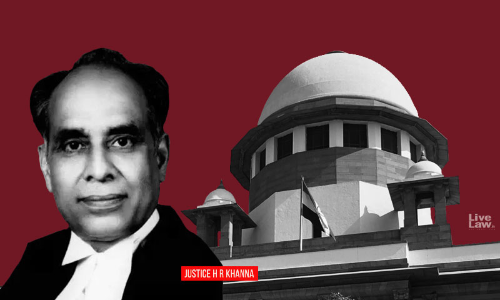
Remembering Justice H R Khanna On The 44th Anniversary Of ADM Jabalpur Verdict
In April 1976, when the infamous Emergency was in place in India, the New York Times wrote an article eulogising a Judge of the Indian Supreme Court, for his dissenting opinion in a judgment. The article titled 'Fading Hope in India' lauded Justice H.R. Khanna for his dissenting opinion in ADM Jabalpur v. Shivkant Shukla, (1976) 2 SCC 521, which was delivered 44 years ago today.The case in ADM Jabalpur arose during the period of Emergency in India (1975-1977). The President exercising his...

Legislative Response and Constitutionality in The Time of a Pandemic
In 1896, the residents of Nowroji Hill slums of the present-day Mumbai were afflicted by a mysterious disease which spread rapidly affecting many city residents. The city's commerce was severely hit, and the thriving textile industry was grounded. By September 1896, Dr Acacio Gabriel Viegas accurately diagnosed the illness as bubonic plague, tended patients at great personal peril and initiated a vigorous campaign to clean up slums.[1] In the wake of this debilitating contamination, to...
"The Pandemic" - Effect On Part III Of Constitution Of India "A Citizen's View"
Part – 1 : Introduction The global spread and social mayhem caused by the 'COVID-19' Virus, being a subset of the viruses known in medical circles as belonging to the family of 'Coronovirus' has shaken the world and its global citizenry and has heralded us into situations rarely witnessed in the past. The COVID-19 is now classified as a Pandemic[1] by the WHO[2]. While there have been noted instances of virulent and destructive diseases, such as the Bubonic plague of...
A Critique On The Epidemic Diseases (Amendment) Ordinance, 2020
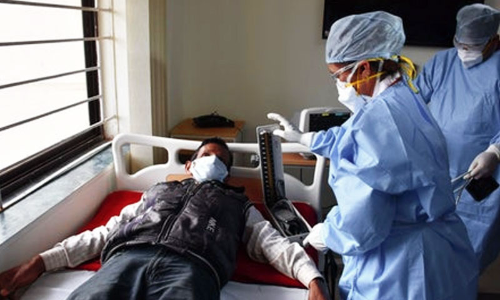
On 22nd April 2020, the Central Government has taken the "Ordinance route" to amend the Epidemic Diseases Act, 1897. COVID 19 has undoubtedly been probably the biggest challenge which the human race has witnessed in recorded history. On 11th March, 2020, when the WHO declared COVID 19 as a global pandemic, 1,18,000 cases were reported from 114 countries with 4,291 causalities. As on date these figures have crossed 29,21,000 with 2,03,299 deaths recorded globally. As far as India is concerned,...
Kesavananda Bharati -II : The Case We Do Not Know, But Ought To Know
[This post is part of a special series celebrating 47 years of the decision in Kesavananda Bharti v. State of Kerala, wherein the Supreme Court of India laid down the 'Basic Structure Doctrine']. The Supreme Court of India in Kesavananda Bharti v. State of Kerala [(1973) 4 SCC 225] had laid down the basic structure doctrine, according to which the Parliament can amend any part of the Constitution barring certain fundamental features. The verdict did not please the government led by...
[Further Investigation] Laxman Rekha By The Supreme Court On Power Of The Investigating Agencies
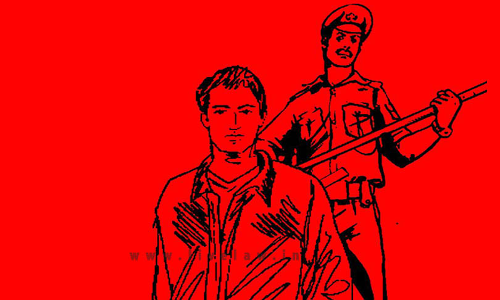
The Hon'ble Supreme Court has put an end to the endless investigation; basically it has created an embargo to unending investigation and put chains to the wrath of investigation faced by the accused. A three judge bench headed by HMJ Nariman has drawn a Laxman Rekha for the investigation agencies across the country in the case titled Vinubhai Haribhai Malaviya vs. State of Gujarat. The interesting question which arose before the Hon'ble Supreme Court was 'whether after filing of...
![[Column] World IP Day 2020 – Innovate For A Green Future By Justice Pratibha M Singh](https://www.livelaw.in/h-upload/2019/12/28/500x300_368477-justice-prathiba-m-singh.jpg "[Column] World IP Day 2020 – Innovate For A Green Future By Justice Pratibha M Singh")
[Column] 'World IP Day 2020 – Innovate For A Green Future' By Justice Pratibha M Singh
Greetings on World IP Day. The World Intellectual Property Organisation (WIPO) was created more than 50 years ago as one of the 16 agencies of the United Nations for promoting the protection of Intellectual Property. Its predecessor was the BIRPI which was established in 1893 to promote the creative industry. The WIPO decided to celebrate 26th April every year as the World IP Day. The day is usually marked with various events being held by IP owners, IP lawyers and other...
Covid's Clarion Call For Foreign Contribution
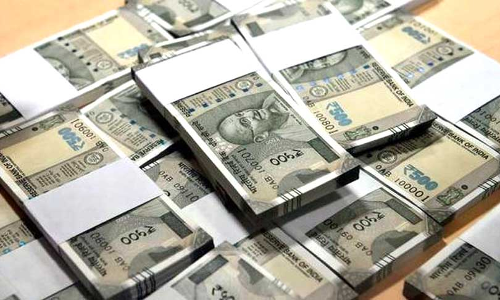
The ubiquitous Covid-19 has taken the planet by a storm with its imperious influence being felt everywhere. The crisis has compelled some far-reaching steps by all nations to arrest the progression of the pandemic. India, too, has been steamrollered into undertaking unprecedented measures to tackle Covid-19 and put brakes on the rising corona-curve. One such measure has been invocation of foreign aid and donations to combat Covid-19 pandemic; a shift from a decade-and-a-half-old stance...
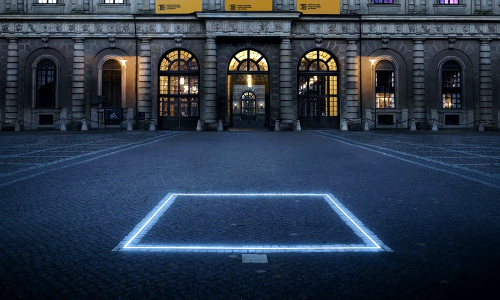
World Intellectual Property Day : The Square of Infinity
"The Square is a sanctuary of trust and caring Within its boundaries we share equal rights and obligations" "The Square", a Swedish movie which was screened at the International Film Festival of India at Goa in 2017, amazed many with its different approach in communicating an age old common message of humanity, the echoes of which have been ignored persistently. It bagged various awards at film festivals including the Palme d'Or (highest prize awarded) at the 2017 Cannes Film...