


Articles


Amended Section 6 Of Hindu Succession Act : Cauldron Of Confusions
1. The amendment of 2005 to Hindu Succession Act is a cauldron of confusions and inconsistencies. This might be because of factors such as imperfect language used in the amendment , inconsistent judicial interpretations and also injustice resulting to wife of the coparcenor. 2. Historical background: Before the enactment of the Hindu Succession Act, 1956, Hindus were covered by Shastric and customary law which varied from region to region. Dayabhaga school of law was prevalent in...
Section 50 NDPS Act: Mis-Understanding The Jurisprudence Of Compliance
This is a response to "Section 50 NDPS Act: Understanding the Jurisprudence of Compliance", In the aforesaid article, the author has concluded that Section 50 requires a mandatory search of a suspect in the presence of a Magistrate or a Gazetted Officer. The presence of a Magistrate or a Gazetted Officer is an inviolable requirement. The relinquishment or waiver by accused for search in the presence of a Magistrate or a Gazetted Officer is insignificant. The conclusion is...

COFEPOSA: Is The Recent Supreme Court Judgment In Dimple Happy Dhakad Against Settled Position In Law?
A two-judge bench of The Hon'ble Supreme Court of India, in a recent judgment in Union of India v. Dimple Happy Dhakad (AIR 2019 SC 3428) set aside a Bombay High Court judgment, which had quashed detention order passed against one Dimple Happy Dhakad, thereby restoring the detention order. One of the major ground discussed for setting aside the detention order was the non-pendency of a bail application of the accused, rendering the detention order bad in law. The judgment of the...
Kashmir: Fundamental Rights And Sealed Covers
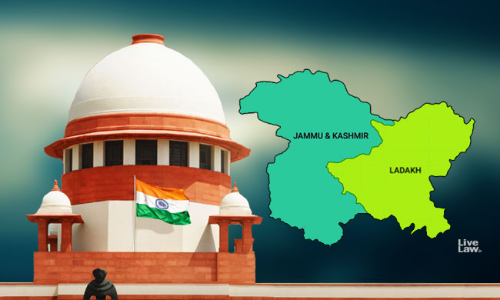
In a previous post, we discussed one of the peculiar features of the ongoing litigation regarding the communications shut-down and other restrictions in Kashmir. One of these features is the absence – in court – of the government's orders that constitute the basis for the restrictions (whether under the Telecom Suspension Rules or Section 144 of the CrPC). As we discussed, one of the basic requirements for a restriction upon fundamental rights is the existence of a law, and its publication...

Lack of Judicial Infrastructure Despite Availability of Funds
It goes without saying that the district judiciary in India receives relatively less attention compared to the higher judiciary despite being burdened with the largest share of litigation. Often filling up judicial vacancies is touted as the one stop solution for the pendency woes of the judiciary. However, owing to the lack of existing courtrooms, it so happens that the judiciary is not able to fill vacancies up to its sanctioned strength. This glaring reality has come to the fore...

Sedition Charge For Writing A Letter To PM: My Dear CJM Ji, Ignorance Of Law Is No Excuse!
Article 141 of Indian Constitution says: The law declared by the Supreme Court shall be binding on all courts. It is called precedent, which is one of the important sources of law for any democratic nation and such law would bind all the lower courts. As recently as on September 7, 2016, Supreme Court Bench of Justice Dipak Misra quoted an old judgment to reassert that "Someone's statement criticising the government does not invoke an offence of sedition or defamation." On May 26, ...

Transferability of Arbitration Clauses: Comment On SC Decision in Giriraj Garg v. Coal India Limited
Abstract Arbitration, as an alternative model of dispute resolution, was founded upon the plinth of effective, fastidious, and straightforward conflict settlement in the arena of commercial horn locking, so that the procedural claptraps of classical courtroom litigation could be circumvented and conservation both in terms of time and money could be encouraged. However, in a country such as India that has mostly been the seat of ad-hoc arbitrations instead of institutional ones,...


Jammu And Kashmir Police Has Violated The JJ Act In Detaining Children
The Supreme Court last month called for a report from the Juvenile Justice Committee of the Jammu and Kashmir high court in respect to complaints that a number of children – described as juveniles in legal parlance – had been illegally detained in the state. The four High Court judges who make up its Juvenile Justice Committee submitted their report, which is now in the public domain. As a conscious citizen I know my limitations on commenting upon a matter which is sub judice and...