


Articles

How Law Protects Rights Of Widows?
Widows have always got a raw deal in our culture. Though things have changed a lot from the times when widows were asked to burn themselves, the orthodoxy is still finding it tough to recognize their right to share in property.In a landmark judgment, the Supreme Court recently upheld thedecision of the lower court and ordered the brother-in-law to maintain his brother's widow. Two judges' bench of Justice Chandrachud and Justice Gupta held so in a case of a Hindu Undivided Family where the...

Foreigners Tribunals In Assam : Practice & Procedure
The Border police and Foreigners Tribunal came into existence in 1962 and 1964 respectively. On 23rd day of September 1964, The Foreigners (Tribunal) Order, 1964 was enacted by the central Government in exercise of the powers conferred by Section 3 of the Foreigners Act, 1946. Para 2 of the 1964 Order provides for the constitution of Foreigners` Tribunal. On May 30, 2019, the Central Government further amended the Foreigners (Tribunals) Order 1964 to create a new Foreigners (Tribunals) Amendment...

Prashant Kanojia's Case: A Strange Kind Of Justice
Prashant Kanojia was arrested for posting a tweet about a political personage. He did not abuse, use names, or anything of that sort. He posted a link to another story that was carried in the news about the claims of another person, about having an affair with the said personage. People were not up in arms at the suggestion. There was no public order disturbance. And yet, Prashant Kanojia was taken into custody by the police on trumped up charges, contrary to law, some rules, and judicial...

Plagiarism In AILET (NLU-Delhi Entrance Test) 2019
All India Law Entrance Test ("AILET") is the admission test for National Law University, Delhi ("NLU-D") that is organised by it every year for admission into its various courses. This year, for the first time, AILET has come under severe scrutiny due to plagiarism in its papers for B.A. LL.B. (Hons.) course. This post closely examines plagiarism in AILET 2019. Currently, the Common Law Admission Test ("CLAT") has been under the scanner due to the numerous blunders in the conduct...

Letters To An Aspiring Judge (Part I)
Since you're here, I take it that you want to be a Judge, or, at any rate, are intrigued by the thought of being a judge.You may find this ironic that someone who hung his boots as a judge after roughly 4 years of service is writing an article on what it means to be a judge, and how does one go about achieving that objective. I am happy if you had this thought. The first part of training to be a judge is to take absolutely nothing at face value. Measure skepticism is a virtue. There's nothing...

Prosecution For Contempt Of Lawful Authority Of Public Servants And For Offences Against Public Justice And Offences Relating To Documents Given In Evidence
Offences pertaining to contempt of the lawful authority of public servants are dealt with under Sections 172 to 188 (both inclusive) in Chapter X of the Indian Penal Code, 1860 ("IPC" for short). But, for the prosecution of an offender for any of those offences or for any abetment, attempt or criminal conspiracy to commit any of those offences, Section 195 (1) (a) of the Code of Criminal Procedure, 1973 ("Cr.P.C." for short) insists that the public servant concerned or any other public...

Exclusionary Rules (Past, Present & Future)- A Comparative Study Between USA, England & Wales And India
"The public interest demands not only that the guilty are brought to conviction, but also that they are brought to conviction in a civilised and publicly acceptable manner. In other words, the public has an interest not only in the conviction of the guilty, but also in the moral integrity, or to put it more simply, the quality, of criminal proceedings".[1] -Commonwealth Law Bulletin 1992 The above statement signifies the irrefutable principle of fair trial. One of the devices...
Should I Wear My Patriotism On My Sleeve? Analysing The Law On Sedition In India And The Demand For Its Stricter Enforcement
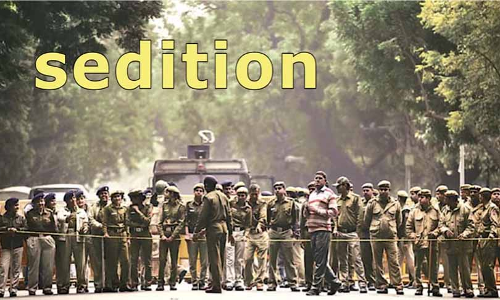
One's patriotism and feelings of nationalism have always been a personal sentiment. One need not show their love for the country by explicit gestures as long as the sentiment is genuine from within. Recent times in India show otherwise, as the citizens are expected to wear their patriotism on their sleeve and even by mistake not criticize government institutions. If they do, they are termed an 'anti-national' and booked under the draconian Section 124-A of the Indian Penal Code which ...