



CEC Protest: Supreme Court Directs No Illegal Detention Of Peaceful Protesters, Normal Metro & Rail Services, Free Movement, Undisturbed Internet
Debby Jain & Nupur Thapliyal
11 Oct 2026 12:31 PM IST
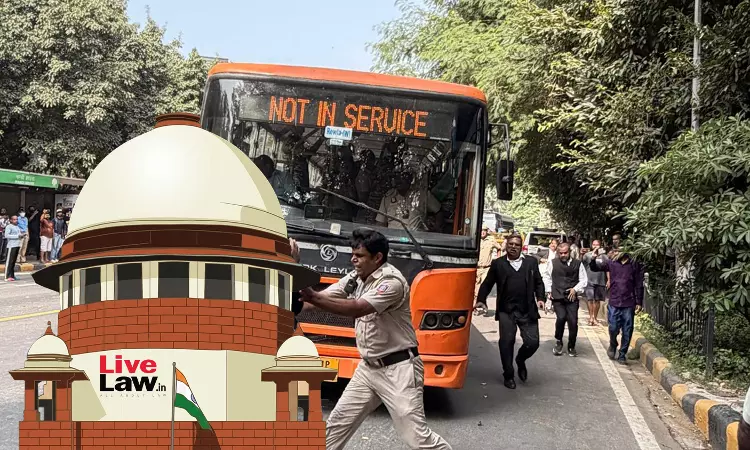
The interim directions are subject to any law and order situation.
In a special Sunday sitting related to protests in Delhi against CEC Gyanesh Kumar, the Supreme Court today directed that there shall be no detention of any person except in accordance with the procedure established by law, particularly with respect to any assembly of peaceful and unarmed persons beyond the area where Section 163 BNSS prohibitory orders are in operation.
A bench of Justice Joymalya Bagchi and Justice V Mohana also directed the authorities to take down the board concerning the imposition of Section 163 of BNSS in the area around the Supreme Court, if not already done, to ensure there is no apprehension regarding access to justice, including ingress and egress to any court of law.
The Court further directed that metro and rail facilities shall function normally unless restrictions are required to be imposed keeping in mind disturbances to public order, as contemplated under Article 19(2) of the Constitution of India.
On the movement of people, the Court directed that free movement in the city be permitted subject to traffic regulations. It further ordered that the imposition of barricades be reviewed forthwith, keeping in mind law and order and other traffic conditions.


The Court also directed that internet facilities shall remain undisturbed, with Justice Bagchi orally adding that the Court is not taking away authorities' powers under the IT Act.
The Court noted SG Tushar Mehta's assurance that metro railway is functioning fully and all stations are open since 10 PM yesterday, that trains are functioning normally and that internet connection has been restored.
It further referred to the order passed on Friday vide which the authorities concerned were directed to revisit the earlier notification of Delhi Metro of closure of 57 metro stations keeping in mind that operation of metro and rail services may be regulated but not prohibited outrightly in appropriate cases. This order had also directed authorities to widely publish the reconsidered decision to avoid further inconvenience.
Upon hearing the parties, and perusing the averments in the listed contempt petition, the Court issued notice upon alleged contemnors to file affidavit and also submit a compliance report in terms of order as aforesaid.
It added that the other unlisted petitions mentioned today shall be tagged with the contempt proceedings.
During the hearing, Senior Advocate Kapil Sibal, appearing for RJD MP Manoj Jha, said that the police was picking up people from trains and anyone outside the 4 km radius of the Jantar Mantar area where S.163 was imposed. He also said that there was suspension of internet in the area and that 45 metro stations remained shut despite the judicial order on Friday.
Senior Advocate Shadan Farasat told the Court that even he was brutalized yesterday during the protest.
“Question is not only about lawyers. We don't have special rights as lawyers. Yesterday, situation in city was remarkably suppressive. Person was not allowed to stand there also. I was thrown in a moving bus after I was picked up. It's about citizens' right to protest. The sense I got - yesterday, we were one step away from POLICE STATE. Kindly restore citizens' right to protest peacefully in the capital. Yesterday, that right was destroyed,” he said.
Senior Advocate N Hariharan submitted that the situation is such that practicing lawyers cannot move around the city and that pictures circulated are self-explanatory.
Senior Advocate Gopal Sankaranarayanan referred to various screen-grabs from videos and submitted that Section 163 of BNSS had been imposed outside the Supreme Court as well.
“It's reported in LiveLaw also. It's shocking. Nature of violence being perpetrated-it's not even a question of proportionate. First, necessity is to be seen. Unarmed children - to beat, kick them...scuffle with them uncalled for. We are finding several videos - these people wear it as a badge of courage. This is something which has raised many emotions amongst us. It's come so close to the door,” he said.
He sought that free movement be completely restored and that all barricades be removed and metro rail functioning be directed to be restored.
“They feel 47 (metro stations) is okay. No changes in trains made by them. People have to be brought to account about this. Police without badges should not have been permitted. I flagged this earlier - it has gone to Committee. We hope your lordships will direct. Those who are responsible should be held responsible!,” he said.
Senior Advocate Sanjay Hegde submitted that access to justice includes access to lawyers and if lawyers are prevented from doing their duties, it's Supreme Court's dignity that is directly impacted.
“Solicitor General is leader of the Bar. He must ensure that every lawyer can access their clients and provide assistance at police stations. yesterday, lawyers were beaten in police stations. policemen threatened lawyers with FIR,” Hegde said.
Advocate Sumita Hazarika also told the Court that she, along with 150 other lawyers, started peacefully walking yesterday and 4 of them were picked up and taken in a prison van. She said that a lady officer started pushing and hustling her, did not allow her to wait for a second. “No name badge. If there was violence, action could have been taken. But we were peaceful,” she said. She also highlighted that without a badge, it was difficult to ascertain if the people detaining protestors were in fact with the police.
Senior Advocate Shoeb Alam submitted that the concern in the matter goes to citizens' fundamental rights, and that Article 19 of Constitution of India is in favor of the people.
On this, Justice Bagchi remarked that the CJI had made it clear that Article 19(2) is not a prohibition, but is a regulation.
Senior Advocate Kirti Uppal, appearing for a Lawyers' Foundation, also sought intervention in the matter. He quoted a senior lawyer who apparently said that lawyers should address such issues in court, not in streets. He also urged that the current situation is impacting lawyers' profession. The senior counsel's submissions were met with booing by lawyers present in court, who were later urged by the senior counsels on the petitioner side to maintain decorum. The bench also expressed disapproval over the booing.
Advocate Jai Anant Dehadrai appeared for Delhi Police officers and said that he represented few police officers who were brutalized during protests. On this, Justice Bagchi remarked: “Police officers don't have individual right to maintain law and order over and above the state. Please assist learned SG. Life and liberty equally sensitive - we have said that before. Be it police officer, citizen. All intervention applications will be listed.”
Seeking interim directions, Senior Advocate Menaka Guruswamy appearing as petitioner in person said that by disrupting metro, the police cannot take away citizens' ability to move. She said that 7000 people were reported as detained and that the State was not providing anyone official numbers.
“45 detention centres reported as setup all across delhi. Opposition leaders picked up. MPs barricaded into their houses. This is not just. Young people have decided to lawfully protest, because they feel election system is not fair. Interim prayer is there. Constitution says in Art. 358 that Art. 19 rights can be restricted when emergency is imposed. Is the State saying there is undeclared emergency? habeas is the classic relief. when we filed, we were not aware of the magnitude of people taken away. As internet was disconnected,” she said.
”You are assembled here today because something graver is at stake. Suspension of citizens' peacefully exercised right. The last time this court had to consider such challenges was at the time of emergency. We come back 50 years later - your lordships had passed ADM Jabalpur!,” she added.
She said that the interim prayers were to issue notice to the alleged contemnors to respond and remain present before the court, including Home Secretary and Metro superior official and that all prohibitory orders be revoked immediately.
SG Tushar Mehta said that the habeas corpus petition may not survive as those detained had been released. Regarding the contempt plea, he said that there was no curtailment of any metro service on 10th October and that there was 0 reduction in total volume of metro operations.
“Trains were inducted as per standard schedule. 4750 trains run on 10th Oct as per schedule on internet. Delhi Metro - there are 303 stations, 47 were closed/restricted,” he said.
On this, Justice Bagchi said: “Are advisories by railway authorities? Please file your response to these petitions and compliance by Tuesday. In the meantime, the metro functioning should continue in accordance with the normal schedule (subject to a public order condition envisaged under Art.19(2)). No advocate should in any way be hindered in discharging their professional duties. we are consciously saying 'professional'. Internet facility to city has to be restored.”
The Court said that while it will pass an interim order, it would like to be addressed on the issue as to how far the Police Act falls in sync with requirement of expression under Article 19. Sibal responded that no Police Act or law in the country can violate Article 19(2) except for public order.
“My Art. 19(1)(a) right is subject to public order...interim order required that internet be restored throughout city. Last thing is on journalists - they are being handicapped within and outside,” he added.
After the order was dictated, Advocate Tanushree Bhalla argued for release of digital devices seized by authorities, pointing out that the same were seized even though persons were not detained. She highlighted that the devices contained data of vulnerable victims and other sensitive information.
The court held a special sitting on Sunday, October 11, to hear pleas arising from the Delhi Police's handling of protests held on October 10 against Chief Election Commissioner Gyanesh Kumar and the Election Commission of India.
The matters include a contempt petition alleging that authorities continued to restrict Delhi Metro services in violation of the Court's October 9 order, and a habeas corpus petition filed by Senior Advocate and Trinamool Congress Rajya Sabha MP Menaka Guruswamy challenging the detention of several political leaders.
The proceedings arise from allegations of mass detentions, excessive police force against protesters, restrictions on public transport and mobile internet services, and the treatment of women protesters and journalists during the protests.
Background
The contempt petition was filed by advocate Shailendra Mani Tripathi, alleging that the authorities continued to close Metro stations and restrict train services despite the Supreme Court's October 9 directions in M.A. Baby v. Union of India.
In that case, taking note of Delhi Police communications directing the closure of 57 Metro stations and the cancellation of trains arriving at New Delhi and Hazrat Nizamuddin railway stations, the Court observed that the notifications appeared to be “overreaching” insofar as they imposed a complete prohibition on essential public transport. It held that Metro services could be regulated but should not be subjected to an outright ban, consistent with the principle of proportionality.
Tripathi has alleged that Metro station access remained closed despite the order. The petition seeks contempt proceedings against Union Home Secretary Govind Mohan, Delhi Police Commissioner Anurag Kumar and DMRC Chairperson D Thara.
Senior Advocate Menaka Guruswamy's petition challenges the detention of political leaders, including former Delhi Chief Minister Arvind Kejriwal, former West Bengal Chief Minister Mamata Banerjee, former Kerala Chief Minister Pinarayi Vijayan and former Tripura Chief Minister Manik Sarkar. It alleges that several leaders were picked up from their residences and taken to undisclosed locations before they could reach the protest site.
RJD Rajya Sabha MP Manoj Jha has also approached the Court alleging disproportionate use of force, illegal detention and house arrests of protesters, students, advocates and political leaders, as well as sexual harassment of women protesters. His petition also challenges the restrictions imposed on public transport and mobile internet services, road closures and the use of phone jammers. It alleges that more than 6,000 people were detained and refers to reports of 250 train cancellations and the closure of 45 Metro stations on October 10. Jha has sought a declaration that the authorities' actions between October 9 and 10 were illegal and unconstitutional.
Advocate Aman Prasad has filed a contempt petition against Delhi Police Commissioner Anurag Kumar, alleging that police personnel assaulted and detained unarmed protesters, manhandled women, and operated without visible name tags or other identifying details. The petition refers to alleged incidents near Jantar Mantar, INA and Dilli Haat, including the alleged assault of Senior Advocate Shadan Farasat near the Safdarjung Airport flyover and the detention of journalist Ayush Tiwari of Scroll while he was covering the protests.
Prasad's petition alleges violations of the Supreme Court's earlier orders in Shailendra Mani Tripathi v. Union of India, concerning allegations of police excesses during the July student protests, and the October 9 order in M.A. Baby. The earlier proceedings in Tripathi's case resulted in formation of a High-Powered Enquiry Committee to examine allegations concerning the use of force, treatment of women protesters and accountability of police officers.


