Supreme Court To Hear Pleas On Delhi Protest Crackdown, Rahul Gandhi's Plea Against ECI's SIR Today
Amisha Shrivastava
15 Oct 2026 8:10 AM IST
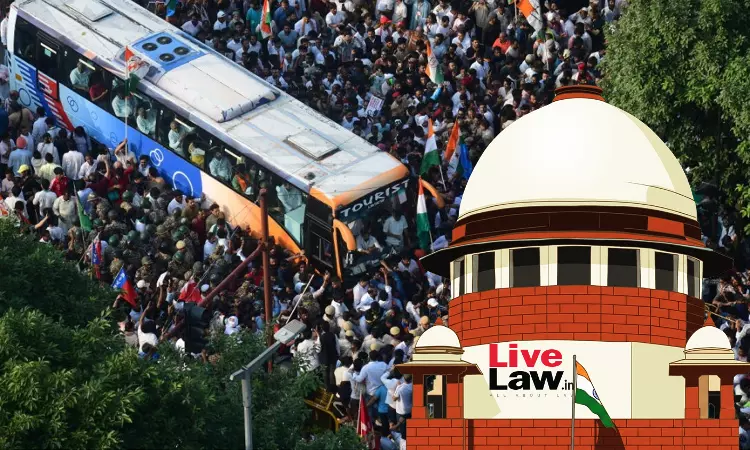
The Supreme Court will hear today the petitions concerning the Delhi protest against Chief Election Commissioner Gyanesh Kumar, including pleas alleging police excesses against protesters, journalists and lawyers, contempt case over restrictions on public transport, and a challenge to the constitutional validity of a provision of the Bharatiya Nagarik Suraksha Sanhita (BNSS).
The petition by Rahul Gandhi challenging the Special Intensive Revision (SIR) of electoral rolls and the petitions concerning the gathering and alleged disruption at the Supreme Court premises on October 12, when Rahul Gandhi and other Opposition leaders marched towards the Court Registry to file a petition challenging the Election Commission's Special Intensive Revision (SIR) exercise are also listed.
The matters are listed before Chief Justice of India Surya Kant and Justice Joymalya Bagchi at 10:30 am.
The cases include petitions filed by Leader of Opposition Rahul Gandhi and other INDIA bloc leaders, CPI(M) General Secretary MA Baby, RJD MP Manoj Jha, former MP Digvijaya Singh, senior advocate and Rajya Sabha MP Menaka Guruswamy, AIMIM chief Asaduddin Owaisi, the Supreme Court Bar Association (SCBA), the Supreme Court Advocates-on-Record Association (SCAORA), journalists' organisations and individual petitioners.


Petitions were initially filed challenging restrictions imposed by the Union and Delhi authorities ahead of the October 10 protest called by the Cockroach Janta Party and others. Subsequent petitions have raised allegations of non-compliance with the Supreme Court's directions, illegal detention of protesters and lawyers, assault and harassment of journalists covering the demonstrations, and restrictions on movement and communication.
The October 9 order addressed restrictions imposed on Metro stations and train services in anticipation of the demonstrations. The Court directed authorities to regulate transport rather than impose a blanket prohibition, while ensuring that the arrangements did not unnecessarily impede the public's movement. Advocate Shailendra Mani Tripathi filed a contempt petition alleging that authorities continued to restrict Metro and train services despite the October 9 directions.
On October 11, the Supreme Court issued notice on Tripathi's contempt plea after finding a prima facie case of non-compliance. It also directed that lawyers, journalists and other professionals should not be impeded from carrying out their professional duties. It directed that there shall be no detention of any person except in accordance with the procedure established by law, particularly with respect to any assembly of peaceful and unarmed persons beyond the area where Section 163 BNSS prohibitory orders are in operation
The Supreme Court Bar Association (SCBA) and the Supreme Court Advocates-on-Record Association (SCAORA) have approached the Court over alleged detention and manhandling of advocates during the protests.
The SCBA has sought details of detained advocates and the police personnel involved. It has also sought disclosure of prohibitory orders and preservation of relevant records, along with safeguards to ensure that lawyers can access courts and discharge their professional responsibilities.
The SCAORA has moved the Court seeking an independent, impartial and time-bound inquiry into the alleged illegal detention and manhandling of lawyers by Delhi Police during the CEC protest march on October 10.
The petition by the Lawyers' Association for Constitution, which has alleged assault and unlawful detention of advocates during the demonstrations is also listed. The petition raises concerns about alleged denial of legal assistance and medical aid, as well as police conduct towards protesters, lawyers and journalists.
In contrast, an application filed by Lawyers Voice has argued that disruptions caused by the protests and restrictions on public transport affected access to courts and lawyers' ability to discharge their professional duties.
Several petitions by journalists and media organisations are also listed. Free Speech Collective and the Network of Women in Media, India, have sought protection for journalists covering the demonstrations, alleging detention, assault, intimidation and obstruction by police personnel. Their petitions seek safeguards against interference with reporting and journalists' professional duties.
The Supreme Court on Tuesday sought the personal presence of a senior Delhi Police officer to explain the alleged assault on women journalists during the recent protests in Delhi.
The Delhi Union of Journalists has approached the Supreme Court, alleging that reporters were detained, assaulted or prevented from recording events during the October 10 and 11 protests. It seeks protection for independent journalists. Its petition alleges that journalists were forcibly removed from protest sites and phones, cameras and other reporting equipment were confiscated or obstructed.
Journalist Amaan Rastogi has also filed a contempt petition alleging wilful disobedience of the Supreme Court's October 11 directions. He has alleged that he was detained while covering the demonstrations despite the Court's directions protecting journalists and lawyers from being hindered in the discharge of their professional duties.
Advocate Narendra Kumar Goswami has filed a PIL seeking judicial scrutiny of the suspension of mobile internet services within a four-kilometre radius of the Janpath–Kartavya Path crossing on October 9 and 10. The petition seeks production of the suspension order and the material relied upon to justify the restriction, as well as records concerning publication of the order and the statutory Review Committee's proceedings.
Rashtriya Janata Dal Rajya Sabha MP Professor Manoj Kumar Jha has moved the Supreme Court challenging the police response to the protests. His petition alleges illegal detention, house arrest and excessive force against protesters, students, advocates, politicians and civilians. It also raises allegations of sexual harassment of women protesters.
Jha has challenged restrictions on public transport, road closures and the suspension of mobile internet, and has questioned the alleged use of phone jammers during the demonstrations. The petition seeks a declaration that the authorities' actions during the relevant period were illegal and unconstitutional.
Senior advocate and Rajya Sabha MP Menaka Guruswamy has filed a habeas corpus petition challenging detention of political leaders during the protests. The plea names leaders including Arvind Kejriwal, Mamata Banerjee, Pinarayi Vijayan and Manik Sarkar.
A petition by B.Tech. student Samriddhi Das challenges the constitutional validity of Section 172 of the Bharatiya Nagarik Suraksha Sanhita, 2023 contending that it enables arbitrary police action and detention without adequate procedural safeguards, and violates fundamental rights under Articles 14, 19 and 21 of the Constitution.
The petition also questions the legality and proportionality of the restrictions imposed on demonstrations, public transport and mobile internet, and seeks relief concerning alleged unlawful detentions. The petitioner has also sought safeguards governing the exercise of police powers during peaceful assemblies, along with disclosure of detention details and preservation of relevant evidence.
The petition by Swaty Singh challenges the removal of Jantar Mantar from the list of designated protest sites and the designation of alternative venues for demonstrations.
A petition by Rajya Sabha MP AA Rahim seeks an independent inquiry into the alleged illegal detention and custodial torture of DYFI office-bearers, Central Committee members and activists during the October 11 protest.
The petition filed by Leader of the Opposition Rahul Gandhi and nine other INDIA bloc leaders challenges the Election Commission of India's SIR of electoral rolls.
The opposition leaders have questioned the Election Commission's handling of the revision and sought disclosure of documents and files relating to the electoral process, along with an independent audit mechanism. Their challenge arises amid allegations of irregularities in voter-list revision and concerns over the deletion of names.
The petition was filed after opposition leaders marched towards the Supreme Court on October 12. The leaders' entry into the Court premises was accompanied by a large gathering, prompting separate petitions raising concerns about the crowd inside the complex.